Greece
Zosimades Stadium
Stadium · Ioannina Municipality
Art museum
The city's formal name, Ioannina, is probably a corruption of Agioannina or Agioanneia, 'place of St. John', and is said to be linked to the establishment of a monastery dedicated to Saint John the Baptist, around which the later settlement (in the area of the current Ioannina Castle ) grew.
According to another theory, the city was named after Ioannina, the daughter of Belisarius, general of the emperor Justinian.
William Martin Leake wrote in Travels in Northern Greece (published in 1835), in a passage dated July 1809, that in Byzantine sources and in ecclesiastical usage, the city's name appears as Τὰ Ἰωάννινα. In the spoken language, however, this form became corrupted into popular variants such as Ίάννινα, Ίάνενα, Γιανένα, and, most commonly, Γιάννινα, from which the Italian form Giannina is derived. The ordinary pronunciation follows this vulgar spelling and may be approximately rendered in English as Yannina; but the more educated people not only adhere to the orthography derived from the name Ιωάννης, but also preserve the sound of the omega in pronunciation.
There are two forms of the name in Greek, Ioannina being the formal and historical name, while the colloquial and much more commonly used Υannena or Υannina ( Greek : Γιάννενα, Γιάννινα ) represents the vernacular tradition of Demotic Greek. The demotic form also corresponds to those in the neighboring languages (e.g., Albanian : Janina or Janinë, Aromanian : Ianina, Enina or Enãna, Macedonian : Јанина, Turkish : Yanya ).
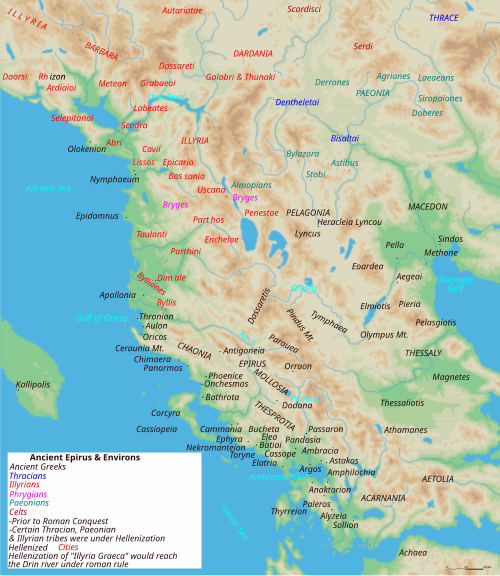
See also: Byzantine Greece and Despotate of Epirus The first indications of human presence in Ioannina basin are dated back to the Paleolithic period (24,000 years ago) as testified by findings in the cavern of Kastritsa. During classical antiquity the basin was inhabited by the Molossians and four of their settlements have been identified there. Despite the extensive destruction suffered in Molossia during the Roman conquest of 167 BC, settlement continued in the basin albeit no longer in an urban pattern.
The exact time of Ioannina's foundation is unknown, but it is commonly identified with an unnamed new, "well-fortified" city, recorded by the historian Procopius as having been built by the Byzantine emperor Justinian I for the inhabitants of ancient Euroia. This view is not supported, however, by any concrete archaeological evidence. Early 21st-century excavations have brought to light fortifications dating to the Hellenistic period, the course of which was largely followed by later reconstruction of the fortress in the Byzantine and Ottoman periods. The identification of the site with one of the ancient cities of Epirus has not yet been possible.
It is not until 879 that the name Ioannina appears for the first time, in the acts of the Fourth Council of Constantinople, which refer to one Zacharias, Bishop of Ioannine, a suffragan of Naupaktos. After the Byzantine conquest of Bulgaria, in 1020 Emperor Basil II subordinated the local bishopric to the Archbishopric of Ohrid. The Greek archaeologist K. Tsoures dated the Byzantine city walls and the northeastern citadel of the Ioannina Castle to the 10th century, with additions in the late 11th century, including the south-eastern citadel, traditionally ascribed to the short-lived occupation of the city by the Normans under the leadership of Bohemond of Taranto in 1082. In a chrysobull to the Venetians in 1198, the city is listed as part of its own province ( provincia Joanninorum or Joaninon ). In the treaty of partition of the Byzantine lands after the Fourth Crusade, Ioannina was promised to the Venetians, but in the event, it became part of the new state of Epirus, founded by Michael I Komnenos Doukas.
Under Michael I, the city was enlarged and fortified anew. The Metropolitan of Naupaktos, John Apokaukos, reports how the city was but a "small town", until Michael gathered refugees who had fled Constantinople and other parts of the Empire that fell to the crusaders of the Fourth Crusade (1202–1204), and settled them there, transforming the city into a fortress and "ark of salvation". Despite frictions with local inhabitants who tried in 1232 to expel the refugees, the latter were eventually successfully settled and Ioannina gained in both population and economic and political importance. In the aftermath of the Battle of Pelagonia in 1259, much of Epirus was occupied by the Empire of Nicaea, and Ioannina was placed under siege. Soon, however, the Epirote ruler Michael II Komnenos Doukas, aided by his younger son John I Doukas, managed to recover their capital of Arta and relieve Ioannina, evicting the Nicaeans from Epirus.
In c. 1275 or c. 1285, John I Doukas, now ruler of Thessaly, launched a raid against the city and its environs, and a few years later an army from the restored Byzantine Empire unsuccessfully laid siege to the city. Following the assassination in 1318 of the last native ruler, Thomas I Komnenos Doukas, by his nephew Nicholas Orsini, the city refused to accept the latter and turned to the Byzantines for assistance. On this occasion, Emperor Andronikos II Palaiologos elevated the city to a metropolitan bishopric, and in 1319 issued a chrysobull conceding wide-ranging autonomy and various privileges and exemptions on its inhabitants. A Jewish community is also attested in the city in 1319. In the Epirote revolt of 1337–1338 against Byzantine rule, the city remained loyal to Emperor Andronikos III Palaiologos. Soon afterwards Ioannina fell to the Serb ruler Stephen Dushan and remained part of the Serbian Empire until 1356, when Dushan's half-brother Simeon Uroš was evicted by Nikephoros II Orsini.
The attempt of Nikephoros to restore the Epirote state was short-lived as he was killed in the Battle of Achelous against Albanian tribes, but Ioannina was not captured. It thus served as a place of refuge for many Greeks of the region of Vagenetia. In 1366–67 Simeon Uroš, having recovered Epirus and Thessaly, appointed his son-in-law Thomas II Preljubović as the new overlord of Ioannina. Thomas proved a deeply unpopular ruler, but he nonetheless repelled successive attempts by Albanian chieftains including a surprise attack in 1379, whose failure the Ioannites attributed to intervention by their patron saint, Michael.
After Thomas' murder in 1384, the citizens of Ioannina offered their city to Esau de' Buondelmonti, who married Thomas' widow, Maria. Esau recalled those exiled under Thomas and restored the properties confiscated by him. In 1389, Ioannina was besieged by Gjin Bua Shpata, and only with the aid of an Ottoman army was Esau able to repel the Albanians. Despite the ongoing Ottoman expansion and the conflicts between Turks and Albanians in the vicinity of Ioannina, Esau managed to secure a period of peace for the city, especially following his second marriage to Shpata's daughter Irene in c. 1396. Following Esau's death in 1411, the Ioannites invited the Count palatine of Cephalonia and Zakynthos, Carlo I Tocco, who had already been expanding his domains into Epirus for the last decade, as their new ruler. By 1416 Carlo I Tocco had managed to capture Arta as well, thereby reuniting the core of the old Epirote realm, and received recognition from both the Ottomans and the Byzantine emperor. Ioannina became the summer capital of the Tocco domains, and Carlo I died there in July 1429. Carlo I's army, as well as the army of the city of Ioannina itself both before and during Carlo I's rule, was composed primarily of Albanians. His oldest bastard son, Ercole, called on the Ottomans for aid against the legitimate heir, Carlo II Tocco. In 1430 an Ottoman army, fresh from the capture of Thessalonica, appeared before Ioannina. The city surrendered after the Ottoman commander, Sinan Pasha, promised to spare the city and respect its autonomy.
Under Ottoman rule, Ioannina remained an administrative centre, as the seat of the Sanjak of Ioannina, and experienced a period of relative stability and prosperity. The first Ottoman tax registers for the city dates to 1564, and records 50 Muslim households and 1,250 Christian ones; another register from 15 years later mentions Jews as well.
In 1611 the city suffered a serious setback as a result of a peasant revolt led by Dionysius the Philosopher, the Metropolitan of Larissa. The Greek inhabitants of the city were unaware of the intent of the fighting as previous successes of Dionysius had depended on the element of surprise. Much confusion ensued as Turks and Christians ended up indiscriminately fighting friend and foe alike. The revolt ended in the abolition of all privileges granted to the Christian inhabitants, who were driven away from the castle area and had to settle around it. From then onwards, Turks and Jews were to be established in the castle area. The School of the Despots at the Church of the Taxiarchs, that had been operating since 1204, was closed.
Aslan Pasha also destroyed the monastery of St John the Baptist within the city walls in 1618 erected in its place the Aslan Pasha Mosque, today housing the Municipal Ethnographic Museum of Ioannina. The Ottoman reprisals in the wake of the revolt included the confiscation of many timars previously granted to Christian sipahis ; this began a wave of conversions to Islam by the local gentry, who became the so-called Tourkoyanniotes (Τoυρκογιαννιώτες). The Ottoman traveller Evliya Çelebi, who visited the city in c. 1670, counted 37 quarters, of which 18 Muslim, 14 Christian, four Jewish and one Gypsy. He estimated the population at 4,000 hearths.
Center of Greek Enlightenment (17th–18th centuries)
Despite the repression and conversions in the 17th century, and the prominence of the Muslim population in the city's affairs, Ioannina retained its Christian majority throughout Ottoman rule, and the Greek language retained a dominant position; Turkish was spoken by the Ottoman officials and the garrison, and the Albanian inhabitants used Albanian, but the lingua franca and native language of most inhabitants was Greek, including among the Tourkoyanniotes, and was sometimes used by the Ottoman authorities themselves.
The city also soon recovered from the financial effects of the revolt. In the late 17th century Ioannina was a thriving city with respect to population and commercial activity. Evliya Çelebi mentions the presence of 1,900 shops and workshops. The great economic prosperity of the city was followed by remarkable cultural activity. During the 17th and 18th centuries, many important schools were established. Its inhabitants continued their commercial and handicraft activities which allowed them to trade with important European commercial centers, such as Venice and Livorno, where merchants from Ioannina established commercial and banking houses. The Ioannite diaspora was also culturally active: Nikolaos Glykys (in 1670), Nikolaos Sarros (in 1687) and Dimitrios Theodosiou (in 1755) established private printing presses in Venice, responsible for over 1,600 editions of books for circulation in the Ottoman-ruled Greek lands, and Ioannina was the centre through which these books were channeled into Greece. These were significant historical, theological as well as scientific works, including an algebra book funded by the Zosimades brothers, books for use in the schools of Ioannina such as the Arithmetica of Balanos Vasilopoulos, as well as medical books. At the same time these merchants and entrepreneurs maintained close economic and intellectual relations with their birthplace and founded charity and education establishments. These merchants were to be major national benefactors.
Thus the Epiphaniou School was founded in 1647 by a Greek merchant of Ioannite origin resident in Venice, Epiphaneios Igoumenos. The Gioumeios School was founded in 1676 by a benefaction from another wealthy Ioannite Greek from Venice, Emmanuel Goumas. It was renamed Balaneios by its rector, Balanos Vasilopoulos, in 1725. Here worked several notable personalities of the Greek Enlightenment, such as Bessarion Makris, the priests Georgios Sougdouris (1685/7–1725) and Anastasios Papavasileiou (1715–?), the monk Methodios Anthrakites, his student Ioannis Vilaras and Kosmas Balanos. The Balaneios taught philosophy, theology and mathematics. It suffered financially from the dissolution of the Republic of Venice by the French and finally stopped operation in 1820. The school's library, which hosted several manuscripts and epigrams, was also burned the same year following the capture of Ioannina by the troops the Sultan had sent against Ali Pasha.
The Maroutses family, also active in Venice, founded the Maroutsaia School, which opened in 1742 and its first director Eugenios Voulgaris championed the study of the physical sciences (physics and chemistry) as well as philosophy and Greek. The Maroutsaia also suffered after the fall of Venice and closed in 1797 to be reopened as the Kaplaneios School thanks to a benefaction from an Ioannite living in Russia, Zoes Kaplanes. Its schoolmaster, Athanasios Psalidas had been a student of Methodios Anthrakites and had also studied in Vienna and in Russia. Psalidas established an important library of thousands of volumes in several languages and laboratories for the study of experimental physics and chemistry that aroused the interest and suspicion of Ali Pasha. The Kaplaneios was burned down along with most of the rest of the city after the entry of the Sultan 's armies in 1820. These schools took over the long tradition of the Byzantine era, giving a significant boost to the Greek Enlightenment. "During the 18th century", Neophytos Doukas wrote with some exaggeration, "every author of the Greek world, was either from Ioannina or was a graduate of one of the city's schools."
In 1788 the city became the center of the territory ruled by Ali Pasha, an area that included the entire northwestern part of Greece, southern parts of Albania, Thessaly as well as parts of Euboea and the Peloponnese. The Ottoman-Albanian lord Ali Pasha was one of the most influential personalities of the region in the 18th and 19th centuries. Born in Tepelenë, he maintained diplomatic relations with the most important European leaders of the time and his court became a point of attraction for many of those restless minds who would become major figures of the Greek Revolution ( Georgios Karaiskakis, Odysseas Androutsos, Markos Botsaris and others). During this time, however, Ali Pasha committed a number of atrocities against the Greek population of Ioannina, culminating in the sewing up of local women in sacks and drowning them in the nearby lake, this period of his rule coincides with the greatest economic and intellectual prosperity of the city. As a couplet has it " The city was first in arms, money and letters ".
Closest places in our Greece guide.
More places to explore in Greece.