
Canada
Battle of the Windmill National Historic Site
Battlefield · Edwardsburgh/Cardinal
Military museum

Fort Wellington National Historic Site is a historic military fortification located on the north shore of the St. Lawrence River at Prescott, Ontario. The military fortification was used by the British Army, and the Canadian militia for most of the 19th century, and by the militia in the 20th century, until 1923, when the property was handed over to the Dominion Parks Commission, the predecessor to Parks Canada. The fort was earlier named a National Historic Site of Canada in January 1920. Built in the midst of the War of 1812, the British commissioned the construction of the fortification in 1813 to protect the head of the Gallop Rapids in the St. Lawrence. Completed in 1814, the fort was abandoned by the British shortly after the war, although it formally remained the property of the British Board of Ordnance. The British commissioned the construction of a new fort, on top of the earthwork of the first fort in 1838, during the onset of the Rebellions of 1837–1838. Completed in 1839, the fort was used by the British Army, and the Canadian Militia. The fort was used by the British until 1863, when British units left the area, making the militia the fort's sole occupant. The militia...
Fort Wellington was commissioned by the British government during the War of 1812 to protect the head of the Galop Rapids in the St. Lawrence River. Prior to the creation of the St. Lawrence Seaway in the 1950s, a series of rapids ran downriver from Prescott to Montreal. Shipping of freight and passengers on regular lake ships was impossible through these rapids, and so freight and passengers who travelled downriver to Prescott from Kingston would be "forwarded" to smaller bateaux which could travel through the rapids. Likewise, freight travelling upriver from Montreal would be unloaded from smaller bateaux and loaded onto larger lake ships for carriage upriver. At the time, the Rideau Canal had not been constructed and the colony's road network was primitive. The only means of shipping heavy cargo and passengers into the Great Lakes from the lower St. Lawrence was by way of Prescott.
Since Prescott is located only a mile from the town of Ogdensburg, New York, it was especially vulnerable to military action by the United States Army. As a communications hub upon which the rest of the colony of Upper Canada relied, the town had to be defended. The fort was built on land owned by Major Edward Jessup, a prominent Loyalist from Connecticut who founded Prescott in 1784.
Initial construction and the War of 1812
The fort was built with earthen ramparts reinforced with horizontal frieze pickets. The ramparts were surrounded on the east, west and south facades by a dry ditch with a vertical palisade fence and a glacis. A masonry gate on the north facade of the fort was the only entryway. Inside the fort, timber buildings were constructed and designed to be concealed behind the ramparts. Casemates were tunnelled into the inside of the ramparts and these were used for storage.
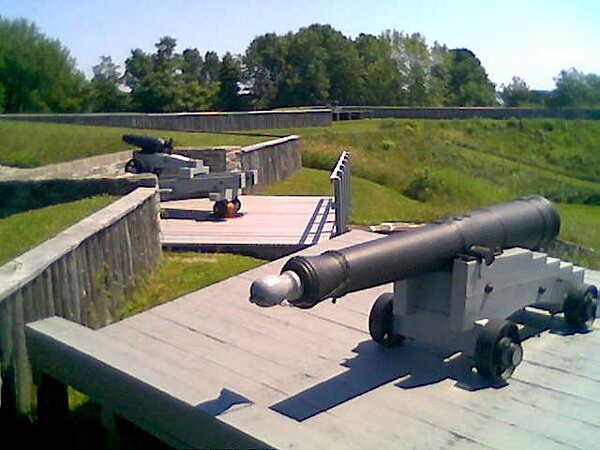
The fort's main armament was a pair of 24-pounder iron cannon mounted on the southeast and southwest corners of the ramparts. These guns had a range which permitted them to fire on buildings across the river in Ogdensburg, New York, and consequently any ship or boat passing the fort was (and is) within range of these guns. Smaller guns defended other points on the ramparts walls.
Unusually for a fortification of its age in Ontario, Fort Wellington was never directly attacked. The military historian Robert D. Bradford later argued that, despite a naturally defensible position, it is unlikely that the fort's palisade could have stood up to bombardment, and that the main value of the fort's presence was in holding territory and providing a sense of security to the local civilian population.
During the War of 1812, Prescott remained an important communications point. Fort Wellington served as the rallying point for the local militia, and in early 1813 was also a base of operations for members of the Glengarry Light Infantry under the command of Lieutenant Colonel George Macdonell. On February 22, 1813, Macdonell led the approximately 500 men under his command in a drill exercise on the frozen St. Lawrence River. The British troops then streamed across the frozen river to attack the town of Ogdensburg, where they destroyed the military barracks and four American ships frozen in the ice, and returned to Prescott with significant amounts of food, ammunition, cannon and prisoners. This winter raid was in direct response to prior raids on Gananoque and Elizabethtown (present-day Brockville, Ontario) by Captain Benjamin Forsyth and soldiers of the U.S. 1st Rifle Regiment, who in February 1813 were based in Ogdensburg.
The fort's guns and garrison again saw action in November, when an American army under General Wilkinson descended the St. Lawrence River in an attempt to capture Montreal. Wilkinson feared Fort Wellington's guns enough that he unloaded his army upriver from Ogdensburg and marched it through the town at night while his boats slipped past, empty of passengers.
Once Wilkinson passed Ogdensburg, Prescott's garrison followed along the King's Highway (the modern Highway 2 ) along the north shore of the river. On November 11, 1813, the two armies fought the Battle of Crysler's Farm, near present-day Morrisburg, Ontario. Wilkinson's army was decisively defeated by a much smaller British and Canadian force, and retreated across the river to Fort Covington, New York. The attack on Montreal was abandoned, and Canada saved.

The fortifications were completed in 1814, coinciding with the peace negotiations which resulted in the Treaty of Ghent. Following the war, the garrison was reduced due to lack of necessity during peacetime. Gradually, the fortifications were allowed to deteriorate, and the fort was abandoned by the British army in 1833.
The end of the War of 1812 in December 1814 led to a rapid demobilization of British fortications in Upper Canada. Fort Wellington was quickly abandoned, although the land itself remained the property of the Board of Ordnance of the British Crown. Built quickly, the buildings and casemates inside the fort deteriorated.
In 1837, political dissidents in the Canadas launched a rebellion, including at the City of York (modern Toronto ). With few British regular soldiers in the Colony, the Upper Canadian militia was quickly mobilized and Fort Wellington became the main depot for the militia in the Prescott area. The Crown commissioned a reconstruction of the fort using the original earthworks from 1813, and work commenced in the spring of 1838.
The buildings in the modern Fort Wellington survive from this period. The three-storey stone blockhouse was completed in 1839, as was the officer's quarters, latrine, cookhouse, and guardhouse. The 1839 improvements were in response to Hunters' Lodges seizure of the steamer Sir Robert Peel The original 24-pounder cannon first installed in 1813 were remounted on the southeast and southwest corners of the ramparts, as were two 12-pounder cannon on the northeast and northwest corners, a 36-pounder carronade over the gate, and two 14-inch mortars on the parade behind the southern rampart facade. In addition, an enclosed, stone caponiere was constructed in the dry ditch outside the palisade on the south facade. This was accessed through a tunnel from the interior of the fort.
Main article: Battle of the Windmill After their defeat at York in the autumn of 1837, many of the Upper Canadian political dissidents fled to the United States. Among the citizens of the northern states of New York, Pennsylvania, Ohio and Michigan, these exiles found much sympathy and anti-British sentiment. Overnight, an army of sympathizers was organized. Calling themselves Hunter Patriots, they combined a neo-Masonic organizational structure with militant republicanism. Their propaganda machine convinced many Americans in the northern states that the citizens of Upper and Lower Canada were being oppressed by undemocratic British government, and were simply waiting for the intervention of liberty-loving American sympathizers.

Early in 1838, these hunters conducted insurgent operations in the Niagara Region, the area around Windsor and Amherstburg, Ontario and on Pelee Island. At one point, Navy Island, upriver from Niagara Falls, which was and remains Canadian territory, was occupied by a sizeable army of Patriot Hunters.
Tensions escalated when a force of Upper Canada militia seized a Hunter vessel, Caroline, in the Niagara River and burned it. Although officially opposed to the actions of the Patriot Hunters, the United States government soon found that most of its local agents and officials were either themselves members of the Lodges or complicit in their activities. For example, the New York State militia "lost" several cannons from its armouries in New York State and Michigan.
In November, 1838, a force of Patriot Hunters met at Sackets Harbor, New York and then travelled downriver on civilian vessels to Ogdensburg. They planned to seize the militia strongpoint at Fort Wellington and organize the disaffected citizens of Upper Canada into a Patriot-led insurgent army with the goal of deposing the British Governor of the Colony.
The Patriots' attempt to land at Prescott proved farcical. The local militia commander had been warned that trouble was afoot. When a Hunter vessel attempted to land early on the morning of 12 November at a wharf in Prescott, it was challenged and fired upon by alert Canadian militiamen. Attempting to withdraw, it and a companion vessel ran aground off Ogdensburg. Later in the morning, both vessels were freed and drifted downriver, past the incredulous sentries at Fort Wellington, and landed two miles downriver at Windmill Point, a promontory on the north shore of the St. Lawrence River. Windmill Point was the site of a hamlet called Newport and—most prominently—a tall, stone windmill. The Hunters disembarked and occupied the village and windmill. Their commanding officer returned by ship to Ogdensburg, promising that a larger force of Hunters would be embarked there and brought as reinforcements. He left a Swedish immigrant named Nils von Schoultz in command at the windmill.
With no regular British forces in the area, the local commander of the Upper Canadian militia summoned all available militiamen in Grenville, Leeds and Dundas Counties and began preparations to assault. He established a cordon of militiamen around Newport and Windmill Point. He also opened communications with the American military commander at Ogdensburg, who had arrived on the scene and had begun to restore order in that town.
Closest places in our Canada guide.
More places to explore in Canada.


