Italy
Gallerie d'Italia – Milano
Museum · Milan
Memorial

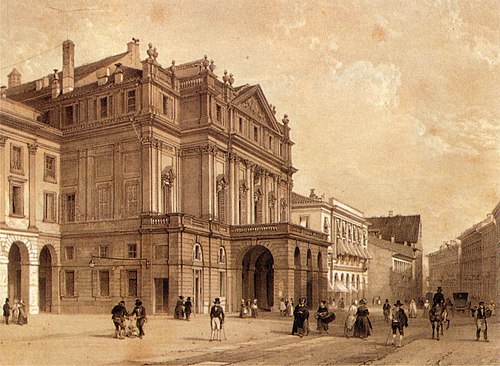
The monument to Leonardo da Vinci is a commemorative sculptural group in the Piazza della Scala, Milan, unveiled in 1872. It is surmounted with a statue of Leonardo da Vinci, while the base has full-length figures of four of his pupils: Giovanni Antonio Boltraffio, Marco d'Oggiono, Cesare da Sesto, and Gian Giacomo Caprotti (under the name Andrea Salaino). The monument was executed by the sculptor Pietro Magni, beginning in 1858; due to Milan's transition from the Lombardo-Venetian Kingdom to first the Kingdom of Sardinia and then the Kingdom of Italy, funding for its construction had problems and delays. After its inauguration the monument was much criticised because of the choice of location and because it was considered a legacy of the Austrian administration.
In 1834, references are found to a "noble and highly cultured fellow citizen of ours" from Milan who intended to create a bronze monument to Leonardo at his own expense. The anonymous person had also obtained permission from the Austrian government to place the monument in the courtyard of the Palazzo Brera, decorating the access to the double staircase. Monuments to Cesare Beccaria and Giuseppe Parini were also being prepared for the staircase at the time.
But the most sumptuous monument for which models are now being made, to be cast in bronze, will be that of the great Leonardo da Vinci, which is being erected by one of our most generous gentlemen at his own expense, not only a lover of fine arts, but professing sculpture for pleasure himself. He did not want the design to be seen or judged until the work was finished, promising to have it completed in three years. Thus all was accepted by the Superiority, who alone will have presented the design to it, and he was granted permission for its placement, in that space of a platform, which divides the two staircases on the ground floor and thus comes to remain in front of the great doorway, in the middle of the facade, so that its view will also be revealed from the street. It is known, however, concerning the design, that it is large and copious in figures, by descriptions interpellated by some, and that it will be very expensive.
— Letter from the painter Paolo Landriani, 1834
The granite base was to have been about 2 meters high, with bronze figures about 3 meters high, showing a personification of Immortality in the act of handing a laurel wreath to Leonardo, intent on deep meditations on his books. A bas-relief on the base would have reproduced Leonardo's Last Supper. However, this project was not completed.
In 1856, among the competitions of the Academy of Fine Arts in Milan, the design of a monument to Leonardo in the form of a fountain to be placed in the courtyard of the Palazzo Brera was requested.
- A rich honorary monument to Leonardo da Vinci, composed of marble and bronze, serving at the same time as a source of drinking water, to be placed in the Palazzo Brera facing the main gate, and set where the present trumpet stands. The project may be both in drawing and in relief. The drawing will be of the precise measurement of 0.54 meters by 0.81 meters; the model will be 1.08 meters high, and it will be marked how much there is of marble and how much of bronze. Prize = A gold medal of the intrinsic value of twenty sequins.
On February 8, 1857, the Emperor Franz Joseph determined that a proper monument should be erected in Piazza San Fedele with a marble statue 3.6 meters high. A new program was therefore established on October 1, 1857, with a deadline of October 31, 1858.
On December 22, 1858, the commission unanimously decided to choose the "Think in marble" [ clarification needed ] model submitted by Pietro Magni; however, it was also pointed out that it would require an expenditure greater than the 60,000 Austrian liras stipulated in the call for proposals. It was also decided that the monument would be destined for Piazza della Scala.
Magni set to work, but the outcome of the Second Italian War of Independence forced him to turn first to Urbano Rattazzi, at that time the minister of the interior, and then to Cavour, president of the Council of Ministers. In fact, the government believed that it had no obligation to Magni since the competition had not been approved by the authorities and the amount of expenditure planned for his work was greater than that established by the competition. However, Cavour instructed Massimo d'Azeglio, Governor of Milan, to examine the situation in the sculptor's studio and make a decision.
D'Azeglio not only confirmed the design but also suggested essential changes that increased the cost of the monument.
- And it was especially following V. E.'s wise observations and suggestions that the thought arose to detach from the monument the said 4 statues of the pupils and to place them on separate pedestals around the monument, thus obtaining a much more homogeneous eurhythmic line. Moreover, having substituted for the primitive model with a round base, the other with an octangular base of pure Bramantesque style with the addition of the various ornaments, and with the introduction of 4 large bronze bas-reliefs representing scenes from the life and works of the great artist, it was achieved, as the E. V. had also very appropriately suggested, that the monument be given all that majesty and grandeur that was required of it, both because of the importance of the subject and because of the size of the square for which it is intended.
— Pietro Magni to Massimo d'Azeglio, June 20, 1860
Magni left for Bologna as standard-bearer of the National Guard and on his return in 1861 found Giuseppe Pasolini as the new governor; in order to try to obtain confirmation of the commission to build the monument, he thus contacted the Academy, d'Azeglio (who had retired from politics), Pasolini, the mayor of Milan Antonio Beretta and the president of the Council of Ministers Bettino Ricasoli.
A value of about 100,000 liras (corresponding to the 60,000 Austrian liras of the competition plus another 47,000 Italian liras) was estimated for the monument's construction. In 1862 the authorities requested changes to the project to reduce the expense to 90,200 liras, and the city of Milan pledged a contribution of 20,000 liras.
Magni carried on with the monument by incurring expenses for materials; by 1867, however, he had received no payment and the ministerial file had made no progress. He then decided to take advantage of the inauguration of the Galleria Vittorio Emanuele II alongside the Piazza della Scala, scheduled for September 15; he installed a model of the monument at his own expense for the entire month of September, hoping that the authorities, seeing it, would finally allow the work to be completed.
In 1868 Magni was informed that the government intended to award him only the original amount of the competition, which amounted to about 52,000 Italian liras; even counting the 20,000 for which the municipality of Milan had pledged, he would suffer a net loss of at least 15,000 liras for out-of-pocket expenses.
As a last hope, in 1879 Magni wrote to Filippo Antonio Gualterio, minister of the Royal Household, to try to get the sovereign to intervene, but to no avail. At the same time he was presented with a warning from the Royal State Property Office because he was late in paying rent for the premises he used for his studio; in early 1870 all his models and all his works were seized for auction. Giovanni Battista Brambilla bought them all to return them to the sculptor.
Seeing the impossibility of obtaining what was owed, Magni in August 1870 presented a writ of judicial warning to the Ministry of Public Education. Finally, with the contract signed on March 23, 1871, he managed to obtain a total of 72,000 liras. The amount was less than that allocated for other monuments, such as that to King Charles Albert in Turin (700,000 liras) or that to Cavour in Milan (more than 100,000 liras).
According to Ettore Verga, the general hostility toward the monument's construction was not due to the sculptor Magni, but to the monument's origin itself. It was Elia Lombardini, head of the office of public constructions under the Austrian government, who proposed its construction, and it was Lombardini himself who tried to get it accepted after the unification of Italy by presenting Leonardo as the "true creator of hydraulic science".
Closest places in our Italy guide.
More places to explore in Italy.