.jpg?width=1200)
Australia
Colonial Mutual Life building, Dubbo
Historic site · New South Wales
Historic site
_-_Igloo_building_and_Double_Bellman_Hangar_(5054834b4).jpg?width=1200)
The Dubbo RAAF Stores Depot is a heritage-listed former Royal Australian Air Force (RAAF) stores depot in Dubbo, New South Wales, Australia. The depot, located on Cobra Street, was designed by Sidney Williams & Co and built from 1940 to 1943. It is also known as Dubbo RAAF Stores Depot (former) and was formerly named No. 5 Stores Depot (1942); No. 6 Stores Depot (1942–52); No. 2 Stores Depot Detachment D (1952–92) and Defence National Storage and Distribution Centre Detachment (1992–1995). The property is owned by private companies, Andorra Developments and Belmorgan Property Development. The depot was added to the New South Wales State Heritage Register on 29 June 2004.
In 1874, a large chunk of land abutting the south end of the Dubbo Common was notified as "Reserve Not For Sale No.442", of which the former RAAF Stores Depot is the largest remnant. In parish maps between 1916 and 1933 it was marked Blocks 147 and 148, and remained bushland dedicated to "public recreation" with a "gravel pit" marked in its north-west sector. It was said to be known as "Bradfield Park". Around 1919, as a result of the Amending Forestry Act of 1916, this area became the Dubbo Acclimatisation Area. Dubbo State Forest No. 807 was dedicated in 1927, two years after the railway spur line to Molong cut across the site.
In the Great Depression of the 1930s the area was known as "Bagtown" because it was inhabited by a number of families who camped there in makeshift tents. It is likely that these people included Aboriginal families.
The declaration of World War II in September 1939 led to Australia's involvement and to the systematic expansion of defence sites which had begun in the mid-1930s. The construction of prefabricated and pre-cut structures is consistent with the rapid increase in military facilities around Australia which followed the Japanese attack on Pearl Harbor and America's entry into the war. Australian concerns as to the safety of Australian territory were borne out when Darwin was bombed by the Japanese in February 1942.
The RAAF operated ten stores depots around Australia during World War II and Dubbo was one of two within NSW. Its siting at Dubbo is important for illustrating the military decision to locate training and maintenance depots well inland, away from coastal areas and carrier -borne aircraft. Several sites in inland NSW were surveyed in February 1942, and in April Dubbo was chosen in preference to Orange and Parkes. The Commonwealth Government bought the state forestry land from the NSW Government in 1943 for A£ 1,911. Dubbo was well sited within the triangle formed by the "Strategic Land Corridors" between Bourke, Sydney and Melbourne, and was also located conveniently to the " Brisbane Line " (running from Brisbane to Melbourne or from Brisbane to Adelaide ). In December 1942 the RAAF Stores Depot No. 5 (renamed No. 6) was formed at Waterloo, Sydney, before being quickly moved to Dubbo. Stores Depot No.5 was never built. Stores Depots 1-4 were located in the suburbs of the capital cities. Like the Dubbo base, Stores Depots 7 and 10 were located well inland to support training and maintenance functions. Stores Depots 8, 9, and 11 supported operational units in the northern areas of Australia.
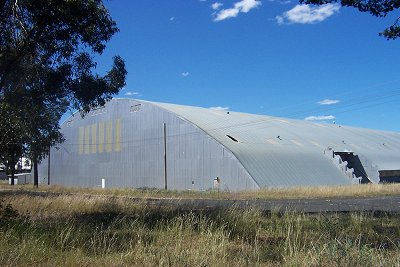
Built at the same time as several other RAAF premises in Dubbo (including the Dubbo Aerodrome and the "Barracks" for housing personnel), the selection of the RAAF Stores Depot No.6 site capitalised on its use by the NSW Forestry Department. The existing cypress pine forest and railway line allowed immediate rail servicing while camouflaging the site's military nature. Indeed, the site was referred to as "The Pines", due to the prominence of the State Forest vegetation. In June 1942 the State Forest was revoked. By July 1942, two Bellman Hangars were well under construction. By November 1942, the residential quarters in the associated Barracks were complete. By April 1943, all 27 buildings at the Dubbo Stores Depot were also complete and stores were arriving daily. The site was used to store aeroplane parts, wireless equipment, ammunition and bombs. By June 1945 there were approximately 866 men and women personnel, both military and civilian, employed by the RAAF in its six sites in the town of Dubbo. With the cessation of hostilities the RAAF Stores Depot at Dubbo was the largest in Australia in terms of its size and the stock held. A delegation from the Dubbo Chamber of Commerce inspected the site at the end of the war and was told that the total cost of construction had been over A£300,000.
The layout of the former RAAF Stores Depot indicates it was comprehensively planned as an entire complex with all new buildings. The buildings, features and roadways were constructed in such a way to deceive overhead observers. The layout of the streets for example followed the lines of the surrounding suburbs. Garden beds were created around buildings and planted with vegetables. The semi-underground PBX bunker (or Wireless Transmitting Station) was constructed in the centre of the site. The Igloo storage buildings are particularly important in illustrating the techniques employed to camouflage such large structures. In attempting to pass off these huge structures as hills, the buildings were oriented to minimise shadows and appropriately painted. Galvanised iron sheeting, cut to resemble tree shapes, was used to modify the profiles of their openings and gables. Much of this camouflage treatment has since been removed.
The former RAAF Stores Depot also made effective use of prefabricated building designs. These techniques accommodated the enormous demands made on the local construction authorities across Australia following the bombing of Darwin. The site displays five types of prefabricated buildings: the five Igloo stores buildings, three Bellman hangars, the Sidney Williams Hut, the Rabaul Store and former Inflammable Liquids Store. The site is unusual and important in its demonstration of the variety of design and innovative construction techniques used in prefabricated storage buildings constructed during World War II.
Development of the site, post-World War II
Most of the ten RAAF stores depots built around Australia were only temporary and were disbanded within the decade after the end of the war. The exceptions were those in Dubbo, Sandridge, Victoria, Waterloo, New South Wales and Drayton, Queensland. Only the RAAF Stores Depot, Dubbo remained in military operation until the 1990s. It functioned in the immediate post-war period as a receiving store, holding a large numbers of weapons and surplus stock. The RAAF unit was also acknowledged in the town history as having rendered flood relief to the town and surrounding areas in February 1955, and more generally having "rendered invaluable service both to the town brigade and the bush fire brigades". In 1951 the National Service used the depot to support training flights from the military aerodrome, now Dubbo Airport. The site was transferred to the Army in 1952, leading to it being disbanded in November 1953 and reformed as "No.2 Stores Depot, Detachment D". RAAF involvement ended in 1956. The operational life of Detachment D ended in 1992. From 1992 to 1995 the depot was used as a tri-service facility before becoming surplus to requirements. Two small blocks of land were alienated in 1971 and 2003, on the north west corner and the south west corner respectively, for sale or transfer to the Department of Health and the Vietnam Veterans Association. In 1997 the associated RAAF Barracks site in Dubbo was sold for residential development. In June 2003 the former RAAF Stores Depot site was also sold to Belmorgan Property Development, the first time the land had passed out of public ownership.

Post-war civilian uses included leasing a small block to Westhaven Sheltered Workshops 1960–1984, and another to the Health Department, eventually resulting in the sale of a section from the north-west corner of the site. This area is now owned by the NSW Department of Health and the Baptist Church. In 1976 another part of the site was leased to become the headquarters of the East Coast Plague Locust Commission. The former RAAF Stores Depot was an important component of the Civil Emergency services operations during and after the rebuilding of Darwin following Cyclone Tracy in 1974 and during a number of other civil disasters throughout the Pacific region during subsequent decades. In 1978 the Natural Disasters Organisation entered into an agreement with the Army to store materials for natural disaster relief. The Vietnam Veterans Association uses buildings at the south western corner of the site. Other storage uses have included: Harvey Norman storing furniture in the Rabaul store; Robert Holmes Transport storing palleted goods in buildings 10 and 18; police storing recovered stolen vehicles in building 5 and training police dogs; and Robert Samuels storage of baled hay in the Bellman hangars. Local craftspeople banded together in 1992, using the site as a workshop to build a new "State Coach" in honour of the visit of Queen Elizabeth II in 1992. There was also the 1999-2000 collaboration between French company Plasticiens Volants and the troupe of Aboriginal choreographer Raymond D. Blanco to produce a street theatre based on the Aboriginal dreamtime " Rainbow Serpent ", which was constructed and rehearsed in the No.4 shed. Between 1945 and 1992 the depot was used intermittently to stage events such as conference, concerts, trade fairs and rodeos. The band Silverchair played a concert at the depot in 1997.
The former stores depot site was sold in 2011 to property developers. Plans to redevelop the site to include more than 400 houses, tourism and hospitality businesses and accommodation were approved by the NSW Office of Environment and Heritage in 2018. The Dubbo Local Council approved the redevelopment in 2019, and it received final approval from Heritage NSW in June 2020.
The declaration of World War II in September 1939 led to Australia's involvement and to the systematic expansion of defence sites which had begun in the mid-1930s. The construction of prefabricated and pre-cut structures is consistent with the rapid increase in military facilities around Australia which followed the Japanese attack on Pearl Harbor and America's entry into the war. Australian concerns as to the safety of Australian territory were borne out when Darwin was bombed by the Japanese in February 1942.
The RAAF operated ten stores depots around Australia during World War II and Dubbo was one of two within NSW. Its siting at Dubbo is important for illustrating the military decision to locate training and maintenance depots well inland, away from coastal areas and carrier -borne aircraft. Several sites in inland NSW were surveyed in February 1942, and in April Dubbo was chosen in preference to Orange and Parkes. The Commonwealth Government bought the state forestry land from the NSW Government in 1943 for A£ 1,911. Dubbo was well sited within the triangle formed by the "Strategic Land Corridors" between Bourke, Sydney and Melbourne, and was also located conveniently to the " Brisbane Line " (running from Brisbane to Melbourne or from Brisbane to Adelaide ). In December 1942 the RAAF Stores Depot No. 5 (renamed No. 6) was formed at Waterloo, Sydney, before being quickly moved to Dubbo. Stores Depot No.5 was never built. Stores Depots 1-4 were located in the suburbs of the capital cities. Like the Dubbo base, Stores Depots 7 and 10 were located well inland to support training and maintenance functions. Stores Depots 8, 9, and 11 supported operational units in the northern areas of Australia.
Built at the same time as several other RAAF premises in Dubbo (including the Dubbo Aerodrome and the "Barracks" for housing personnel), the selection of the RAAF Stores Depot No.6 site capitalised on its use by the NSW Forestry Department. The existing cypress pine forest and railway line allowed immediate rail servicing while camouflaging the site's military nature. Indeed, the site was referred to as "The Pines", due to the prominence of the State Forest vegetation. In June 1942 the State Forest was revoked. By July 1942, two Bellman Hangars were well under construction. By November 1942, the residential quarters in the associated Barracks were complete. By April 1943, all 27 buildings at the Dubbo Stores Depot were also complete and stores were arriving daily. The site was used to store aeroplane parts, wireless equipment, ammunition and bombs. By June 1945 there were approximately 866 men and women personnel, both military and civilian, employed by the RAAF in its six sites in the town of Dubbo. With the cessation of hostilities the RAAF Stores Depot at Dubbo was the largest in Australia in terms of its size and the stock held. A delegation from the Dubbo Chamber of Commerce inspected the site at the end of the war and was told that the total cost of construction had been over A£300,000.

The layout of the former RAAF Stores Depot indicates it was comprehensively planned as an entire complex with all new buildings. The buildings, features and roadways were constructed in such a way to deceive overhead observers. The layout of the streets for example followed the lines of the surrounding suburbs. Garden beds were created around buildings and planted with vegetables. The semi-underground PBX bunker (or Wireless Transmitting Station) was constructed in the centre of the site. The Igloo storage buildings are particularly important in illustrating the techniques employed to camouflage such large structures. In attempting to pass off these huge structures as hills, the buildings were oriented to minimise shadows and appropriately painted. Galvanised iron sheeting, cut to resemble tree shapes, was used to modify the profiles of their openings and gables. Much of this camouflage treatment has since been removed.
The former RAAF Stores Depot also made effective use of prefabricated building designs. These techniques accommodated the enormous demands made on the local construction authorities across Australia following the bombing of Darwin. The site displays five types of prefabricated buildings: the five Igloo stores buildings, three Bellman hangars, the Sidney Williams Hut, the Rabaul Store and former Inflammable Liquids Store. The site is unusual and important in its demonstration of the variety of design and innovative construction techniques used in prefabricated storage buildings constructed during World War II.
Most of the ten RAAF stores depots built around Australia were only temporary and were disbanded within the decade after the end of the war. The exceptions were those in Dubbo, Sandridge, Victoria, Waterloo, New South Wales and Drayton, Queensland. Only the RAAF Stores Depot, Dubbo remained in military operation until the 1990s. It functioned in the immediate post-war period as a receiving store, holding a large numbers of weapons and surplus stock. The RAAF unit was also acknowledged in the town history as having rendered flood relief to the town and surrounding areas in February 1955, and more generally having "rendered invaluable service both to the town brigade and the bush fire brigades". In 1951 the National Service used the depot to support training flights from the military aerodrome, now Dubbo Airport. The site was transferred to the Army in 1952, leading to it being disbanded in November 1953 and reformed as "No.2 Stores Depot, Detachment D". RAAF involvement ended in 1956. The operational life of Detachment D ended in 1992. From 1992 to 1995 the depot was used as a tri-service facility before becoming surplus to requirements. Two small blocks of land were alienated in 1971 and 2003, on the north west corner and the south west corner respectively, for sale or transfer to the Department of Health and the Vietnam Veterans Association. In 1997 the associated RAAF Barracks site in Dubbo was sold for residential development. In June 2003 the former RAAF Stores Depot site was also sold to Belmorgan Property Development, the first time the land had passed out of public ownership.
Post-war civilian uses included leasing a small block to Westhaven Sheltered Workshops 1960–1984, and another to the Health Department, eventually resulting in the sale of a section from the north-west corner of the site. This area is now owned by the NSW Department of Health and the Baptist Church. In 1976 another part of the site was leased to become the headquarters of the East Coast Plague Locust Commission. The former RAAF Stores Depot was an important component of the Civil Emergency services operations during and after the rebuilding of Darwin following Cyclone Tracy in 1974 and during a number of other civil disasters throughout the Pacific region during subsequent decades. In 1978 the Natural Disasters Organisation entered into an agreement with the Army to store materials for natural disaster relief. The Vietnam Veterans Association uses buildings at the south western corner of the site. Other storage uses have included: Harvey Norman storing furniture in the Rabaul store; Robert Holmes Transport storing palleted goods in buildings 10 and 18; police storing recovered stolen vehicles in building 5 and training police dogs; and Robert Samuels storage of baled hay in the Bellman hangars. Local craftspeople banded together in 1992, using the site as a workshop to build a new "State Coach" in honour of the visit of Queen Elizabeth II in 1992. There was also the 1999-2000 collaboration between French company Plasticiens Volants and the troupe of Aboriginal choreographer Raymond D. Blanco to produce a street theatre based on the Aboriginal dreamtime " Rainbow Serpent ", which was constructed and rehearsed in the No.4 shed. Between 1945 and 1992 the depot was used intermittently to stage events such as conference, concerts, trade fairs and rodeos. The band Silverchair played a concert at the depot in 1997.
The former stores depot site was sold in 2011 to property developers. Plans to redevelop the site to include more than 400 houses, tourism and hospitality businesses and accommodation were approved by the NSW Office of Environment and Heritage in 2018. The Dubbo Local Council approved the redevelopment in 2019, and it received final approval from Heritage NSW in June 2020.
Closest places in our Australia guide.
More places to explore in Australia.


.jpg?width=1200)
.jpg?width=1200)
.jpg?width=1200)


