
Australia
Castlemaine Post Office
Post office · Victoria
Art museum

Castlemaine Art Museum is an art gallery and museum in Castlemaine, Victoria, Australia. Founded in 1913, it is housed in a purpose-built Art Deco building, completed in 1931 and heritage-listed by the National Trust. Its collection concentrates on Australian art and the museum houses historical artefacts and displays drawn from the local district. The museum is governed by private trustees and managed by a board elected by subscribers. It is funded by state and local governments with additional support from benefactors, local families, artists and patrons. Its trustees also oversee the management of Buda, a heritage-listed villa and garden 1.3 km adjacent to the museum, which houses its own collection of art and artefacts associated with the Leviny family, and is also open to the public for exhibitions, events displays and garden tours.
The founding of Castlemaine Art Gallery and Historical Museum was preceded by four other public regional galleries in the state of Victoria: Ballarat in 1884, Warrnambool in 1886, Bendigo in 1887 and Geelong in 1900, but its significance, by comparison, was that it was in a small town, not a regional city like its forebears.
Cultural precedents were the 1855 Castlemaine Mechanics Institute which included a library; the School of Mines whose art teacher C. Steiner in 1908 taught engineering, surveying, architecture and fine art students; and numbers of artists, including S. T. Gill, Samuel Calvert, George French Angas, and early photographers Antoine Fauchery and Richard Daintree, had visited to document the swarming goldfields.
The Castlemaine Progress Association's display of items of a 'novel and interesting nature', Castlemaine Past and Present, the town's first major exhibition, running 18–20 August 1910, celebrated the commercial, civic and cultural achievements of the town with "a collection of geological specimens and curios from the Government collection," photographs of historical interest, maps, furniture, applied art, books and artefacts, as well as landscapes by local artists intended to "popularise our town as a resort for artists and painters".
The committee included a "special feature" of "modern art, the only stipulation being that works of art, as well as all other exhibits, must relate in some way to Castlemaine or its district," and called for "historical curios, weapons, maps, manuscripts, medals, trophies, or any other article of local significance". An early supporter was Elioth Gruner. The exhibition thus established the principle of collecting of Australian art and of looking locally, for works connected to Castlemaine in some aspect, in contrast to a policy of concentrating on British and European art that was pursued by most Australian galleries of the period, in particular the National Gallery of Victoria purchases in Europe by L. Bernard Hall through the Felton Bequest.

Two years later, in October 1912, the first solo exhibition of paintings by a local resident, Elsie Barlow, wife of a Castlemaine police magistrate, was held in the reading room of the Mechanics Institute, raising hopes "that the Castlemaine public will have the same opportunity in this matter as is afforded to the Melbourne public, which now-a-days is rarely without an Art Exhibition".
Subsequently, a meeting at Barlow's Hunter Street home on 9 July 1913 proposed the creation of a permanent gallery for Castlemaine and approached the Mayor to "affirm the advisability of establishing a Museum and Art Gallery in Castlemaine" on 30 July at a public meeting of Mayors and Councillors from Chewton, Maldon, Metcalfe, Newstead and Mount Alexander with Col. Davies, Secretary of the Bendigo Art Gallery, Mr A T Woodward Director of the Bendigo School of Arts, Mr Bernard Hall, Director of the National Gallery of Victoria, Trustees of the National Gallery and Museum and the Old Pioneers Association, and with support of the local High School committee.
Winifred Brotherton, who took the minutes, emphasised the imperative of establishing a museum in which to preserve the heritage of the town, and the museum was later to be given her name in her honour.
Colonel Davis spoke from the experience of Bendigo Art Gallery where he was secretary, advising not to expect government funds such as they had received as the grant was only £2,000 to be divided amongst all the arts organisations, but to secure donations of pictures, be prepared to go into debt, and make use of loans from the National Gallery of Victoria. The housing of the gallery was considered and proposals included the cooking classroom of the Technical High School, the Market Building, the Town Hall, and the School of Mines.
The gallery became a reality when Bertha Leviny of Buda homestead provided use of a room in a shop in Lyttleton St. for one year free of charge. Bendigo Art Gallery offered a loan of paintings. A loan exhibition of 30 works in the Stock Exchange Room of the Town Hall launched the Castlemaine Art Gallery and Historical Museum on 24 October 1913, its first office bearers being Mary Leviny, Lilian Sheridan, Alice Waterhouse and her husband (President), Winifred Brotherton, Elsie Barlow, Mary Brough Woolley and Mrs. Cox. Significant exhibitors who made donations of their work included Harold Herbert and Jessie Traill.
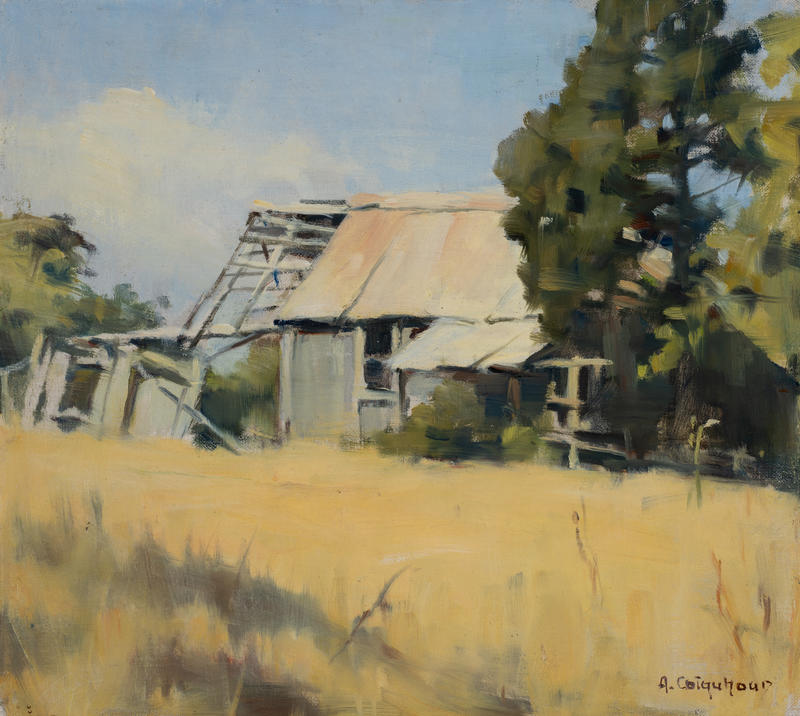
When the gallery moved into the room offered by Leviny in Lyttleton St., more donations were made. Bertha Merfield made generous loans of works from her collection to its inaugural exhibition, including paintings by Tudor St George Tucker, Alexander Colquhoun, George Clausen, Frederick McCubbin and Blamire Young. joined by direct loans by artists, and by the National Gallery of Victoria which contributed Franz Courtens ' Morning, David Wynfield 's Death of the Duke of Buckingham, Robert Dowling's Sheikh and His Son Entering Cairo; Hermann Eschke 's Freshwater Bay, Isle of Wight ; Cave Thomas ' Canute Listening to the Monks at Ely ; and Louis Buvelot 's Summer afternoon, Templestowe.
The 1914 annual report recorded 30 memberships and a collection of 23 pictures with others on loan and a balance of £75. Initial opening hours in 1914 were daily from 3 to 5 p.m., and Wednesday and Saturday evenings from 7.30 to 9.30, changed later to weekdays 10 am to 12 pm and 2 to 5 pm, and Sundays 2 to 5 pm.
The next home of the gallery and museum, by June 1915, was in the rooms above the Castlemaine Post Office which it rented for £1 per annum, and where it remained until 1931 in three well-lit rooms: two small ones, and one measuring 9 by 5.5 metres (30 by 18 ft) which served as the main gallery. Nevertheless, the Victorian Government rejected their grant application of 1915 because the Gallery's tenure of its premises was not secure. Electric lighting was added in 1927.
The facility proved popular, with attendances rising from 800 in 1920 to 3,600 in 1923. Many in 1928 came for a series of talks by John Shirlow intended to boost interest in the Gallery. Artists too were noticing it, as The Age reported in November 1923;
'Tis said that the reputation of this gallery is such that every artist of note throughout Australia has heard of the little gallery which so cherishes and encourages the work of Australian men and women that a renaissance of effort has been brought about among Australian painters.

The insurance value of the collection rose in 1925 to £2,000 (a value of $190,800.00 in 2024), with a further 37 paintings gifted in 1926 by, among others, Arthur Streeton, George Coates, Dora Meeson, Jo Sweatman, and A.M.E. Bale, etchings by Martin Lewis, and purchases including The Dark Horse by George W. Lambert, and The Coming Storm by Blamire Young, as reported by Lieut. Col. Francis S. Newell, then President of the Castlemaine Art Gallery in Art in Australia of December 1926. Newell also commented on attendance by 5,248 visitors; "When it is remembered that the population of this town is about 7,000, the progress of this gallery is remarkable. The committee has now purchased a site for a new building, but more funds are needed before the project can be carried out."
The Castlemaine Progress Association's display of items of a 'novel and interesting nature', Castlemaine Past and Present, the town's first major exhibition, running 18–20 August 1910, celebrated the commercial, civic and cultural achievements of the town with "a collection of geological specimens and curios from the Government collection," photographs of historical interest, maps, furniture, applied art, books and artefacts, as well as landscapes by local artists intended to "popularise our town as a resort for artists and painters".
The committee included a "special feature" of "modern art, the only stipulation being that works of art, as well as all other exhibits, must relate in some way to Castlemaine or its district," and called for "historical curios, weapons, maps, manuscripts, medals, trophies, or any other article of local significance". An early supporter was Elioth Gruner. The exhibition thus established the principle of collecting of Australian art and of looking locally, for works connected to Castlemaine in some aspect, in contrast to a policy of concentrating on British and European art that was pursued by most Australian galleries of the period, in particular the National Gallery of Victoria purchases in Europe by L. Bernard Hall through the Felton Bequest.
Two years later, in October 1912, the first solo exhibition of paintings by a local resident, Elsie Barlow, wife of a Castlemaine police magistrate, was held in the reading room of the Mechanics Institute, raising hopes "that the Castlemaine public will have the same opportunity in this matter as is afforded to the Melbourne public, which now-a-days is rarely without an Art Exhibition".
Subsequently, a meeting at Barlow's Hunter Street home on 9 July 1913 proposed the creation of a permanent gallery for Castlemaine and approached the Mayor to "affirm the advisability of establishing a Museum and Art Gallery in Castlemaine" on 30 July at a public meeting of Mayors and Councillors from Chewton, Maldon, Metcalfe, Newstead and Mount Alexander with Col. Davies, Secretary of the Bendigo Art Gallery, Mr A T Woodward Director of the Bendigo School of Arts, Mr Bernard Hall, Director of the National Gallery of Victoria, Trustees of the National Gallery and Museum and the Old Pioneers Association, and with support of the local High School committee.
Closest places in our Australia guide.
More places to explore in Australia.


.jpg?width=1200)
.jpg?width=1200)
.jpg?width=1200)


