
Australia
Glen Innes Post and Telegraph Office
Historic site · New South Wales
Historic site
.jpg?width=1200)
Glen Innes Showground is a heritage-listed showground at Bourke Street, Glen Innes, in the New England region of New South Wales, Australia. It was designed by various architects, including Thompson and Holmes, J. P. O'Connor, Rowland Bros and Madigan and Cusick. It was built from 1873 by various builders, including A. W. Lane, G. Cooper and H. A. Tutt and Son. It was added to the New South Wales State Heritage Register on 4 September 2015.
Pre European settlement, the area around Glen Innes was the traditional land of the Ngarabal people, whose totem was the koala. Their land extended to include current towns of Glencoe, Kingsplains, Wellingrove, Strathbogie, Bolivia and Beardy Plains. Due to the severity of the winters in the area and the consequent reduction in food resources, the people migrated away from the high tableland area during the coldest months to the warmer regions along tributaries to the Clarence River in the south and east and the Mole district in the west. The population again swelled during the summer months as the Ngarabal returned to feast on wallaby, bandicoots, possum, lizards, birds and many other creatures. Wild berries including the local wild raspberry, peach heath, wattle, roots of the bracken fern, native yam and native asparagus, were among other plants that augmented their diet and provided medicinal treatment. Those too old or to weak to undertake the migration stayed on the high tablelands and protected themselves from the cold by wearing Possum or Kangaroo skin cloaks and tending large camp fires established close to their bark huts.
While tribal boundaries were clearly drawn and incursion of these often provoked fierce battles, there was also movement of neighbouring Clarence River / Macleay River Aboriginal tribes and those of the western districts up to theNgarabal tribal lands near Glen Innes for corroborees, to trade goods information and also for marriage and initiation purposes. Goods traded included ochre, sourced near Dundee in the Glen Innes area and stone from creeks in tribal lands to the south.
In 1818, during his journey from Bathurst to the Macquarie Marshes, thence to the Liverpool Plains and Port Macquarie, John Oxley first reported sighting Aboriginal people in the New England area. While Oxley met with some Aboriginal men, women and children were kept hidden. Similarly in 1827 while making his journey of exploration through to the Darling Downs region, Richard Cunningham noted signs of indigenous habitation but rarely saw or met with Aboriginal people. After coming upon cattle and a European hut Cunningham surmised that Aboriginal people may have had a bad experience of some white men and chose to avoid them.
Avoiding White settlers became increasingly difficult for the Aboriginal people of the area after 1830. At this time the Australian Agricultural Company took up vast estates north of the Hunter Valley on the Liverpool Plains. With the large agricultural company in possession of this land, new squatters were forced to seek seeking new lands further north, including in the New England area. In 1838 Thomas Hewitt took up Stonehenge located south of present Glen Innes, for Archibald Boyd. In 1839 a New England Pastoral district was formed with Commissioner MacDonald based at Armidale.

The early years of settlement in the Glen Innes area was marked by mixed relations between Aboriginal people and the new colonists. Inevitably, as the Aboriginal people were increasingly locked out of their traditional hunting grounds, there were many incidents of conflict between Aboriginals and whites farmers. Aboriginal people on occasion took stock as compensation for the decimation of their traditional food resources. On other occasions they would attempt to drive stock off their traditional lands and in some cases European shepherds were killed. Settlers in return chased Aboriginal people from their farms and in a number of cases between 1839 and 1842 killed Aboriginal people en masse. This happened on the Beardy Plains, at Deepwater Station and at Bluff Rock in the vicinity of Glen Innes.
In the 1840s towns were established along the Tablelands and initially a government town was established at Wellingrove. Unlike the village of Glen Innes, Wellingrove did not thrive and in January 1858 the Court of Petty Sessions was moved to Glen Innes. Other businesses then followed. It was in December 1851 that Surveyor J. J. Galloway surveyed a town sites at Glen Innes and Stonehenge. In the early 1870s, Glen Innes developed rapidly following the discovery of tin in the district. New stores and hotels were constructed in the town and a number of social and professional organisations were established in Glen Innes including the Pastoral and Agricultural Association which was initially established in conjunction with Inverell.
Pastoralism was an essential element in the development of the local, regional and national economies. Livestock production influenced the development of pastoral stations and modified the landscape in Glen Innes as elsewhere in NSW and Australia. The successful development of pastoralism in the area led the establishment of the Inverell-Glen Innes Pastoral and Agricultural Association which worked hard to establish a local Show where stock could be displayed and judged. The first show to be held in the Glen Innes district was in 1869 at Inverell and the 1870 show was held at Glen Innes, near the Glen Innes Primary School.
The first show to be held on the current showground site was in 1874. This date indicates that Glen Innes was one of the earliest shows to be established and continuously operating on its site outside metropolitan Sydney. Other early regional showgrounds in continuous use are Maitland which held its first show at its current site in 1873, Singleton, which held its first show on its current site in 1868, Bathurst, which held the first show on site in 1878, and Armidale show began on its current site in 1877. The joint Inverell-Glen Innes Pastoral and Agricultural Association remained operational until 1876 when, after a less successful show which went into debt to the tune of 144 pounds, Glen Innes members decided to establish an independent Association. The Government of New South Wales formally gazetted the present showground site in 1877. This site became an important part of the Town Plan.
The first president of the Glen Innes Pastoral and Agricultural was William Alexander Dumaresq, the son of the well-known, and at times notorious colonial figure and brother-in-law to Governor Darling, Captain William John Dumaresq. William John Dumaresq was made provisional civil engineer and inspector of roads and bridges by Governor Darling and at one stage was acting colonial Treasurer. He and his brother Henry amassed large, profitable land holdings in both the Hunter and the New England tablelands, Saumarez and Tilbuster being those in the New England. His son William Alexander Dumaresq served as an Australian Army Officer in India, married the sister-in-law of Governor Somerset Lowry-Corry, 4th Earl Belmore and was a wealthy grazier in the Glen Innes district.
Another important association for the Glen Innes Pastoral and Agricultural Association was with W. T. Cadell and Deepwater Station. Deepwater Station was initially taken up by noted landowner and pastoralist Archibald Windeyer junior in 1839 and rapidly developed into a prosperous station which made a large contribution to NSW fine merino wool exports. On his demise in 1870 the station was purchased by a family company representing the union of several NSW and Queensland pastoral dynasties, the Windmyers, the Macansh family and W. T. Cadell who had married into the Macansh family. It was Cadell who was the hands-on sheep and cattle breeder and he successfully improved the Deepwater herd and flock to such an extent that Deepwater wool was regarded as the finest in the NSW market and regularly fetched top price. Cadell became official patron and sponsor of the Glen Innes Show in 1903. In this role he worked tirelessly to "advance the Glen Innes Pastoral and Agricultural Society to a leading place in NSW".
The first buildings to be built at Glen Innes Showground were a Grandstand and an Exhibition Hall for the 1874 Show. As the annual show continued to grow in terms of both attendance and exhibition these initial buildings were extended and stock yards built. A mark of the popular success of the show was the organisation of excursion trains from Tamworth and Tenterfield to ferry eager show goers to the Glen Innes Show. In 1888 a grand new entrance to the showgrounds was opened on Torrington Street.
By 1892 the original Exhibition Hall had seen its best years and was replaced by the existing, attractive Victorian free classical style Main Exhibition Pavilion. Similarly in 1896 the original grandstand was removed and replaced by the Federation Carpenter style grandstand which eventually opened for use in 1899 and is still in situ. The timber from the original grandstand was used to construct the caretakers cottage. In 1897, to celebrate Queen Victoria 's Jubilee, a program of tree planting began and the grounds were lit for the first time. The tree planting program was continued over the years, funded by financial and in-kind donations and by the takings of the annual show. The planting program has resulted in the well maintained park-like showground.
As a marker of the progress of the show and of its reputation through NSW, by the end of the 19th century is the fact that on several occasions the annual Glen Innes Show was opened or attended by various dignitaries. Show openings were officiated by Premier of New South Wales Sir George Dibbs in 1893; the Governor of NSW, Admiral Sir Harry Rawson in 1903; the NSW Premier, Joseph Carruthers in 1904; and NSW Premier Charles Wade in 1909. The prestige of the show and its success reached its zenith in 1922 when it was widely recognised as the leading annual show in NSW with buildings and exhibition facilities rivalling those at other showgrounds through NSW. During the middle decades of the 20th century it became something of a "tradition" for dignitaries to open the Glen Innes show with NSW Premier, Bertram Stevens opening the 1934 Show; Earle Page opening the 1939 Glen Innes Show and veteran politician Hubert Lawrence Anthony opened the 1941 Show.
The early years of the 20th century also saw a spate of building projects with Rowland Bros architects designing an additional pavilion for the showground in 1905, extensive stables buildings in 1906 and J. F. O'Connor, architect, preparing plans and supervising construction of the cattle pavilion between 1909 and 1910. New entrance gates were erected in 1911. In 1922 a major addition to the Main Exhibition Pavilion was designed by architect F. J. Madigan, a widely noted architect and mentor for his son, Colin Madigan. In that same year the sheep pavilion was completed and a new piggery and a new refreshment room was constructed. The new buildings at the showground used designs sympathetic to the buildings already established on the grounds. This dedication to creating a cohesive suite of architect-designed buildings has extended to the design and construction of buildings at Glen Innes Showground through the history of the showgrounds.

Late in 1922, after officially opening the show seated in his car as he could not stand, W. T. Cadell died. His dedication to the establishing the best show in NSW was memorialised in the erection of the Cadell Memorial sheep rotunda which was opened in 1927 by Michael Bruxner MLA.
During the 1930s the showgrounds were extended with the purchase of two extra acres of land. The Caged Bird Pavilion was erected and a public address system installed. Further developments were cut short by the onset of World War II during which the showground was occupied by the Army. While the 1941 show went ahead, by 1942 the grounds were in Army control and there was no show. The next show to be held was in 1946. In preparation 1944 and 1945 were spent restoring the grounds and facilities after the military use.
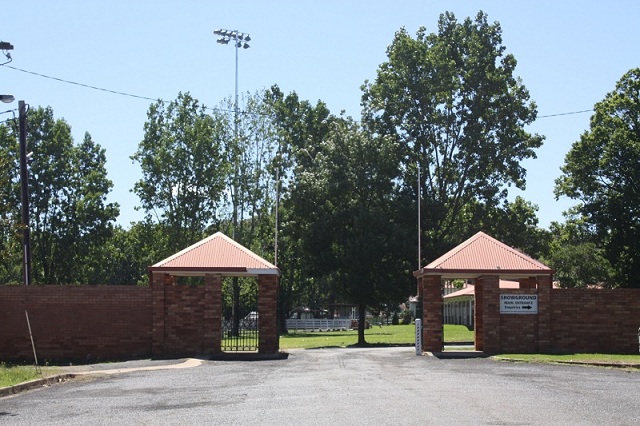
The 1950s saw a further 2 acre purchase of land to enlarge the showgrounds and also the installation of a Ringside Broadcast Box, horse and cattle stalls and further plantings. By this time the suite of buildings that now characterises the Glen Innes Showground were in place. The exception was the 1991 bar and barbeque, designed to complement the neighbouring grandstand, and the new entrance gates on Bourke Street. The 1960s and 1970s saw the continued care and interest in tree planting in the grounds, the establishment of the Industrial pavilion in 1974 and then in the 2000s the Men's Shed was erected near the Torrington St entrance.
The changing nature of pastoralism and related agricultural activities in the Glen Innes area was reflected at the annual show. Initially sheep, beef cattle and horses were paraded and judged. As small farming developed maize, wheat and other cash crops were exhibited as well as dairy herds, pig farms and poultry farms.
In time related secondary industries were developed in the town and appeared at the show. Wheat growing led to the development of Flour Mills in Glen Innes; dairy herds led to the development of butter and cheese factories; horses led to the development of blacksmiths, coach companies and coach manufacturing businesses. The development of these industries explains the construction of the Hall of Industries in 1922 and the Industrial Pavilion in 1974.
Closest places in our Australia guide.
More places to explore in Australia.

.jpg?width=1200)
.JPG?width=1200)


.jpg?width=1200)
.jpg?width=1200)
.jpg?width=1200)
.jpg?width=1200)


