Germany
Senftöpfchen
Theater building · Altstadt-Nord
Church building

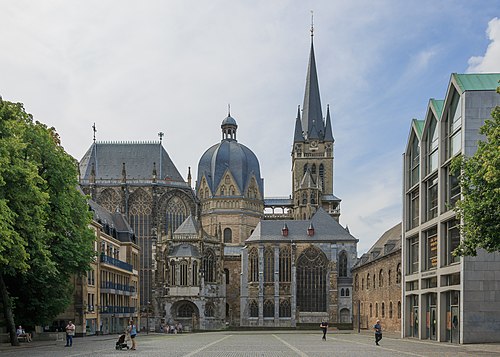
The Great Saint Martin Church (German: Groß Sankt Martin, mostly shortened to Groß St. Martin, pronounced [ˈɡʁoːs ˌzaŋkt ˈmaʁtiːn] or [- maʁˈtiːn] ; Kölsch: Jruhß Zint Määtes [ˈjʁús ˌtsɪ̂nt ˈmɛ́ːtəs] ) is a Romanesque Catholic church in Cologne, Germany. Its foundations (c. 960 AD) rest on remnants of a Roman chapel, built on what was then an island in the Rhine. The church was later transformed into a Benedictine monastery. The current buildings, including a soaring crossing tower that is a landmark of Cologne's Old Town, were erected between 1150–1250. The architecture of its eastern end forms a triconch or trefoil plan, consisting of three apses around the crossing, similar to that at St. Maria im Kapitol. The church was badly damaged in World War II; restoration work was completed in 1985.
As of 2009 Great Saint Martin is being used by a branch of the Monastic Fraternities of Jerusalem and is open for visits again.
The story of Great St. Martin is inextricably connected to that of the Benedictine abbey, located at the church for most of its history. A few documents from the time of the building have survived, and it is from these that knowledge of its founding comes. This information is also supported by archeological findings onsite and the study of the style of building and its ornamentation.
The Cologne text Aedidius Gelenius, a catalogue of local saints, mentions in the 1645 edition a possible origin for the church in pre-Carolingian times. The missionaries Viro and Plechelmus, who later were affiliated with the Kaiserswerth cloister, are said to have come to the Rhine, to found monasteries and churches. They were said to be sponsored by the mayor of the palace Pepin of Herstal and his wife Plectrude, situating their work during the years 670–714. It is possible that these two founded a church that would later become Great St. Martin.
Theories of the Church’s pre-Carolingian beginning are supported by the Chronicon Sancti Martini Coloniensis, which up until the end of the 19th century was regarded as a valid historical source for Churches and Abbeys in Cologne. According to it, Great St. Martin was founded as a chapel in 690, and was transformed into a monastery by Viro, Plechelmus and Otger in 708. The Chronicon provides an unbroken history of the abbey and the events leading to its partial destruction by Saxons in 778, while Charlemagne was fighting in Spain. Other events included in this history include a papal visit from Leo III and the damage from the Normans in 846 and 882.
Writing in 1900, Otto Opperman, a scholar in Germany, proved that this chronicle is a false history, concocted by Oliver Legipont, a Benedictine Monk residing at Great St. Martin’s in 1730. Other theories, including one that suggests the Church was built in Frankish times (during the 5th to 9th centuries) are similarly unsupported by evidence and likely apocryphal.
Foundation and building of the monastery in the 10th and 11th Centuries
The Lorsch Codex, which provides a more trustworthy source of information, mentions the founding of the church by archbishop Bruno the Great (953–965) as a men’s choir house in honor of Martin of Tours. Brun also lists the church in his records and mentions the donation of the relics of St. Eliphius, who was the second named patron of the church. These relics were later transferred to Toul.
Later chronicles written by Johann Koelhoff the younger in 1499 mention that Archbishop Warin of Cologne (976–985) had renovated the Church and placed Minnborinus of Cologne in charge of it (see Hiberno-Scottish mission ). Ebergar (985–999) wrote that with donations in 989, the Church was transformed into a monastery for Benedictine monks from Ireland. They included Kilian of Cologne (died 1003), Helias of Cologne (died 1040), Aaron Scotus (died 1052), and Molanus (died 1061).
During the 11th century, these Irish residents were gradually replaced by local monks. This is due to the fact that archbishop Pilgrim of Cologne was averse to their presence, and applied himself to their removal. As a result, the last Irish abbot, Arnold of St. Martin's, died there in 1103.
The Vita Annonis reports that Archbishop Anno II (1056–1075) was given a vision by St. Eliphius of two towers at the church, and that this vision was the inspiration for the towers later erected over the east choir.
Romanesque rebuilding in the 12th and 13th centuries
Section of Cologne city map from 1571, showing Great St. Martin An early 19th-century view of the north side of the church, after the demolition of the abbey, reveals the triapsidal Romanesque structure of the eastern end. In 1150, a fire destroyed much of Cologne. The abbey at the site of Great St. Martin was caught in the conflagration, and although the specific damages are not known, it is supposed that the entire Church was destroyed. The Archbishop of Cologne Philipp I. von Heinsberg sanctified the new building in 1172, and the first phase of construction, the tri-apsidal structure was built, with three round apses meeting in the shape of a cross. This is the only element of the church still present today. The eastern end of the nave was completed before a further fire in 1185, as well as aisles on the Southside. At the northern apse, two Benedictine chapels were later added, built over the ruins of the previous abbey buildings.
More information concerning the construction comes from the tenure of Abbott Simon (1206–1211). The abbot’s brother bequeathed in his final will money towards the purchase of new stone for the abbey, indicating some construction was ongoing.
In the middle of the 13th century, new walls for the three apses were completed, with larger windows. These provided a sought-after lightness to the interior. The nave was also made five meters longer, and the atrium in the west was built.
Developments from the 14th to 17th century
After the completion of the church in the 13th century, few modifications to the form of the church were undertaken. Most significant during this period were the various renovations needed for the four surrounding towers.
In 1378, fire destroyed the roofs of the four towers, which were repaired with help from saved financial resources. A strong storm in 1434 provided later troubles. Three of the four gables of the towers were thrown down. One of the gables struck a nearby fish market, two others fell directly onto the vault over the main altar. The vault was later repaired, and a commemorative bell dated with the year 1436 was hung.
Reforms under abbots Jakob von Wachendorp (1439–1454) and Adam Meyer (1454–1499) provided a stronger financial footing for the Benedictine abbey. From this the inner decoration of the church was embellished, including figures from the altar, installed in 1509, that are still present today.
The unstable construction of a western flanking tower resulted in the destruction of it and a nearby chapel in 1527. The chapel would later be torn down, and neither it nor the tower was rebuilt. Also during this period, the interior of Great St. Martin was decorated with medieval altars, which would later be replaced with newer furnishings in the 17th century.
Closest places in our Germany guide.
More places to explore in Germany.