Germany
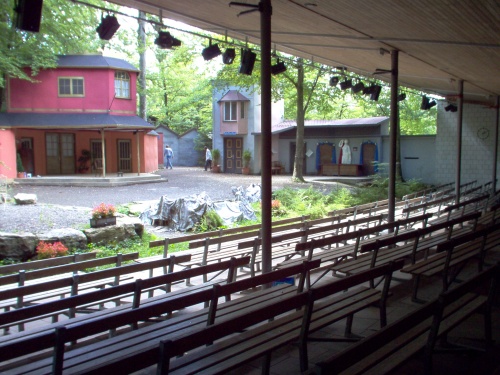
Waldbühne Sigmaringendorf
Other · Sigmaringendorf
Fortress

Sigmaringen Castle (German: Schloss Sigmaringen) was the princely castle and seat of government for the Princes of Hohenzollern-Sigmaringen. Situated in the Swabian Alb region of Baden-Württemberg, Germany, this castle dominates the skyline of the town of Sigmaringen. The castle was rebuilt following a fire in 1893, and only the towers of the earlier medieval fortress remain. Schloss Sigmaringen was a family estate of the Swabian Hohenzollern family, a cadet branch of the Hohenzollern family, from which the German Emperors and kings of Prussia came. During the closing months of World War II, Schloss Sigmaringen was briefly the seat of the Vichy French Government after France was liberated by the Allies. The castle and museums may be visited throughout the year, but only on guided tours. It is still owned by the Hohenzollern-Sigmaringen family, although they no longer reside there.
Sigmaringen is located on the southern edge of the Swabian Jura, a plateau region in southern Baden-Württemberg. The Hohenzollern castle was built below the narrow Danube river valley in the modern Upper Danube Nature Park (German: Naturpark Obere Donau ). The castle rises above the Danube on a towering chalk projection that is a spur of the white Jura Mountains formation. The hill is known simply as the Schlossberg or Castle Rock. The Schlossberg is about 200 meters (660 ft) long and up to 35 meters (115 ft) above the river. On this free-standing towering rock, the princely Hohenzollern castle is the largest of the Danube valley castles. The sheer cliffs and steep sides of the tower made it a natural site for a well-protected medieval castle.
The first castle at Sigmaringen appeared during the end of the Early Middle Ages, during the early 11th century. The castle was first mentioned in 1077 following the unsuccessful siege of Burg Sigmaringen by Rudolf of Rheinfelden in his fight against the King of Germany, Henry IV. In 1083 a pair of brothers, Ludwig and Manegold von Sigmaringen, are listed as witnesses on a document for the Königseggwald abbey.
Ludwig von Sigmaringen was married to Richinza von Spitzenberg, daughter of Berthold I. von Zähringen. At the end of the 11th century he built a castle on the Spitzenberg at Kuchen, Germany. The castle and the surrounding land and villages were part of the inheritance of Richinza. From their marriage Richinza and Ludwig had four children; Mathilde von Spitzenberg, the wife of Aribo von Wertingen, the clergyman Ulrich von Sigmaringen, Ludwig II von Sigmaringen-Spitzenberg and Manegold von Sigmaringen-Spitzenberg. The three brothers, Ulrich, Ludwig and Mangold von Sigmaringen are named as the founders of the 11th-century St. George's Abbey in the Black Forest.
From 1133 until 1170 Rudolf von Sigmaringen-Spitzenberg, the son of Ludwig II, ruled at Sigmaringen. In 1183 Graf Ludwig von Sigmaringen-Spitzenberg- Helfenstein, the son of Rudolf, is mentioned at the castle. In 1147 Ludwig as well as his father Rudolf and brother Ulrich II von Sigmaringen-Spitzenberg are mentioned in a document of Walter von Dillingen, Prince-Bishop of Augsburg, as lords of Spitzenberg-Sigmaringen.
Under the Helfenstein family, until 1290
Under the Helfenstein family, the castle was renovated around 1200. The castle was totally rebuilt with buckel stones (squared-off stones with a rounded outer surface). Between 1209 and 1258 the castle was occupied by Graf Gottried von Sigmaringen-Helfenstein and his son Graf Gebhard von Sigmaringen-Pietengau. In 1258 the cousin of Graf Gebhard, Graf Ulrich II. von Helfenstein, became the owner of Burg Sigmaringen. Later, Ulrich's daughter Agnes married Graf Ulrich I. von Montfort. Following the marriage in 1272, Sigmaringen was owned by the Counts of Montfort. Then, in 1290 Graf Hugo V. von Montfort, son of Ulrich I, sold the castle and the city of Sigmaringen to Albrecht and Rudolf von Habsburg.
By 1325 Duke Luipold von Habsburg had sold the castle and the county of Sigmaringen to the Count of Württemberg.
Finally in 1399 Count Eberhard von Württemberg granted the castle and county of Sigmaringensein as well as the county of Veringen in Margraviate of Austria, to his uncle and liegeman Count Eberhard III. von Werdenberg (1387–1416) as a fief. His son Count Johann IV. von Werdenberg (1416–1465) and his wife Countess von Württemberg (disinherited by the House of Württemberg ), in 1459 inherited the castle and county of Sigmaringen. To protect his land, in the following year he declared Sigmaringen an Austrian fief. From 1460 until 1500 the Counts von Werdenberg renovated the Burg (a military fortress) into Schloss Sigmaringen (a fortified residence), and expanded it to the dimensions which remain today. Toward the end of the 15th century they built two long, angular buildings in the north east. Then, in the early 16th century another wing was added to the west. The two round towers that flank the entrance to the castle also date from this time
Hugo IX. zu Sigmaringen (1459–1508), son of Johann IV., died without any male offspring. His sister Anna von Werdenberg married Count Friedrich von Fürstenberg in 1516.
In 1521 Christoph (1494–1534), together with his brothers Johann VI. and Felix I. von Werdenberg, was granted the fief of Sigmaringen from Emperor Charles V. Count Christoph married, after his first marriage to Eleonore Gonzaga remained childless, Johanna von Bröseln, widow of the Count Eitel Friedrich III. von Hohenzollern in 1526. All of his children died, except for his daughter Anna, who married Friedrichs II. von Fürstenberg.
According to the Zimmern Chronicle in 1530, as Count Felix I was in the bath house with Leonora Werdenberg (the illegitimate daughter of Hugo IX and the mistress of Felix and Christoph von Werdenberg) a fire broke out. The bath house fire was allowed to spread, leading to a fire which raged throughout the outbuildings around the castle.
In 1534, following the death of the last male member of the Werdenberger family, Count Friedrich von Fürstenberg demanded the Werdenberger lands. However, King Ferdinand I granted the fief of Sigmaringen and Veringen, in 1535, to Charles I of Hohenzollern (1516–1576), the son from Johanna von Bröseln's first marriage with Friedrich III. von Hohenzollern.
The Hohenzollern and Hohenzollern-Sigmaringen families, 1535–1850
In 1539 there was another fire that damaged the castle.
A year later, in 1540, Sigmaringen and Veringen were transferred to the House of Hohenzollern as part of the Pfullendorf agreement (German: Pfullendorfer Vertrag ). Count Charles I. von Hohenzollern occupied the castle.
Charles II. von Hohenzollern-Sigmaringen (1547–1606), son of Charles I was the count of Sigmaringen from 1576 until 1606. He was also the founder of the Hohenzollern-Sigmaringen line of the Hohenzollern family. Under Charles II the castle was renovated. Between 1576 and 1606 the gatehouse was expanded to cover the entrance to the castle and a new church was built near the castle.
In 1576 the House of Hohenzollern split into four lines, Hohenzollern (died out in 1602), Hohenzollern-Haigerloch (absorbed by Hohenzollern-Sigmaringen after 1630), Hohenzollern-Hechingen (died out in 1869) and Hohenzollern-Sigmaringen. Sigmaringen was the main residence of the Hohenzollern-Sigmaringen family from 1576 until 1850.
Johann von Hohenzollern-Sigmaringen (1578–1638), the son of Charles II was the count of Hohenzollern-Sigmaringen from 1606 until 1623. Then in 1623 the family was promoted from Count (German: Graf ) to the rank of Princes of the Holy Roman Empire (German: Reichsfürst ). Johann then became the first prince (German: Fürst ) of Hohenzollern-Sigmaringen.
During the Thirty Years' War, the castle was besieged by Swedish troops in 1632, and retaken by the Imperial troops in the following year. During the attack by Imperial troops under General Horn, the eastern section of the castle was destroyed by fire.
Closest places in our Germany guide.
More places to explore in Germany.