Germany
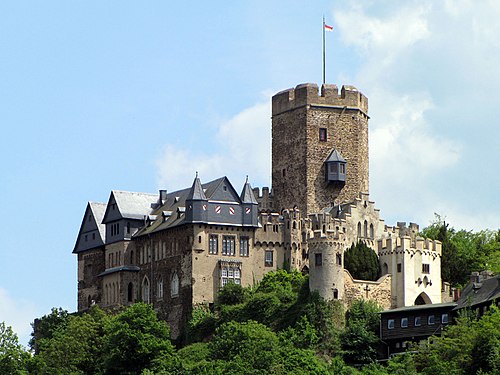
Lahneck Castle
Fortress · Oberlahnstein
Large district town

Lahnstein (German pronunciation: [ˈlaːnʃtaɪn] ) is a verband-free town of Rhein-Lahn-Kreis in Rhineland-Palatinate, Germany. It is situated at the confluence of the Lahn with the Rhine, approximately 6 kilometres (3.7 mi) south of Koblenz. Lahnstein was created in 1969 by the merger of the previously independent towns of Oberlahnstein (or Upper Lahnstein) on the south side of the Lahn (above the river mouth) and Niederlahnstein on the north side (below the river mouth). In 2020, it had a population of 18,030. Situated on the heights of the foothills of the Westerwald and the Taunus, Lahnstein is considered a fresh-air spa city with spa facilities and thermal baths. It is also the seat of a district court. In religious affairs, it is assigned to the Roman Catholic Diocese of Limburg and to the Evangelical Church in Hesse and Nassau. Because of its strategic importance on the Rhine, Lahnstein was heavily fortified. Many old gates and towers still demonstrate its importance in the Middle Ages. Lahneck Castle, situated high above Oberlahnstein, was built between 1240 and 1245 and served as a residence of the Archbishop-Electors of Mainz. Other sights in Lahnstein include Martinsburg Castle...
- Rail Lahnstein is located on the right side of the Rhine line and the Lahntal railway. Lahnstein has three railway stations, Oberlahnstein, (Environmental Train Station) Niederlahnstein and Friedrichssegen.
- Road Lahnstein is connected on the right side of the Rhine with the Federal Roads 42 and 260.
- Bridges The Lahn Lahn Valley can be crossed by the Lahn bridge (B 42), Rudi Geil Bridge between Ober- and Niederahnstein, the Lahn bridge Friedrichssegen and two railway bridges.
- Waterways Rhineships dock on in Oberlahnstein and Niederlahnstein
The annual rainfall is 673 mm. The rainfall is in the middle third of the recorded values in Germany. The driest month is February, the wettest June. In June fall 2.1 times more rainfall than in February. The rainfall varies moderately.
- Rail Lahnstein is located on the right side of the Rhine line and the Lahntal railway. Lahnstein has three railway stations, Oberlahnstein, (Environmental Train Station) Niederlahnstein and Friedrichssegen.
- Road Lahnstein is connected on the right side of the Rhine with the Federal Roads 42 and 260.
- Bridges The Lahn Lahn Valley can be crossed by the Lahn bridge (B 42), Rudi Geil Bridge between Ober- and Niederahnstein, the Lahn bridge Friedrichssegen and two railway bridges.
- Waterways Rhineships dock on in Oberlahnstein and Niederlahnstein
The annual rainfall is 673 mm. The rainfall is in the middle third of the recorded values in Germany. The driest month is February, the wettest June. In June fall 2.1 times more rainfall than in February. The rainfall varies moderately.
Based on archeological evidence, settlement in Lahnstein dates to the Late Stone Age (4000 to 1800 BC), continuing through the Bronze Age and Iron Age.
Around c. 369–370 AD, the Romans built a burgus (or watch tower ) at the mouth of the Lahn on the site of present-day Niederlahnstein. It served the Rhine border fortifications and acted as a sentry for the fortress at Koblenz ( Latin : Castellum apud Confluentes ). It was this tower made of stone, which was called the "fortified house on the Lahn" ( Latin : domus fortis supra Lonetam ) in the Middle Ages, that gave the town its name. Traces of the Roman Limes Germanicus, the border fortifications built to safeguard the Empire from the Germanic tribes, still exist today about 8 km (5 mi) from the town in the Oberlahnstein city forest.
In the Carolingian Empire, the Lahn formed the border between two provinces (or gaus ). Niederlahnstein belonged to the Engersgau, while Oberlahnstein was part of the Rheingau.
Around 900 AD, the Frankish Salhof of Oberlahnstein came into the possession of the Archbishopric of Mainz. Under Archbishop Siegfried III of Eppstein, Mainz acquired the rest of town of Oberlahnstein in 1220. The documents also mention a nearby silver mine at a Diefendal Mountain. Siegfried had Lahneck Castle built in 1226 to protect these territories, which were Mainz's northernmost exclave (in religious matters, Oberlahnstein was under the Archbishopric of Trier ).
In 1298, Mainz built a customs castle on the Rhine in Oberlahnstein. In 1324 Holy Roman Emperor Louis the Bavarian gave Oberlahnstein town rights. The construction of the town fortifications dates to this time.
In 1018, the Castle "Lohenstein/Logenstein/Lainstein" (the former Roman burgus) at Niederlahnstein came into the possession of the Archbishopric of Trier. Niederlahnstein received town rights in 1322. In 1348, the Archbishopric of Trier built a customs tower there on the Lahn.
On 4 June 1400, King Wenceslaus of Germany was called by the four Rhenish Prince-electors to appear before them in Oberlahnstein to answer charges of failing to maintain the public peace. Together with his overlord the Prince-Elector of Mainz, the Burggraf of Lahneck Castle, Friedrich of Nuremberg, hosted many of many delegates sent by the cities at the castle. When Wenceslaus failed to appear, the electors declared him deposed in August 1400 on account of drunkenness and incompetence. In Rhens, the following day, Rupert, Count Palatine of the Rhine, was elected the new " King of the Romans ".
Between 1632 and 1646, during the Thirty Years War, both towns experienced multiple occupations by Swedish, Imperial, Hessian and French troops. In 1688, Lahneck Castle was destroyed and burned by French troops. Between 1795 and 1800, during the French Revolutionary Wars, both towns again experienced multiple occupations by foreign troops (Austrians, Prussians, French and Russians).
In the German mediatisation of 1803, Oberlahnstein came into the possession of Nassau-Usingen, while Niederlahnstein fell to Nassau-Weilburg. In 1806, the independent Nassau principalities were united in the Duchy of Nassau.
Closest places in our Germany guide.
More places to explore in Germany.