Germany
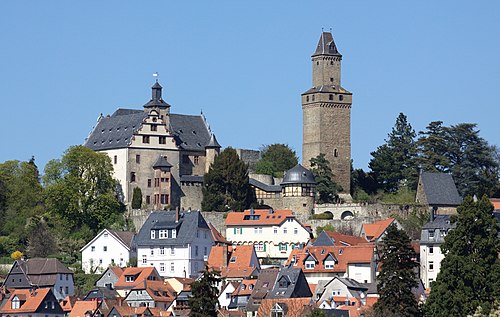
Falkenstein Castle
Castle ruin · Königstein im Taunus
Town

Königstein im Taunus (German pronunciation: [ˈkøːnɪçʃtaɪn ʔɪm ˈtaʊnʊs], lit. 'Königstein in the Taunus') is a spa town that lies on the thickly wooded slopes of the Taunus in Hesse, Germany. The town is part of the Frankfurt Rhein-Main urban area and belongs to the Hochtaunuskreis district. Neighbouring places are Kronberg im Taunus, Glashütten, Schwalbach am Taunus, Bad Soden am Taunus and Kelkheim.
Königstein is neighbouring the municipalities of Glashütten, Schmitten, Oberursel, and Kronberg inside the Hochtaunuskreis district. From the south-west to the south-east it borders the municipalities of Schwalbach, Bad Soden and Kelkheim in the Main-Taunus-Kreis district.
Königstein consists of four parts, the city centre, Falkenstein, Mammolshain and Schneidhain. Since 2001, Falkenstein has borne the designation Heilklimatischer Kurort (spa town) independently of the complete town's status as such.
The town's founding date is unknown. The name 'Königstein' means 'King stone'. Local legend states that King Chlodwig (466–511) founded the town after building a castle on a hill, as well as a chapel.
Königstein was first mentioned in a document in 1215, making it likelier that the castle was built around the 12th century for the town's – and the Frankfurt- Cologne commercial road's – security.
Also in that time came the town's first lords, the Counts of Nürings, but they were supplanted in 1239 by the Lords of Hagen-Münzenberg into whose ownership the castle went as an Imperial fief. The Lords of Hagen-Münzenberg were in turn followed by the Lords of Bolanden-Falkenstein from 1255 to 1418, under whose rule Königstein was granted town rights in 1313. The Lords of Bolanden-Falkenstein were succeeded by the Lords of Eppstein, who were followed by the Counts of Stolberg in 1535, introducing the Reformation to the area.
By 1581, Königstein belonged to the Electorate of Mainz, which had incorporated the old County through a legal dispute. Early in the 17th century, in connection with the Counterreformation, the castle was remodelled into a fortress. However, this newer military stronghold met its end in the French Revolutionary Wars when the French blew it up in 1796, although this may have been unintentional.
In 1803 Königstein passed to the Principality of Nassau-Usingen, which itself later merged with Nassau-Weilburg to form the Duchy of Nassau. By 1866 it was in Prussian hands, and since 1945 it has been part of Hesse. The three constituent municipalities Falkenstein, Mammolshain and Schneidhain were amalgamated with Königstein as part of Hesse's municipal reforms in 1972.
Königstein enjoyed an economic upswing from less wealthy times when the coldwater spa first opened in 1851. It reached its high point just before the First World War broke out. The designation Heilklimatischer Kurort was granted in 1935.
Jewish health resort and summer residence
Königstein was regarded as a "Jewish spa" – especially in the era of National Socialism – mainly due to the high proportions of Jewish guests (for example Otto Klemperer, Kurt Hahn, Carl Sternheim, Botho Graef, Reinhold Lepsius ), who stayed in the Sanatorium Dr. Kohnstamm and Hotel Cahn, which offered kosher food. For these reasons, Königstein was an attractive city to visit for a day trip for many Jews in Frankfurt. Königstein became even more easily accessible from Frankfurt am Main in 1902, when the railway between Königstein and Frankfurt was built.
Königstein was also the residence of prominent Jewish citizens (for example Mathilde Hannah von Rothschild, Sigmund Kohn-Speyer, L. Albert Hahn, Hermann Wronker, Albert Katzenellenbogen, Julius Blau, Max Neisser, Adolf Sabor, Selmar Spier, the family of Richard Musgrave ), who in turn brought their friends and guests. The poet Stefan George often visited his school friend Oskar Kohnstamm, and then after Kohnstamm's death in 1917 (and the sale of Kohnstamm's sanatorium) moved to Königstein to be near his sister, Anna George. In her apartment, he received members of the George-Kreis. George's and Kohnstamm's school friend Karl Wolfskehl had contacts to the Sanatorium Dr. Amelung, whose director had been a friend of Oskar Kohnstamm.
Carl Frankl (also Jewish) was the owner of the renowned Kohnstamm sanatorium from Kohnstamm's death in 1917 until 1938. Carl was a brother of the World War I fighter pilot Wilhelm Frankl (his brother Wilhelm had converted from Judaism to Christianity in order to marry his high school sweetheart). While in 1937, 24 hotels, hostels and guest houses still refused to comply with Nazi law and accepted Jewish guests, the following year, in 1938, all 54 hotels, hostels and guest houses in Königstein added the following sentence to their advertisements: "All the guest houses are run Jew-free."
In 1938 public discussions arose about keeping the name of the Sanatorium Dr. Kohnstamm or aryanizing it. Königstein's mayor preferred changing the name and commented that (should the name be kept) "the reputation of Königstein as "Jews' resort" would yet again be cemented in an irreparable way".
Even after the Holocaust famous Jewish people settled in Königstein. Thus, e.g. Max Dessoir moved here for his retirement (he had previously lived once before in the "Sanatorium Amelung"), as did publisher Samuel Fischer 's wife Hedwig Fischer (née Landshoff). Paulette Goddard, Charlie Chaplin 's wife, was a famous visitor of Königstein after World War II.
Königstein was regarded as a "Jewish spa" – especially in the era of National Socialism – mainly due to the high proportions of Jewish guests (for example Otto Klemperer, Kurt Hahn, Carl Sternheim, Botho Graef, Reinhold Lepsius ), who stayed in the Sanatorium Dr. Kohnstamm and Hotel Cahn, which offered kosher food. For these reasons, Königstein was an attractive city to visit for a day trip for many Jews in Frankfurt. Königstein became even more easily accessible from Frankfurt am Main in 1902, when the railway between Königstein and Frankfurt was built.
Königstein was also the residence of prominent Jewish citizens (for example Mathilde Hannah von Rothschild, Sigmund Kohn-Speyer, L. Albert Hahn, Hermann Wronker, Albert Katzenellenbogen, Julius Blau, Max Neisser, Adolf Sabor, Selmar Spier, the family of Richard Musgrave ), who in turn brought their friends and guests. The poet Stefan George often visited his school friend Oskar Kohnstamm, and then after Kohnstamm's death in 1917 (and the sale of Kohnstamm's sanatorium) moved to Königstein to be near his sister, Anna George. In her apartment, he received members of the George-Kreis. George's and Kohnstamm's school friend Karl Wolfskehl had contacts to the Sanatorium Dr. Amelung, whose director had been a friend of Oskar Kohnstamm.
Carl Frankl (also Jewish) was the owner of the renowned Kohnstamm sanatorium from Kohnstamm's death in 1917 until 1938. Carl was a brother of the World War I fighter pilot Wilhelm Frankl (his brother Wilhelm had converted from Judaism to Christianity in order to marry his high school sweetheart). While in 1937, 24 hotels, hostels and guest houses still refused to comply with Nazi law and accepted Jewish guests, the following year, in 1938, all 54 hotels, hostels and guest houses in Königstein added the following sentence to their advertisements: "All the guest houses are run Jew-free."
In 1938 public discussions arose about keeping the name of the Sanatorium Dr. Kohnstamm or aryanizing it. Königstein's mayor preferred changing the name and commented that (should the name be kept) "the reputation of Königstein as "Jews' resort" would yet again be cemented in an irreparable way".
Even after the Holocaust famous Jewish people settled in Königstein. Thus, e.g. Max Dessoir moved here for his retirement (he had previously lived once before in the "Sanatorium Amelung"), as did publisher Samuel Fischer 's wife Hedwig Fischer (née Landshoff). Paulette Goddard, Charlie Chaplin 's wife, was a famous visitor of Königstein after World War II.
Closest places in our Germany guide.
More places to explore in Germany.