.jpg?width=1200)
Australia
Richmond Park
Park · New South Wales
Heritage site

Toxana is a heritage-listed residence and initial premises of the Hawkesbury Agricultural College (1891-1896) at 147 Windsor Street, Richmond, City of Hawkesbury, New South Wales, Australia. It was added to the New South Wales State Heritage Register on 2 April 1999.
The lower Hawkesbury was home to the Dharug people. The proximity to the Nepean River and South Creek qualifies it as a key area for food resources for indigenous groups. The Dharug and Darkinjung people called the river Deerubbin and it was a vital source of food and transport.
Governor Arthur Phillip explored the local area in search of suitable agricultural land in 1789 and discovered and named the Hawkesbury River after Baron Hawkesbury. This region played a significant role in the early development of the colony with European settlers established here by 1794. Situated on fertile floodplains and well known for its abundant agriculture, Green Hills (as it was originally called) supported the colony through desperate times. However, frequent flooding meant that the farmers along the riverbanks were often ruined.
John Bowman (1763-1825) arrived in NSW in 1798 and settled at Richmond, farming the property "Archerfield" which he received as a grant of 100 acres on 8 April 1799. He came from England as a free settler under certain encouraging conditions.
Bowman quickly identified himself with the cause of free settlers on the Hawkesbury, opposing the monopolistic practices of the New South Wales Corps and supporting stable government as administered by Governors William Bligh and Lachlan Macquarie. The settlers submitted various petitions and addresses from time to time to the Governors, particularly to Bligh, and even wrote to Viscount Castlereagh, Colonial Secretary in England, plainly stating their case against the military faction. Their efforts were rewarded by the instructions given to Macquarie to give help and encouragement to the smaller settlers, and by the decline of the influence of the military during his governorship.

After Bligh was deposed by the Rum Rebellion, the Hawkesbury settlers still persisted in supporting the deposed Governor and stating their claims, and fourteen of them, including Bowman, sent off the 1809 memorial to Viscount Castlereagh stating that they had no hand in the rebellion.
Under Macquarie, who replaced Bligh from 1 January 1810, the colony prospered. He implemented an unrivalled public works program, completing 265 public buildings, establishing new public amenities and improving existing services such as roads. In December 1810, he proclaimed the five Macquarie Towns in the Hawkesbury Region, including Richmond. As a result, the locality became more permanent, with streets, public buildings, and a town square ( Richmond Park ).
When Macquarie had brought stability to the colony, and regained respect for the administration, Bowman concentrated on farming pursuits.
John Bowman was promised land (the site that would become Toxana) by Macquarie. In 1821 he commenced building a house on Richmond's main street, now 367 Windsor Street. He died on 16 December 1825, and left his house to his son, George Bowman, who lived until 1878 and concerned himself with farming and grazing stock on the Hunter River, as well as with public affairs, being elected to the new Parliament of New South Wales in 1851.
John and Honor Bowman had four children and their son William is listed in the 1828 census as having 300 acres at Richmond, with 137 of these cleared and 130 cultivated. He also had four horses and two horned cattle at this time.
In the 1830s William Bowman (the fourth and youngest child of John) became interested in the promotion of free immigration to the colony. He left for a two-year visit to England in 1836, and married Elizabeth Arthur there. In 1837, to sponsor immigrants, he signed an agreement with John Marshall, captain of the ship City of Edinburgh, to pay for the passage of twelve married couples from London to Sydney.
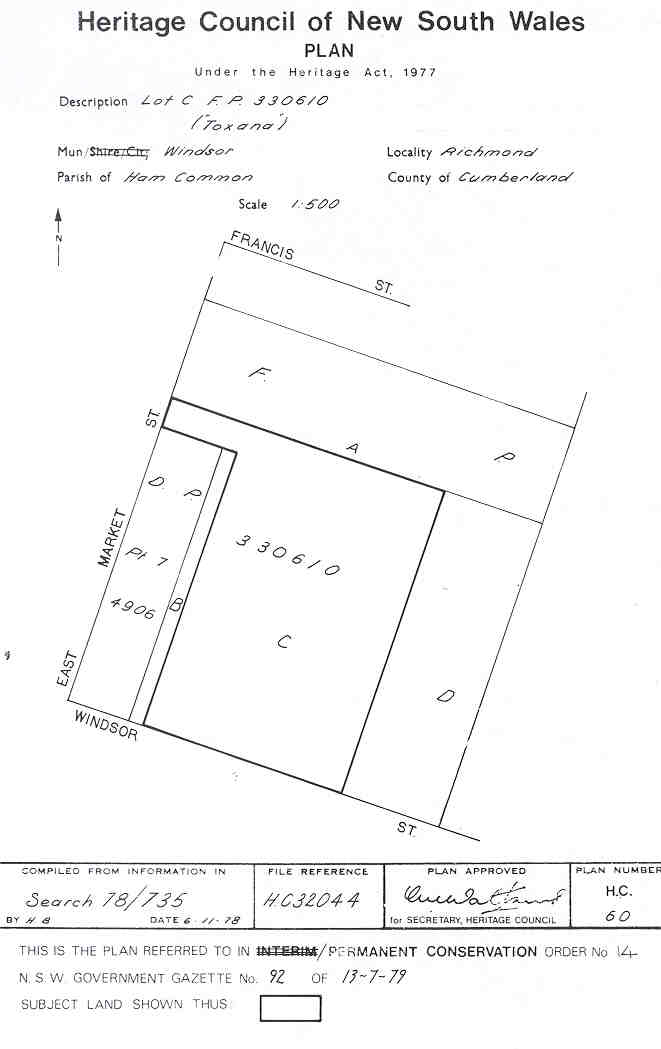
William Bowman was granted the site of Toxana, in Windsor Street, Richmond between Market and Toxana Streets, c. 1830s. H. F. White's 1836 survey of Richmond shows six buildings on Bowman's land, all of which pre-date Toxana. A garden and a series of sheds were shown on the future site of Toxana. Toxana's construction dates are the subject of conflicting sources, but the building's heritage listing notes that recent research suggests its construction dates were probably 1843-4.
There is some dispute as to the identify of Toxana's builder, some claiming it was (carpenter) George Marlin and others asserting brick layer James Melville was the builder. Sam Boughton writing under pseudonym of "Cooramil" in the early 20th century claimed that George Marlin built it after coming under contract from England with his family. Marlin and family settled in Richmond afterwards. George C Johston writing under pseudonym "Cooyal" disputed whether it was built by Marlin and claimed the builder was James Melville. Johnston had heard from Melville himself that he had done the brickwork on Toxana and seen Melville's receipts for sand and other materials for the work. "Cooramil" replied agreeing Melville completed the brickwork, and remembered him working there. It appears that about 1842, James Melville and George Martin/Marlin (who had done the carpenter's and joiner's work with his three sons George Jr., Phil and Jack) erected Toxana for Bowman.
William Bowman, along with his older brother George, played a major role in the development of the district, involved in pastoralism and farming and prominent in public affairs. He also owned several properties in the Bathurst district and was involved in wine-growing. Toxana was a substantial town house erected at the height of the 1840s boom before depression meant straitened circumstances for many of the pastoral elite of the colony. It represents an expression of optimism in a time of boom.
William Bowman died at Richmond on 11 December 1874 and is buried in St Peter's graveyard. The property was left to his wife Elizabeth, who lived there until her death on 25 November 1885. It passed to Ann Catherine Cadell, widow of Thomas Cadell. On 5 January 1881 Cadell (of Mullanmuddy, near Mudgee ) mortgaged her life estate under Bowman's will to Thomas Forster Knox of Sydney and Henry Edward Augustus Allan, merchant of Sydney for 3 years. This included various land parcels, but not Toxana. There were doubts whether it did include Toxana in some later legal transactions.

Eliza Sophia Cameron, née Bowman, wife of Rev. James Cameron died on 27 January 1886. In that year Ann Cadell agreed to sell Toxana and 8 acres of land in Windsor Street to Rev. Cameron for 5000 pounds if she could get the agreement of all the children affected. This was done and she signed a conveyance of the land on 17 June 1886. The land consisted of two lots: the first 4 acres 3 roods 24 perches on which Toxana sat and the second was part of lot 2 section 11.
Toxana became the property of the Rev. James Cameron (bought in 1886, releasing the mortgage from Cadell). He was later Moderator-General of the Presbyterian Church in Australia.
Photographs from 1888 show the front of Toxana obscured by a large jacaranda ( Jacaranda mimosifolia ) tree on the eastern side and an even larger pair of trees on the western side - these appear to be a silky oak ( Grevillea robusta ) and a Southern nettle tree/ hackberry ( Celtis australis ). The front fence at this time was a low masonry wall, with stone pillared gate posts; a wrought iron and "crinkle wire" gate; and low wrought iron balustrade (possibly infilled with wire mesh) atop the masonry wall - the whole below 1m high.
In 1891 it was leased by the newly set up Hawkesbury Agricultural College to provide temporary accommodation for its students, who (25 students originally) took up occupation on 10 March 1891. The College was officially opened on 16 March 1891, a photo shows the Ministerial party and others on Toxana's front steps. An 1891 photo showing the view up Windsor Street from Toxana's upper verandah showed some details of its timber picket, apparently white fence, and what appear to be two Mediterranean cypresses ( Cupressus sempervirens ) in the front western-half garden.
Meals were served in the basement and lectures held in the eastern front verandah room. The rest of Toxana was used for student accommodation. In 1892 meals were taken at Toxana (soon known as the No. 1 College) in the large double first floor room, whilst the front half of that room was used as the first lecture room. The college's work horses were housed in the stables behind Toxana. The College's Ayrshire bull was kept in the "Toxana paddock" and a rough dairy operated in old sheds behind Toxana, where primitive conditions hampered production, halted the manufacture of cheese most of the time and blighted students with fleas. In October 1891 some students moved out of Toxana into Towns' house known as No. 2 College). In 1896 all students moved into the purpose-built college erected on the College site in Ham Common (south-east of the town).
Closest places in our Australia guide.
More places to explore in Australia.
.jpg?width=1200)


.jpg?width=1200)
.jpg?width=1200)
.jpg?width=1200)
.jpg?width=1200)
.jpg?width=1200)


