
Australia
St John the Evangelist Church, Wallerawang
Church building · New South Wales
Heritage site
.jpg?width=1200)
Raffan's Mill and Brick Bottle Kilns is a heritage-listed lime kiln at Carlton Road, Portland, New South Wales, Australia. It was built from 1884 to 1895 by George Raffan and Alexander Currie. It is also known as Raffan's Mill and Brick Bottle Kilns Precinct, Portland Cement Works Site, Williwa Street Portland. The property is owned by Boral. It was added to the New South Wales State Heritage Register on 3 August 2012.
Aboriginal occupation of the Blue Mountains area dates back at least 12,000 years and appears to have intensified some 3000–4000 years ago. In pre-colonial times the region around Portland was inhabited by Aboriginal people of the Wiradjuri linguistic group. European settlement in this region after the first documented white expedition west of the Blue Mountains in 1813 was tentative, largely because of concerns about resistance from Aboriginal people. There was contact, evidenced by sporadic hostility and by the quantity of surviving artefacts manufactured by the Aborigines from European glass. By 1840 there was widespread dislocation of Aboriginal culture, aggravated after 1850 by the gold rush to the region.
Jack Reed, a long-time resident of Portland, recalls how, as a child in the 1930s, he used to go hunting with two Aboriginal men named Jack and Jimmy. He estimated their birthdates as c.1890 and their visits to Portland as quite frequent. As part of the day these men would visit rock engravings (since removed) but never allow Jack to go near them. Neither spoke much English and both hunted with spears and boomerangs. While staying at Portland they camped close to the dam near the Portland Golf Course. Jack also remembers occasional groups of Aboriginal people coming to Portland to hold corroborees for the town's people.
The NSW National Parks & Wildlife Service register lists 19 Aboriginal sites in the immediate area of Portland, typically rock shelters or expanses of rock with archaeological deposits and sometimes with art and / or axe-grinding grooves, open sites with scatters of stone artefacts and carved trees. In 1982 two sites containing scatterings of stone artefacts were discovered in East Portland during an archaeological survey of the Ivanhoe Colliery for Blue Circle Southern Cement Ltd but these sites were not conserved for various reasons. There have been no Aboriginal sites associated with the Portland Cement Works and Quarries Site.
Portland and cement manufacture in Australia
In 1824 Portland cement had been developed in England by Joseph Aspdin, who named it after a pale grey coloured rock associated with Portland, England. Portland Cement is made by mixing limestone with either clay or shale in the right proportions and then burning the mixture at 1,100–1,200 °C (2,010–2,190 °F), a point at which the mixture begins to fuse. The resulting clinker is then ground to produce cement. Portland cement was a far superior building product and it caught on quickly in Europe and especially Germany but was infrequently used in Australia before the end of the 19th century. There is a reference in Australia that locates the earliest experiments with Portland cement at the Portland site in NSW in 1884 by the Cullen Bullen Lime & Cement Company.
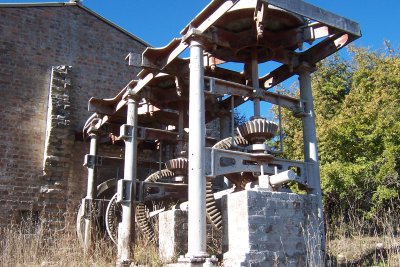
In 1863 Thomas Murray first used the Portland site for lime extraction and production. During the 1880s, Currie and Raffan with others bought Portion 52 and formed the Cullen Bullen Lime & Marble Works. By 1889, the Cullen Bullen Lime & Marble Works had become the Cullen Bullen Lime & Cement Company and was producing Portland cement under the brand name of "Kangaroo". The cement was of variable quality and intermittent and production ceased in 1895. The only remnants of cement production from this era are the two bottle kilns in the northwest corner of Portion 52 and the old brick building known as 'Raffan's Mill'. In 1895 the Cullen Bullen Lime & Cement Company failed and was taken over by one of the original partners, George Raffan, and his brother John, who opened the Ivanhoe Lime and Cement Works & Colliery. In 1898 the Ivanhoe Lime and Cement Works & Colliery also failed. In 1899 these pioneering industrialists sold out to the (British-owned) New Zealand Mines Trust through their agent Dr August Scheidel who bought the land, plant, and leases. Scheidel, who "is considered the father of the modern cement industry in Australia", was born in Heidelberg and received his Ph.D. from Freiberg University in 1880. He obtained backing for an investment of £100,000 to build a cement production plant, which became the most successful cement manufacturing plant in Australia, and of which he remained Managing Director until 1918.
The Cullen Bullen Lime & Cement Company plants on the Portland site used eight static charge (bottle-shaped) kilns with millstone grinding, powered by a small steam plant. As high temperatures were necessary, the open end was of small diameter and chimney-shaped to conserve heat and to induce greater draught through the kiln. Layers of limestone, shale, and timber were hand-packed in each kiln, leaving space for a flue. The doors were then sealed and the kilns fired. The resulting batch of clinker was then removed. Two of these early bottle kilns – built of brick with iron ties and turnbuckles – and the milling plant in the northwest corner of Portion 52 stand as historical monuments to the beginning of the cement industry in NSW.
Timeline for Raffans Mill and the Bottle Kilns at the Portland Cement Works Site
- 1828 – MacPherson family took up a grant of 259 hectares (640 acres) and then another 259 hectares (640 acres) in 1832. The name Limestone Flat was associated with their property and they apparently used limestone found on their property in the building of their home(since demolished?).

- 1863 – Thomas Murray was granted 24 hectares (60 acres) (bought from Lawson?), Portion 52 in the parish of Cullen Bullen, County of Roxburgh. He built two lime kilns on the property sometime after 1869.
- 1882 – Alexander Currie and George Raffan became the owners of Portion 52 in August.
- 1887 – Currie and Raffan with others formed the Cullen Bullen Lime & Marble Works, which bought Portion 52 in this year.
- 1889-1895 – The Cullen Bullen Lime & Marble Works had become the Cullen Bullen Lime & Cement Company by this date. The company produced cement under the brand name of "Kangaroo". The cement was of variable quality and only produced intermittently on site until production ceased in 1895. The only remnants of cement production from this era are the two bottle kilns in the north-west corner of Portion 52 and the old brick building known as "Raffan's Mill".
- 1894 – Village of Portland gazetted, to the south of the cement company's lease, with 200 people recorded as living in the area.

- 1895 – The Cullen Bullen Lime & Cement Company failed and was taken over by one of the original partners, George Raffan and his brother John, who opened the Ivanhoe Lime and Cement Works & Colliery.
- 1899 – The (British-owned) New Zealand Mines Trust through their agent Dr August Scheidel bought the land, plant and leases from the Raffan brothers. Scheidel, a metallurgist PhD with gold mining experience, obtained backing for an investment of A£ 100,000 to build a cement production plant, of which he remained Managing Director until 1918.
- 1900 – A new company was formed in December, the Commonwealth Portland Cement Company (CPCC) under the guidance of Scheidel, soon installed as Managing Director. Most of the plant was demolished and new works begun, including the installation of a new German Cripps plant.
- 1902-1991 – The site was used as a highly successful, high quality lime quarrying and cement production works, reaching its maximum levels of production in 1928. In the first half of the century it specialised in the "Dry Process" but in the 1940s it switched over to the "Wet Process", again requiring decommissioning of much equipment and substantial renewal of the plant.
- 1940s – The company changed hands to Associated Portland Cement Manufacturers U.K. (APCM). A decision was made to change form "dry process" to "wet process" and the old plant was decommissioned or refitted and a new No.1 Rotary kiln installed in 1951.
Closest places in our Australia guide.
More places to explore in Australia.
.jpg?width=1200)

.jpg?width=1200)
.jpg?width=1200)


.jpg?width=1200)
.jpg?width=1200)
.jpg?width=1200)


