Spain
Castle of La Mota
Fortress · Medina del Campo
Monument

The Church of Santa María Magdalena is a Catholic church located in the Spanish town of Matapozuelos, in the Province of Valladolid, within the autonomous community of Castile and León. It stands as one of the most significant examples of 16th-century architecture in the province. The church dominates the town's historic center with its prominent tower, affectionately known locally as "La Giralda de Castilla" (The Giralda of Castile), evoking comparisons to the tower in Seville. Positioned on a hill within the town center, the church has undergone numerous renovations over the centuries, which have partially altered its original structure, resulting in a monument of distinctive character. Its interior houses one of the finest examples of late Gothic architecture in the province, particularly in the vault covering the presbytery. The church also preserves a rich collection of sculptural and pictorial works in its altarpieces. These qualities led to its designation as a Bien de Interés Cultural ('Asset of Cultural Interest') in 1998.
Evidence of human settlement in the Matapozuelos area dates back to prehistoric times. A notable site is the estate known as "Pico," where the Adaja and Eresma rivers converge, approximately 5 km northeast of Matapozuelos' town center. Today, the Hermitage of the Virgin of Sieteiglesias stands there. Archaeological finds in this area include Celtic and Roman remains, confirming the presence of a Roman mansio named Nivaria. A Roman bridge over the Adaja, part of the route between Valdestillas and Hornillos de Eresma, is still standing.
Following the Muslim conquest of the Iberian Peninsula, the region now known as Tierra de Medina saw the settlement of Berber groups engaged in sheep farming. Evidence of Muslim presence in Matapozuelos is found in the southern outskirts at the site called "Aladín," centered around the dovecote of Doña Vicenta.
The name Matapozuelos appears in historical records as early as the 13th century, mentioned in the Chronicle of Rodrigo Jiménez de Rada in connection with the Battle of Las Navas de Tolosa. At that time, the town, like others in the region, was a small settlement clustered around a Romanesque church.
The size of a church often reflects a town's wealth and status, prompting many communities in the Castilian plateau, including Matapozuelos, to demolish or extensively renovate their churches starting in the 16th century. These reconstructions, primarily in the Baroque style, continued through the 17th and 18th centuries. In Matapozuelos, construction of the new church began in the early 16th century and was not completed until the mid-18th century, as evidenced by the inscription on the Baroque façade: "Year 1767."
The sociocultural and economic conditions in Castile during the church's construction, particularly at the start of the 17th century, were marked by significant demographic decline, leading to the abandonment of many villages and population loss in surviving ones. Combined with the general economic crisis, this explains the interruptions in the church's renovation during the first half of that century.
The Church of Santa María Magdalena is the only place of worship in the pine-forested town of Matapozuelos. It occupies a prominent position on a hill at the southern edge of the town center, at the intersection of roads connecting Medina del Campo to Mojados and Matapozuelos to Olmedo, which form a roundabout encircling the building.
The oldest part of the church is the chancel, a rectangular structure begun in 1544 under the direction of Diego de Segovia. By 1556, construction had stalled, with the vaulting and roofing still incomplete. The vault of the chancel bears a striking resemblance to that of the Church of San Juan Bautista in Santovenia de Pisuerga, designed by Juan de Escalante. While no document confirms Escalante as the designer of Santa María Magdalena's plans, his presence in Matapozuelos in 1563 to oversee construction is recorded.
Work on the lateral naves began in 1567, led by Juan de la Vega, completing the enclosure of the church's sides and opening the so-called "Puerta del Sol" (Sun Gate). Carpenters Juan Gallegón and Pedro de Coca installed a temporary artesonado. Four years later, construction resumed with the building of an initial tower. In 1594, work continued under Francisco de la Maza, aiming to extend the church toward the then-freestanding tower. The structure was covered with wood, and a choir was built, but stability issues with the tower necessitated reinforcing its foundations with ashlar masonry and undertaking extensive repairs.
In the late first third of the 17th century, a partial renovation was proposed, focusing on replacing the wooden roofing of the lateral naves with barrel vaults. In 1652, Nicolás Bueno revised the project, highlighting the need to strengthen the interior columns to support the new vaults' weight. The work was completed two years later, approved by architects Mateo Martínez, Pedro Núñez, and Francisco Cillero. The total cost was 40,000 reales, with plaster decoration paid separately.
Upon completion of the vaulting, the tower's instability became evident. In 1659, an episcopal representative noted that its structure, riddled with cracks, could not support large bells without risking collapse. The representative ordered its demolition and reconstruction using salvaged materials, but this was not acted upon until 1671, when the diocese issued an ultimatum due to the imminent threat of collapse.
Demolition of the tower began, with efforts to preserve materials for the new structure. Construction started in 1681, with Manuel Cillero overseeing the foundation and Francisco de las Heras Cuervo managing the main body by 1683. The project took 27 years, leaving only the tower's covering, temporarily done in wood.
Nearly two decades passed before work on the tower's final stage began. When sufficient funds were available, the church commissioned Matías Machuca, a pivotal figure in the church's history. Machuca completed a double octagonal section with corridors and a lantern in just one year, finalizing the tower. From the outset, locals compared it to Seville's Giralda, as recorded in verses by Nicolás de Velasco Moraleja, a townsman, in the church's record book:
more splendid than the Giralda of Seville."
Machuca's involvement with the church continued. In 1731, he signed a contract for an expansion, but his proposal, which involved demolishing the side walls of the main chapel, was rejected. In 1742, the church turned to José Castander from Medina del Campo, who drafted plans to extend the choir and create a baptistery chapel, stating, "the extension of the choir and chapel for the baptismal font…with the corresponding vaults to be built on the existing stone foundations." This work connected the tower to the main structure. Further additions included a new sacristy on the Epistle side in 1754, built by Fray Antonio de Manzanares, and the main portal's inauguration in 1767, crafted entirely in stone by Andrés Añero.
In the early 20th century, a concrete atrium was built due to the construction of the Medina del Campo - Mojados road, requiring the relocation of the calvary near the portal. The atrium, made of mortar coated with concrete, remains largely unchanged today.
In 1979, efforts began to declare the church a Bien de Interés Cultural (BIC). The process culminated in 1998, when the University of Valladolid, in collaboration with the Real Academia de Bellas Artes de San Fernando, approved its designation as a BIC monument. On July 16, 1998, Decree 144/1998 granted the church and its immediate surroundings this status.
The church exemplifies 16th-century Renaissance architecture, with 17th-century modifications, while incorporating Gothic structural solutions. Its 18th-century tower and portal are distinctly Baroque.
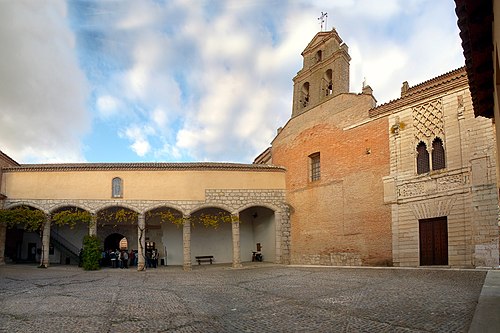
The primary construction material is brick, used in walls and vaults in a manner reminiscent of Mudéjar techniques. Stone appears in arches, supports, and the Baroque portal on the north façade.
In the Diccionario geográfico-estadístico-histórico de España y sus posesiones de Ultramar by Pascual Madoz, the church is described thus:
Closest places in our Spain guide.
More places to explore in Spain.