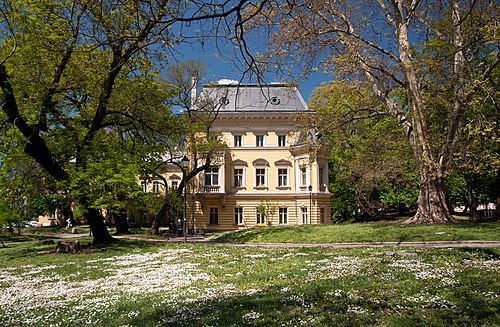
Bulgaria
National Art Gallery of Bulgaria
Art museum · Sofia
Royal palace

The Royal Palace, in fact called Prince's Palace (Bulgarian: Княжески дворец – Knyazheski dvorets) and later Tsar's Palace (Bulgarian: Царски дворец – Tsarski dvorets), is an architectural landmark of national historical and cultural significance, fronting the north side of Battenberg Square, a long, green square in the heart of Sofia, the capital of Bulgaria. Originally built after Bulgaria was made a semi-independent principality of the Ottoman Empire in 1878 to serve as the residence of the first Bulgarian knyaz, Alexander I Battenberg, the building now forms part of the National Gallery. The palace has witnessed the country's transition from monarchy to a socialist people's republic and, ultimately, to today's republican democracy, with its inhabitants playing a pivotal role in Bulgaria's history. Erected in the late 19th century as the royal residence, the palace's architecture blends various styles, with prominent influences from Austrian Neo-Baroque and French Rococo. It was the government headquarters for seven years after the country became a republic. Since 1953 the palace serves as museum compound, housing:
in the northwest wing – the main part of the National Art Gallery...
The location of the royal palace is on top of a hill. Starting from the 16th century, it accommodated the Konak, which served as both the administrative and residential center for the local Ottoman prefect. Unfortunately, the structure was ravaged by a fire in 1816, leading to its destruction. Subsequently, the area lay dormant and unused for an extended period.
Only between 1873 and 1875 a new Konak was erected—a two-story symmetrical building featuring projections at both ends. Below the Konak, dungeons were allocated for confinement. Through underground tunnels, the structure was connected to the nearby places such as the Chelebi Mosque, the Pasha's house, an inn (at the location of the old hotel ‘Bulgaria’).
From Konak to Princely Palace (1879–1887)
During the Russo-Turkish War of 1877–1878, the Konak served as a hospital. The 1878 Treaty of Berlin made Bulgaria an autonomous state, the Principality of Bulgaria, within the Ottoman Empire, with Sofia as capital. Although remaining under Ottoman sovereignty, the principality functioned independently, taking Alexander of Battenberg as its first prince in 1879. The Konak was designated as his official residence.
The National Assembly made funds available to transform the Konak into a princely residence. The building was quickly refurbished by the Russian army, but barely a year after its installation, it became clear that the structure was not suitable to house the prince and his family, who had to move to allow for a complete reconstruction.
From 1880 to 1882, the Austrian architect Viktor Rumpelmayer directed the reconstruction of the old konak, which was almost completely demolished, although the foundations were used to erect the new palace, which was also enlarged with an eastern wing for receptions. Likewise, all the façades were redone following the sumptuous and cosmopolitan Second Empire style with chateauesque connotations. The idea was to give the new princely residence a cosmopolitan air that would symbolize Sofia's transformation from an Ottoman provincial city to the capital of a newly independent state. In the execution of the project, Rumpelmayer was supported by the Austro-Hungarian architects Friedrich Grünanger, Antonín Kolář (also known as Adolf Václav Kolář), Jakob Heinrich Mayer and Leers.
The space were the demolished Konak stood, served as the residence of Prince Alexander I and a place of work, while the new extension of Rumpelmayer was used for parties and receptions and was organized on three floors: the ground floor for administrative functions, the first floor with the grand ballroom, the throne room, the gala dining room and a winter garden; and the second floor or attic for the service. An opening ceremony took place on 26 December 1882, with the advent of the new year 1883 marked by an unprecedented New Year's ball within the palace.
On 20 August 1886, a group of military men unhappy with the outcome of the Serbo-Bulgarian War (1886) stormed the palace and forced the prince to abdicate and then moved him to the border. However, Prince Alexander would return to the capital again, but having lost the support of Russia, he was forced to abdicate definitively on 8 September of the same year.
From Princely to Tsar's palace (1887–1946)
A few months after the fall of Alexander I, the representatives of the Third Great National Assembly, who held a meeting at Tarnovo, offered the throne to Prince Valdemar of Denmark, which he refused. Similarly, the assembly opposed the appointment of Niko I Dadiani, Prince of Mingrelia, proposed by Tsar Alexander III of Russia, as the new prince. On 7 July 1887, to the surprise of the chancelleries and the European courts, the assembly elected Ferdinand I of Saxe-Coburg-Kohary (1861–1948), son of princess Clémentine of Orléans and therefore grandson of the last king of France, Louis Philippe I, as the new prince.
European governments reacted with indifference, such as Austria or the Ottoman Empire, or with open hostility, such as Russia, but, on 7 August, Ferdinand left his castle in Ebenthal in Austria and traveled to Bulgaria. On the 16th he took the oath before the assembly at Tarnovo, and on the 23rd he entered Sofia, amidst the curiosity rather than enthusiasm of its inhabitants.
In the second construction stage, which started in 1894, the east wing of the palace was built, following the prince's wedding to Marie Louise (1870–1899). Viennese architect Friedrich Grünanger oversaw the construction, while sculptor Andreas Greiss was responsible for the decoration, which incorporated elements of Viennese Neo-Baroque and fin de siècle decoration inspired by the Louis XV and Louis XVI styles.
The new wing was completed in 1896 and included new quarters for the princely family, such as a library, reception rooms, a dining room, two winter gardens and a covered porte-cochère. A state-of-the-art electric elevator from the Schindler company was also installed, connecting the ground floor with the first floor. On the first floor were the apartments of Prince Ferdinand, Princess Maria Luisa as well as from the crown prince, the future king Boris III (1894–1943); on the second floor those of prince Kiril (1895–1945) and Princesses Eudoxia (1898–1985) and Nadezhda (1899–1958).
Friedrich Grünanger was supported by a wide range of artists such as the sculptor Andreas Greis and architects Franz Aisler, Anaki Shamardzhiev, Yordan Sevov, and Ivan Vassilov.
The ornate embellishments adorning the entire palace – including parapets on stairs and terraces, decorative grilles, fences, columns, internal stairs, and more – were meticulously crafted by prestigious Viennese firms "Rudolf Filip Wagner" and "Valerian Hillar", along with the renowned German establishment "Ed. Puls" based in Berlin. The metal facing adorning the fireplaces showcased the expertise of the French company A-ne M-on G. Laury. B-te S.G.D.E. à Paris. Furthermore, the opulent oak doors, featuring intricate marquetry designs composed of exotic wood, ivory, brass, silver, and gold, depicting regal crowns and personal princely emblems, were proudly marked with the insignia of the esteemed firm "Franz Michel" from Vienna.
Despite all these additions, the palace maintained a compact volume, with comfortable and well-thought-out internal communications, which allowed easy transit between the more institutional reception areas and the more domestic spaces of the princely family. Its total area was 5742.30 square meters, and it had 80 rooms. Until the First World War, the palace was the example to follow for all public and residential buildings in the Bulgarian capital.
Not to be forgotten is the garden, created as early as 1879, during the reign of Alexander I of Battenberg, who decided to plant a two-hectare park designed by Anton Kollar that surrounded the palace and was enclosed by a gate. At the west and east ends of the park, aligned with the streets, would be two large, elaborate gates. Its area was 17,690 square meters, and it was adorned with rare species of trees, shrubs and decorative plants.
During Christmas 1889, the Royal Palace featured Bulgaria's first Christmas Tree in an official celebration, under the auspices of princess Clémentine of Orléans. The tree was part of a lavish Christmas celebration at the palace, and was decorated by students from the schools in Sofia.
Closest places in our Bulgaria guide.
More places to explore in Bulgaria.


