
Belgium
Océadium
Water park · Brussels
Multi-purpose sports venue
stade Roi-Baudouin
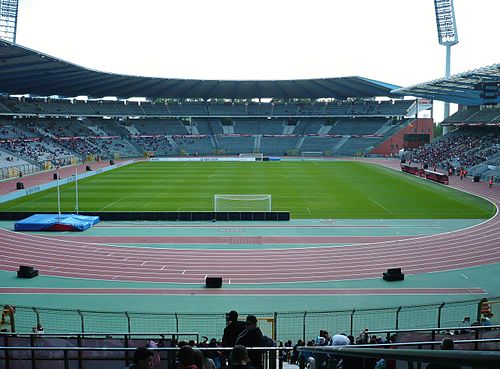
The King Baudouin Stadium (French: Stade Roi Baudouin [stad ʁwa bodwɛ̃]; Dutch: Koning Boudewijnstadion [ˌkoːnɪŋ ˈbʌudəʋɛinˌstaːdijɔn]) is a multi-use stadium in Brussels, Belgium. Located in the north-western district of the City of Brussels, it was built to embellish the Heysel/Heizel Plateau in view of the 1935 Brussels International Exposition. It was inaugurated on 23 August 1930, with Crown Prince Leopold attending the opening ceremony. The stadium hosted 70,000 at the time. Its name honours King Baudouin, Leopold's successor as King of the Belgians from 1951 to his death in 1993. The stadium is located at 135/2, avenue de Marathon/Marathonlaan, on the border of the Bruparck entertainment park (with the Atomium, Mini-Europe miniature park and Kinepolis cinema). It can be accessed from the metro stations Heysel/Heizel and Roi Baudouin/Koning Boudewijn on line 6.
The first version of the King Baudouin Stadium was built in 1929–30 by the architect Joseph Van Neck, also chief architect of the 1935 Brussels International Exposition, in a classical modernist style. Its original name was the Jubilee Stadium (French: Stade du Centenaire, Dutch: Jubelstadion ) because it was inaugurated as part of the centenary celebrations of the Belgian Revolution, with an unofficial Belgium–Netherlands football match.
In 1946, the stadium was stripped of the wood of its cycling track, and was renamed the Heysel Stadium (French: Stade du Heysel, Dutch: Heizelstadion ), after the neighbourhood in which it is located. In 1971, a tartan track was installed allowing the organisation of athletics competitions. Three years later, in 1974, a new lighting system was installed.
The Heysel Stadium hosted European Cup finals in 1958, 1966, 1974, and 1985 and Cup Winners' Cup finals in 1964, 1976 and 1980. The highest attendance at a European game was over 69,000 in 1958.
Main article: Heysel Stadium disaster Despite its status as Belgium's national stadium, the Heysel Stadium was not well maintained. The stadium's poor condition manifested itself at the 1985 European Cup Final. For example, the outer wall had been made of cinder block, and fans who did not have tickets were seen kicking holes in it to get in. Additionally, the only escape route led upward, and there were only three gates on each short side–nowhere near enough for the 22,000 people standing on the terraces on either side.

The stadium's inadequacies had been well known for some time. When Arsenal played there in the early 1980s, its supporters ridiculed it as a "dump." Indeed, the presidents of the two 1985 European finalists, Juventus and Liverpool, had concluded that Heysel was in no condition to host a European Final, especially one featuring two of the largest and most powerful clubs in Europe at the time. They urged UEFA to move the match to another ground, to no avail. It later emerged that UEFA had only spent half an hour inspecting the stadium.
On 29 May 1985, the Heysel Stadium disaster occurred, resulting in the deaths of 39 Juventus spectators in a crowd disorder caused by Liverpool fans before the match. Despite the disaster, the stadium continued to be used for Belgium international games from 1986 to 1990 with only minimal improvements made following the disaster. This was in part because the government had already drawn up plans to remodel the stadium into a 35,000-seat facility. Finally, in 1990, UEFA forced the issue by barring Belgium from hosting a European Final until at least 2000. It also continued to host track and field events and it still hosts the Memorial Van Damme every year.
In 1995, a decade after the disaster, the ground was rebuilt at a cost of BEF 1,500 million (around €37/$50 million in 1995), and at this time renamed the King Baudouin Stadium, after the Belgian monarch who had died two years previously. All that remains of the old stadium is a renovated gateway near the main entrance. The new structure combined the football ground with a running track and facilities for field events. It was re-opened on 23 August 1995 as the home of the Belgium national football team and is the largest stadium in Belgium; it can seat 50,093 spectators. The remodelled stadium hosted the 1996 European Cup Winners Cup final, as well as the opening game for Euro 2000.
On 26 May 2006, the Belgian Football Association decided not to use the King Baudouin Stadium anymore for the national team home matches and for the Cup final, because the gates of stand one were too narrow and the stadium was deemed unsafe. The next match of the national team was thus held at the Constant Vanden Stock Stadium. The City of Brussels complained that contrary to these claims the stadium was safe, and this complaint was upheld in court. On 6 October 2006, the Belgian Football Association met with representatives of the City of Brussels and they agreed to renew the contract and extend it to 30 June 2008.
In March 2019, the Belgian Football Association announced plans for a new redevelopment of the King Baudouin Stadium. The stadium would be rebuilt to a reduced capacity of 40,000 spectators and renamed to the Golden Generation Arena with a prospective completion date of 2022. That idea was quietly discarded. An architectural firm has never been appointed, an environmental study ordered or a client sought. From the politicians, who were said to be positive about the idea across party lines in the beginning, hardly anything is moving.

The first version of the King Baudouin Stadium was built in 1929–30 by the architect Joseph Van Neck, also chief architect of the 1935 Brussels International Exposition, in a classical modernist style. Its original name was the Jubilee Stadium (French: Stade du Centenaire, Dutch: Jubelstadion ) because it was inaugurated as part of the centenary celebrations of the Belgian Revolution, with an unofficial Belgium–Netherlands football match.
In 1946, the stadium was stripped of the wood of its cycling track, and was renamed the Heysel Stadium (French: Stade du Heysel, Dutch: Heizelstadion ), after the neighbourhood in which it is located. In 1971, a tartan track was installed allowing the organisation of athletics competitions. Three years later, in 1974, a new lighting system was installed.
The Heysel Stadium hosted European Cup finals in 1958, 1966, 1974, and 1985 and Cup Winners' Cup finals in 1964, 1976 and 1980. The highest attendance at a European game was over 69,000 in 1958.
Main article: Heysel Stadium disaster Despite its status as Belgium's national stadium, the Heysel Stadium was not well maintained. The stadium's poor condition manifested itself at the 1985 European Cup Final. For example, the outer wall had been made of cinder block, and fans who did not have tickets were seen kicking holes in it to get in. Additionally, the only escape route led upward, and there were only three gates on each short side–nowhere near enough for the 22,000 people standing on the terraces on either side.
The stadium's inadequacies had been well known for some time. When Arsenal played there in the early 1980s, its supporters ridiculed it as a "dump." Indeed, the presidents of the two 1985 European finalists, Juventus and Liverpool, had concluded that Heysel was in no condition to host a European Final, especially one featuring two of the largest and most powerful clubs in Europe at the time. They urged UEFA to move the match to another ground, to no avail. It later emerged that UEFA had only spent half an hour inspecting the stadium.

On 29 May 1985, the Heysel Stadium disaster occurred, resulting in the deaths of 39 Juventus spectators in a crowd disorder caused by Liverpool fans before the match. Despite the disaster, the stadium continued to be used for Belgium international games from 1986 to 1990 with only minimal improvements made following the disaster. This was in part because the government had already drawn up plans to remodel the stadium into a 35,000-seat facility. Finally, in 1990, UEFA forced the issue by barring Belgium from hosting a European Final until at least 2000. It also continued to host track and field events and it still hosts the Memorial Van Damme every year.
In 1995, a decade after the disaster, the ground was rebuilt at a cost of BEF 1,500 million (around €37/$50 million in 1995), and at this time renamed the King Baudouin Stadium, after the Belgian monarch who had died two years previously. All that remains of the old stadium is a renovated gateway near the main entrance. The new structure combined the football ground with a running track and facilities for field events. It was re-opened on 23 August 1995 as the home of the Belgium national football team and is the largest stadium in Belgium; it can seat 50,093 spectators. The remodelled stadium hosted the 1996 European Cup Winners Cup final, as well as the opening game for Euro 2000.
On 26 May 2006, the Belgian Football Association decided not to use the King Baudouin Stadium anymore for the national team home matches and for the Cup final, because the gates of stand one were too narrow and the stadium was deemed unsafe. The next match of the national team was thus held at the Constant Vanden Stock Stadium. The City of Brussels complained that contrary to these claims the stadium was safe, and this complaint was upheld in court. On 6 October 2006, the Belgian Football Association met with representatives of the City of Brussels and they agreed to renew the contract and extend it to 30 June 2008.
In March 2019, the Belgian Football Association announced plans for a new redevelopment of the King Baudouin Stadium. The stadium would be rebuilt to a reduced capacity of 40,000 spectators and renamed to the Golden Generation Arena with a prospective completion date of 2022. That idea was quietly discarded. An architectural firm has never been appointed, an environmental study ordered or a client sought. From the politicians, who were said to be positive about the idea across party lines in the beginning, hardly anything is moving.
Major international football matches have taken place in the King Baudouin Stadium: the finals of the European Champion Clubs' Cup in 1958, 1966, 1974 and 1985, those of the Cup of Cups in 1964, 1976, 1980 and 1996, as well as that of the European Championships in 1972 between West Germany and the USSR (3–0).
Closest places in our Belgium guide.
More places to explore in Belgium.


