Montenegro
Ravni Žabljak Stadium
Stadium
Heritage site
stechak
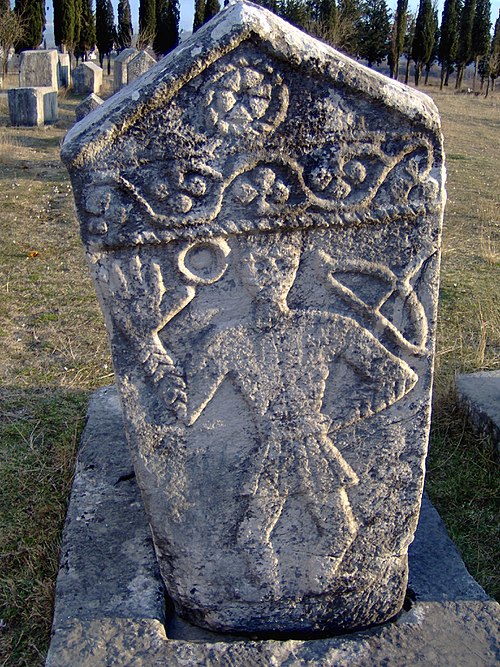
Stećak (plural stećci; Serbian Cyrillic: стећак, стећци) is the name for monumental medieval tombstones that lie scattered across Bosnia and Herzegovina, and the border parts of Croatia, Montenegro and Serbia. An estimated 60,000 are found within the borders of modern Bosnia and Herzegovina and the rest of 10,000 are found in what are today Croatia (4,400), Montenegro (3,500), and Serbia (2,100), at more than 3,300 odd sites with over 90% in poor condition. They are cut in a variety of recognizable stećak forms, with a certain percentage being richly decorated and some individual stećci also containing inscriptions in form of epitaphs. Appearing in the mid 12th century, with the first phase in the 13th century, the custom of cutting and using stećci tombstones reached its peak in the 14th and 15th century, before being discontinued in the very early 16th century during the Ottoman conquest of Bosnia and Herzegovina. They were a common tradition amongst Bosnian, Catholic and Orthodox Church followers alike, and were used by both Slavic and the Vlach populations. On the territory of Bosnia and Herzegovina, all found individual and stećci grouped in necropolises are considered immovable...
The word itself is a contracted form of the older word * stojećak, which is derived from the South Slavic verb stajati (engl. stand ). It literally means the "tall, standing thing". In Herzegovina they are also called as mašeti / mašete (Italian massetto meaning "big rock", or Turkish meşhet / mešhed meaning "tombstone of a fallen hero"), in Central and Western Bosnia as mramori / mramorje / mramorovi (marble), while in Serbia and Montenegro as usađenik (implantation). On the stećci inscriptions they are called as bilig (mark), kamen bilig (stone mark), kâm / kami / kamen (stone), hram (shrine), zlamen (sign), kuća (house), raka (pit), greb/grob (grave). In the 1495 lectionary they are recorded as kamy (stone).
Although the name stećak is meant to represent high monolithic standing stones (i.e. sanduk and sljemenjak form), in the 20th century the word stećak was accepted in science as a general term, including for plate tombstones (i.e. ploče ). The original reference to the word stećak itself is uncertain and seems to be a modern invention as it can only be traced from the note by Ivan Kukuljević Sakcinski from 1851, dictionary by Vuk Karadžić from 1852 (in the first edition from 1812 the term did not exist), although he contradicted himself as the commoners from Zagvozd called them starovirsko ("of the old faith"), dictionary by Bogoslav Šulek from 1860 and so on, while academic dictionaries mention it only from 1956/58. It is believed that the term was usually used in East Herzegovina and in the area of Stari Vlah in Serbia. Until the very early 20th century there was wandering in terminology, and some scholars proposed general terms like nadgrobni biljezi (gravestone markers) and mramorje (marble) to be more appropriate.
The term stećak is uncommon in regional dialects and without etiological value, and semantically incorrect and contradicting as it derives from the verb "to stand", while the chest-type to which it refers predominantly is laid down, while another sub-type of pillars and crosses is the one predominantly upright; this upright or standing sub-type does not amount to even 5% of the overall number of stećci; in the original stećci inscriptions they are most often called as kami (meaning "stone" regardless of the form), thus some scholars proposed the term kamik (pl. kamici ) for all forms of headstones, while stećak would mean only the upright sub-type. The term kamik is more close to the original meaning and sometimes used instead of stećak in professional literature.
The stećci area or cemetery folk names show respect and admiration for their dimensions, age or representations: Divsko groblje (Giants’ cemetery), Mašete (big stones), Mramori/Mramorje (marble blocks), Grčko groblje (Orthodox cemetery), Tursko groblje (Muslim cemetery), Kaursko groblje ( Giaour ’s cemetery).
They are characteristic of the territory of present-day Herzegovina, central Bosnia and Podrinje in Bosnia and Herzegovina, Dalmatia in Croatia, and minor parts of Montenegro, Kosovo, Western Serbia, Northwestern Bosnia, and Croatia ( Lika and Slavonia ).
Stećci are described as horizontal and vertical tombstones, made of stone, with a flat or gable-top surface, with or without a pedestal. The common classification was established by Dmitrij Sergejevski in 1952, who divided them into recumbent stećci and standing stećci. The systematization of stećci is not currently complete. According to Šefik Bešlagić, there are seven main shapes: slab, chest, chest with pedestal, ridge/gable, ridge/gable with pedestal, pillar, and cross; while according to Dubravko Lovrenović, there are nine types in Radimlja : slab, slab with pedestal, chest, chest with pedestal, tall chest, tall chest with pedestal, sarcophagus (i.e. ridge/gable), sarcophagus with pedestal, cruciform.
For instance, in Bosnia and Herzegovina, according to UNESCO, "about 40,000 chests, 13,000 slabs, 5,500 gabled tombstones, 2,500 pillars/obelisks, 300 cruciform tombstones and about 300 tombstones of indeterminate shape have been identified. Of these, more than 5,000 bear carved decorations".
The chronology established by Marian Wenzel assumes they developed from the plate headstones, the oldest one dating back to 1220 (the first were probably erected sometime in the mid-12th century), the monumental ones emerged somewhere around 1360, those with visual representations around 1435–1477, and that total production ended circa 1505. However, some consider that it lasted until the late 16th century, with rare examples that continued until the 18th century. Stećci in the form of a chest ( sanduk ) and ridge/saddle-roofed ( sljemenjak ) do not seem to have appeared before the middle or the end of the 14th century (1353-1477), while the remaining two basic forms – the upright pillar ( stup ) and cross ( krstača / križina ), no earlier than mid-15th century. In the case of the latter, upright or standing forms could be influenced by but also influence the nišan – the upright monolithic stones on top of Muslim (Turkish) graves–during stećak to nišan transition period, which had already emerged by the end of the 14th century in conquered parts of Macedonia and Serbia. This form is predominantly found in Serbia and Eastern Bosnia.
The initial stage of their development, which included simple recumbent plates or slabs isn't specific to the region, but it is of broad West Mediterranean origin, and as such the term stećak (implying the chest and ridge form) is misleading for all tombstone forms. The slabs were typical for a kind of burial in the West Mediterranean world of the 14th and 15th centuries, which had a special method of production and ornamentation in the Balkans, customized according to the stonemasonry skills and microenvironment. They were initially made by the feudal nobility who wanted to affirm individual prestige and power, sometimes also decorated with their coat of arms, while later this tradition was embraced and adopted by other social classes like the Vlachs who experienced socioeconomic growth and almost exclusively built them from the mid-15th century on.
"I have for long lain here, and for much longer shall I lie"; "I was born into a great joy and I died into a great sorrow"; "I was nothing then, I am nothing now"; "You will be like I, and I can not be like you"; "May he who topples this stone be cursed"
— Some translated examples of inscriptions. A fraction of stećci (384) bear inscriptions, mostly in Cyrillic, some in Glagolitic and Latin script. The observed Shtokavian dialect of Serbo-Croatian has some archaic phrases, mainly characterized by Ikavian while toward the end by Ikavian-Ijekavian yat reflex. The inscriptions can be roughly divided into those of: religious phrase, description of heroic death, information of the deceased, information of the deceased's relatives and circumstances of death, information with only a personal name (sometimes with smith-pupil name), and a moral (or religious) lesson. The last are mostly brazen reminders of wisdom and mortality, relay a dread of death, more anxiety than peace.
The most remarkable feature is their decorative motifs roughly divided into six groups which complement each other: social symbols, religious symbols, images of posthumous kolo, figural images, clear ornaments, and unclassified motifs (mostly symbolic, geometrical, or damaged). Many of them remain enigmatic to this day; spirals, arcades, rosettes, vine leaves and grapes, lilium, stars (often six-pointed) and crescent Moons are among the images that appear. Figural images include processions of deer, horse, dancing the kolo, hunting, chivalric tournaments, and, most famously, the image of a man with his right hand raised, perhaps in a gesture of fealty.
A series of visual representations on the tombstones can not be simplistically interpreted as real scenes from the life, and symbolic explanations are still considered by scholarship. The shield on the tombstones, usually with the crossbar, crescent and star, cannot be a coat of arms, neither can the stylized lilium be used in the heraldic sense. On one stećak a tied lion is displayed and above him a winged dragon. In 1979, historian Hadžijahić noted that the horsemen are not riding with reins, yet (if they are not hunting) their hands are free and pointed to the sky, implying possible cult significance. In 1985, Maja Miletić noted the symbolic and religious character of the stećak scenes. All the "life scenes" are considered to be part of a ceremonial. Several scholars concluded that the motifs, as well the tradition of a posthumous cult, show mixing of Romanized Illyrians and Early Slavs traditions with Christianity. Alojz Benac noted that the displays of a sole horse with a snake, as well a sole deer with a bird, symbolize the soul of the deceased going to the otherworld, which representations resemble those found on Iapodian artefacts. The Illyrian god Medaurus is described as riding on horseback and carrying a lance.
Of all the animals, the deer is the most represented, and mostly is found on stećci in Herzegovina. According to Dragoslav Srejović, the spread of Christianity did not cause the disappearance of the old cult and belief in sacred deer. Wenzel considered that it led the deceased to the underworld. Historian Šefik Bešlagić synthesized the representations of deer: sometimes accompanied by a bird (often on the back or horns), cross or lilium, frequently are shown series of deer or doe, as well with a bow and arrow, dog and hunter(s) with a spear or sword (often on a horse). It is displayed in hunting scenes, as well as some kolo processions led by a man who is riding a deer. There scenes where deer calmly approach the hunter, or deer with enormous size and sparse horns. Most of the depictions of "deer hunting" are facing west, which had the symbolic meaning for death and the otherworld. In numerous hunting scenes, in only one deer is wounded (the stećak has some anomalies), indicating an unrealistic meaning. In Roman and Parthian - Sasanian art, hunted animals are mortally wounded, and the deer is only one of many, while on stećci it is the only hunted animal.
The motifs of a kolo (in total 132) procession, along with deer, and its specific direction of dancing, although not always easily identifiable, show it is a mortal dance compared to a cheerful one. In Eastern Bosnia and Herzegovina so-called Ljeljenovo kolo, with ljeljen local name for jelen (deer) implying jelenovo kolo, is danced by making the gate of the raised hand and the ringleader of these gates tries to pull all kolo dancers through them until the kolo is entangled, after that, playing in the opposite direction, until the kolo is unravelled. Its origin is in a mortuary ritual guiding the soul to another world and the meaning of the renewal of life.
The crescent moon and star(s) are a very common motif on stećak tombstones. The vast regional, but scarce (usually only one) in-graveyard distribution mostly in the center or some notable position of cross-type stećci ( križine ), and their almost exclusive ornament of the crescent Moon and stars, could indicate a cemetery label for specific (pagan) religious affiliation. The symbolism of the Moon and stars (Sun), which are often found on them, could be traced to a combination of pagan and Christian beliefs, six-pointed star represent Venus (in Slavic mythology called Danica) and the Moon could represent "astral marriage", or even Mithraism which had and old Mazdakism belief that the dead body goes to the Moon and the soul goes to the Sun, while some considered a connection between astral symbols with the position of celestial bodies at the time of death.
They were carved by a kovač / klesar (smith, mason; in Latin faber, "master"), while the inscriptions, probably as a template, were compiled by dijak / pisar (pupil, scribe). Currently 33 personal names of masons are known, among whom the most notable is Grubač due to his skills and being both a mason and scribe. He made four stećci in Boljuni and four stećci in Opličići near Stolac. The most notable scribe was Semorad who also worked around Stolac. It is believed that the masons studied the craft in Dalmatia and Ragusa, and those from the hinterland learned from them.
Stećci were mostly carved out of huge blocks, mostly of limestone. The location in the vicinity of a quarry was most significant for the cemetery. Some stećci weighed more than 29 tonnes, and it is supposed they were transported by horse or ox carriage and the heaviest with a combination of sledges and flat billets. They were placed directly above the pit, often in cardinal direction west–east, therefore so were the deceased. Seemingly it was related to the Sun path and was of importance that the dead watch the rising Sun.
Stećci in Bosnia and Herzegovina can be roughly divided into two stonemasonry schools: Herzegovian (sarcophagi with arcades, figurative scenes, a wealth of motifs) and East Bosnian (sarcophagi in the form of chalets, floral motives). The former had schools on the territory of Herzegovina, with the center being around Stolac, in the area of Trebinje and Bileća, Gacko and Nevesinje. The fourth workshop was in the area of Konjic, while the fifth around Lištica. The stonemasons center in Western Bosnia was between Kupres and Duvno, in Central Bosnia around Travnik, while in Eastern Bosnia there were four workshops, one between Kladanj, Olovo and Ilijaš, the second around Zvornik, the third in Ludmer, and the fourth around Rogatica.
Closest places in our Montenegro guide.
More places to explore in Montenegro.