Rockwall_in_Potts_Point.jpg?width=1200)
Australia
Rockwall, Potts Point
Heritage site · New South Wales
House

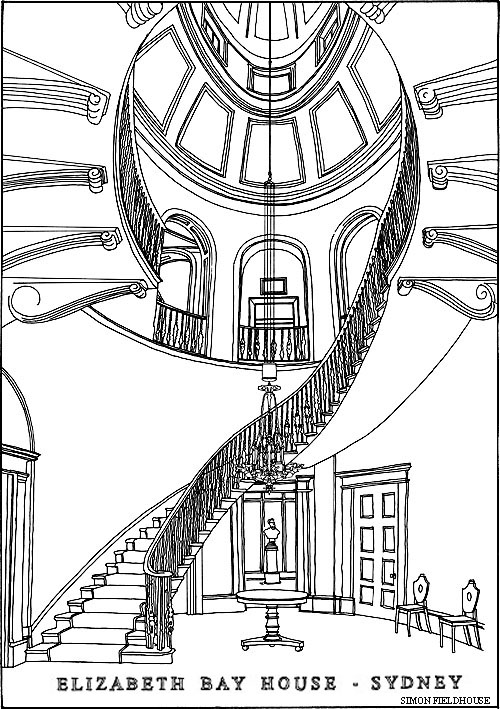
Elizabeth Bay House is a heritage-listed Australian Colonial Regency style house and grotto in the inner Sydney suburb of Elizabeth Bay, New South Wales. The property at 7 Onslow Avenue is owned by Museums of History NSW, funded by the Government of New South Wales. The design of the house and grotto are attributed to John Verge and John Bibb. It was constructed between 1832 and 1839 by James Hume, with the assistance of convict and free artisans. The property also features a carriage drive off Onslow Avenue that was designed by Edward Deas Thomson and was originally surrounded by a 22-hectare (54-acre) garden. Elizabeth Bay House is a superb example of Australian colonial architecture, best known for its central elliptical saloon with domed lantern and geometric staircase, and was listed on the (now defunct) Register of the National Estate. It was added to the New South Wales State Heritage Register on 2 April 1999.
Elizabeth Bay had been the site of a fishing village established by Governor Macquarie (1810–21) in c. 1815 for a composite group of Cadigal people – the indigenous inhabitants of the area surrounding Sydney Harbour – under the leadership of Bungaree (d. 1830). Elizabeth Bay had been named in honour of Mrs Macquarie. Bungaree's group continued their nomadic life around the harbour foreshores. Sir Thomas Brisbane, Governor 1821–25, designated Elizabeth Bay as the site of an asylum for the insane. A pen sketch by Edward Mason from 1822 to 1823 shows a series of Indigenous bark huts in the locality.
Main article: Alexander Macleay Alexander Macleay (1767–1848), public servant and entomologist, was born at Wick, a fishing village in Ross-shire, Scotland. He moved to London in 1786, marrying Elizabeth Barclay there in 1791. Macleay, who was employed in the civil service (1795–1825) was well known in British and European natural history circles, having amassed by 1805 one of the most significant insect collections in Britain. He was elected a fellow of the Linnean Society of London in 1794 commemorating the great Swedish naturalist Carl Linnaeus, whose Species Plantarum (1753) became the internationally accepted starting point for all botanical nomenclature and served as its secretary from 1798 to 1825. He was elected a fellow of the Royal Society in 1809. Botanist Robert Brown, Macleay's close friend and suitor of his eldest daughter Fanny, a competent botanical artist, named the plant genus Macleaya in his honour.
In enforced retirement from 1817 when his department was abolished at the end of the Napoleonic Wars, Macleay's finances were stretched to support a large family (10 of 17 children survived to adulthood), town and country residences, and his obsessive collecting of insects. When assets had to be sold upon the collapse of his brother's private bank in Wick, in which Alexander was a partner, he began in 1824 to borrow heavily from his eldest son, William.
Macleay accepted the position of NSW Colonial Secretary, arriving in 1826 and moving into the Colonial Secretary's house (fronting Macquarie Place ) with his wife Eliza, their six surviving daughters, an extensive library, and an insect collection then "unparalleled in England" for its size, range and number of type specimens (first to be named of a species). Three of the four surviving sons came later to NSW, of whom two, William and George – shared their father's natural history interests. (From the early 1820s the spelling Macleay was adopted; descendants of Alexander's brothers retained MacLeay or McLeay).

Soon after his arrival in 1826 he was granted 22 hectares (54 acres) by Governor Darling at Elizabeth Bay, with commanding views of Sydney Harbour. It was usual practice for grants to be made to eminent citizens in the colony but Macleay's grant generated some heated editorials in Sydney's newspapers. It involved the alienation of public land, the former Aboriginal settlement of Elizabeth Town, later earmarked for an asylum.
In 1826 Macleay set about improving the site, using assigned convict labour. He employed his horticultural expertise, assisted from the late 1820s by gardener Robert Henderson, to establish a private botanic garden with picturesque features of dwarf stone walls, rustic bridges, and winding gravel walks. This was amid the existing native vegetation.
In May 1831 The Sydney Gazette enthusiastically reported improvements at Woolloomooloo Hill ( Potts Point ) and Macleay's neighbouring estate at Elizabeth Bay "5 years ago the coast immediately eastward of Sydney was a mass of cold and hopeless sterility, which its stunted and unsightly bushes seemed only to render the more palpable; it is now traversed by an elegant carriage road and picturesque walks.
That these rapid improvements were originated by the proprietor of Elizabeth Bay cannot be doubted. He was the first to show how these hillocks of rock and sand might be rendered tributary to the taste and advantage of civilized man. As to the estate of Elizabeth Bay, no one can form an adequate judgement of the taste, labour and capital that have been bestowed upon it. A spacious garden, filled with almost every variety of vegetable; a trellised vinery; a flower garden, rich in botanical curiosities, refreshed with ponds of pure water and overlooked by fanciful grottoes; a maze of gravel walks winding around the rugged hills in every direction, and affording sometimes an umbrageous solitude, sometimes a sylvan coup d'oeil, and sometimes a bold view of the spreading bays and distant headlands – these are living proofs that its honourable proprietor well deserved the boon, and has well repaid it."
As with the design of the house, the design of the estate appears to have involved a number of people whose respective contributions are not known. Fanny Macleay regarded her father as the mastermind, referring to Elizabeth Bay as "our Tillbuster the second", a reference to the Macleay family's country estate in Godstone, Surrey, which Alexander had improved in 1817. In September 1826 she promised her brother a plan of the recently acquired grant "when Papa has decided where our house is to be and the garden etc". Although Nurseryman Thomas Shepherd had practised as a landscape gardener many years previously in England and his 1835 (public) lecture (in Sydney) included suggestions for the further improvement of the Elizabeth Bay estate, he does not claim credit for involvement, however informal, in its design. It may be that Macleay considered his views old-fashioned.

In 1825 Robert Henderson had been recruited at the Cape of Good Hope by Alexander Macleay. Henderson's obituary records that he superintended the laying out of the gardens of Elizabeth Bay and Brownlow Hill. In February 1829 Fanny wrote "we have now some beautiful walks thro' the bush. Mr (Edward) Deas-Thompson who is possessed of an infinity of good taste is the Engineer and takes an astonishing degree of interest in the improvement of the place."
John Verge 's office ledger contains many references to the design of garden structures, including gates and piers and copings and "scroll ends" for garden walls. The entries are dated between April and November 1833. A design for a bathing house (not built) dated 1834 and initialled "R.R.", may be attributed to the architect and surveyor, Robert Russell (1808–1900) who arrived in Sydney in that year.
Macleay's approach to the Australian bush was in contrast with that of the majority of colonists, who customarily cleared it and started afresh. Nurseryman Thomas Shepherd wished others to emulate this:
The high lands and slopes of this property are composed of rocks, richly ornamented with beautiful indigenous trees and shrubs. From the first commencement he (Macleay) never suffered a tree of any kind to be destroyed, until he saw distinctly the necessity for doing so. He thus retained the advantage of embellishment from his native trees, and harmonised them with foreign trees now growing. He has also obtained the benefit of a standing plantation which it might otherwise have taken twenty or thirty years to bring to maturity.
The bush was planted with specimen orchids and ferns to enhance its botanical interest, which could be enjoyed in the course of a "wood walk". Two surviving notebooks list the sources of plants for the garden and illustrate a comprehensive approach to plant collecting, similar in their approach to entomology. The plant and seed books contain entries for purchases from nurserymen Messr.s Loddiges of Hackney, London, and exchanges with William Macarthur of Camden Park. They also record the plants contributed by visitors to the estate and by William Sharp Macleay 's natural history collectors in India.
Alexander Macleay had a great passion for bulbous plants, particularly those from the Cape of Good Hope. The explorer Charles Sturt, contributed many bulbs collected on his journey to South Australia in 1838, having been presented with four bulbs of Calostemma album from the Royal Botanic Gardens at Kew during his visit to Elizabeth Bay in February 1831. Bulbs featured in the large collection of plants which William Sharp Macleay brought with him to Australia in 1839. 88 varieties of bulbs were forwarded to him in 1839-40 by his scientific correspondent, Dr Nathaniel Wallich, Superintendent of the botanical garden in Calcutta.
Macleay's garden was also noted for its fruit trees. In 1835, Charles Von Hugel noted "pawpaw, guava and many plants from India were flourishing". Georgianna Lowe (of Bronte House ) described the shrubbery and adjacent garden, in 1842–43 commenting on the wealth of fruit trees and other plants assimilated into a Sydney garden: "Mr Macleay took us through the grounds; they were along the side of the water. In this garden are the plants of every climate – flowers and trees from Rio, the West Indies, the East Indies, China and even England. And unless you could see them, you would not believe how beautiful the roses are here. The orange trees, lemons, citrons, guavas are immense, and the pomegranate is now in full flower. Mr Macleay also has an immense collection from New Zealand."
Many visitors commented on Macleay's achievement in creating a garden in Sydney conditions. Georgianna Lowe described "some drawbacks to this lovely garden: it is too dry, and the plants grow out of a white, sandy soil. I must admit a few English showers would improve it."
Macleay received the Yulan magnolia ( M. denudata ), a small tree from south-eastern China, at Elizabeth Bay, in 1836.
Plans for the villa were in hand from 1832 but construction did not commence until 1835. Elizabeth Bay House was built between 1835 and 1839 by the accomplished architect and builder John Verge. It is believed that Verge worked from plans acquired from a British source prior to 1832. Macleay, in addition to his post, was an entomologist of standing in the world of natural science and had been secretary (1798–1825) of the prestigious Linnean Society in London. He brought with him his huge insect collection, a library of 4000 works and a wide knowledge of horticulture and botany.
Closest places in our Australia guide.
More places to explore in Australia.


Jenner_House_Potts_Point-1.jpg?width=1200)


Bomera_Potts_Point.jpg?width=1200)
.jpg?width=1200)
.jpg?width=1200)
.jpg?width=1200)


