Germany
Gutenberg Museum
Museum · Mainz
Catholic cathedral
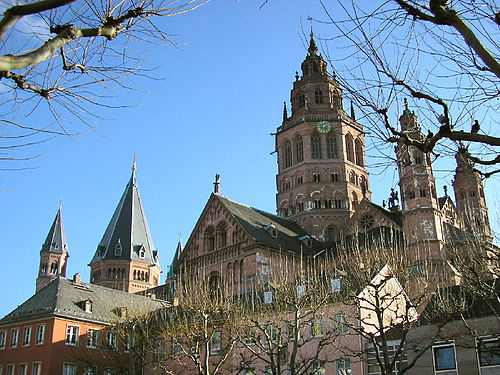
Mainz Cathedral or St. Martin's Cathedral (German: Mainzer Dom, Martinsdom or, officially, Der Hohe Dom zu Mainz) is located near the historical center and pedestrianized market square of the city of Mainz, Germany. This 1000-year-old Roman Catholic cathedral is the site of the episcopal see of the Bishop of Mainz. Mainz Cathedral is predominantly Romanesque in style, but later exterior additions over many centuries have resulted in the appearance of various architectural influences seen today. It comprises three aisles and stands under the patronage of Saint Martin of Tours. The eastern quire is dedicated to Saint Stephen. The interior of the cathedral houses tombs and funerary monuments of former powerful Electoral-prince-archbishops, or Kurfürst-Erzbischöfe, of the diocese and contains religious works of art spanning a millennium. The cathedral also has a central courtyard and statues of Saint Boniface and The Madonna on its grounds.
During the time of Mainz Archbishop Willigis (975–1011), the city of Mainz flourished economically, and Willigis became one of the most influential politicians of that time, ascending to regent of the empire between 991 and 994. In 975–976 shortly after...
From the ninth to 12th century, several important churches in the Holy Roman Empire were built with choirs on both ends. One of the first was Cologne Cathedral of 855 ("Hildebold's Cathedral"). One of the oldest preserved examples is St. Michael's Church, Hildesheim, erected since 1010. Gernrode Abbey church was added a second choir, in the 12th century. This type of footplans also was acquired in Poland ( Tum Collegiate Church ) and Hungary ( Pécs Cathedral ). The reason for building two chancels is not entirely clear. Many scholars suggest that there is some symbolic significance, such as empire and church, or body and spirit, but no irrefutable evidence for these theories exists. Others claim that the construction has a functional purpose for ceremonial processions. Whatever the original intent of the double chancel, the eastern chancel came to serve as the location for the mass and the western chancel was reserved for the bishop and pontiffs.
In most cathedrals at the time, the main chancel lay on the east side. Willigis, however, designed his cathedral with the main chancel on the west, presumably modeled after the great basilicas in Rome, which were constructed this way. (Willigis's design bore a striking resemblance to Old St. Peter's Basilica.)
The chancel was badly damaged in the fire of 1009, and remained that way under Archbishops Erkanbald and Aribo. The chancel was finally reconstructed under Bardo. He then buried his predecessor Aribo there, before the rest of the cathedral was even finished. (Willigis's remains are not, as sometimes believed, in Mainz Cathedral; he was buried in his second construction project, St. Stephen's.)
In 1081, fire once again struck the cathedral, and the appearance of the Salian western end is not known. In 1100, Henry IV ordered reconstruction in the old Lombardic style. The old flat chancel end on the east side was replaced with a large apse, which external gallery with a narrow arcade supported by short columns crowned the semicircular wall with a wide pseudo arcade and tall pilasters on both sides. The new chancel had a triple-nave crypt. The damaged square tower had been replaced with an octagonal dome, above which an octagonal tower was added later. Flanking stair turrets remained from the first cathedral. These changes closely resembled the renovations Henry had overseen on Speyer Cathedral a few years earlier.
Henry also undertook a few other minor changes, such as raising the transept on the east side and adding openings at the column level. These column-level portals were among the first ever such constructed.
Henry died in 1106, before his intended changes were complete. With his death, the funding for the renovation of the cathedral dried up and so the remaining construction was abandoned. Mainz Cathedral is considered one of the three Kaiserdome ("Emperor's Cathedrals") of the Holy Roman (German) Empire, along with Worms Cathedral and Speyer Cathedral.
Archbishop Adalbert I of Saarbrücken (1110–1137) had a two-story chapel, called the Gotthard Chapel, built as the official palace chapel next to the cathedral. It is believed that he also ordered the renovation of the main body of the cathedral, mainly due to similarities between the main hall and the vault of the new chapel.
Conception for the renovations was again taken from the Romanesque Speyer Cathedral. This time, however, without money from the emperor, the builders lacked the resources to acquire the high-quality sandstone used in Henry's additions. They instead used limestone. The other aspects of the renovations were also much cheaper, and the extravagant style of Speyer Cathedral was largely avoided.
The central nave was built to 28 m (92 ft), 5 m (16 ft) short of Speyer Cathedral's 33 m (108 ft). It seems that the blind arches were intended to encompass the windows, as in Speyer Cathedral, but the height of the roof did not allow this. The resulting three-level effect, due to the arches ending before the windows, was a technique not before seen in architecture.
The main hall was further renovated throughout the entire 12th century. The entire outer wall structure was eventually replaced. Around the year 1200, the ceiling was replaced with a ribbed vault, a rather new technique for the time.
Around the time that the ribbed vault was installed it was decided to renovate the western half of the cathedral, which had stayed relatively unchanged since Willigis' construction. In contrast to the eastern renovations done earlier, which were in a high-Romanesque style, these new changes were carried out in a late Romanesque style. A new vault was added to span the north and south arms of the transept. Large windows were added to the wall separating the transept from the main hall. The large dome connecting the transept to the main hall was decorated with friezes and pillars.
Three small apses and two very large pillars were added to support the small flank towers. Pediments were added to the three open sides of the chancel. In general, the western section of the cathedral was extensively decorated to keep up with the newly renovated eastern section.
In most cathedrals at the time, the main chancel lay on the east side. Willigis, however, designed his cathedral with the main chancel on the west, presumably modeled after the great basilicas in Rome, which were constructed this way. (Willigis's design bore a striking resemblance to Old St. Peter's Basilica.)
The chancel was badly damaged in the fire of 1009, and remained that way under Archbishops Erkanbald and Aribo. The chancel was finally reconstructed under Bardo. He then buried his predecessor Aribo there, before the rest of the cathedral was even finished. (Willigis's remains are not, as sometimes believed, in Mainz Cathedral; he was buried in his second construction project, St. Stephen's.)
In 1081, fire once again struck the cathedral, and the appearance of the Salian western end is not known. In 1100, Henry IV ordered reconstruction in the old Lombardic style. The old flat chancel end on the east side was replaced with a large apse, which external gallery with a narrow arcade supported by short columns crowned the semicircular wall with a wide pseudo arcade and tall pilasters on both sides. The new chancel had a triple-nave crypt. The damaged square tower had been replaced with an octagonal dome, above which an octagonal tower was added later. Flanking stair turrets remained from the first cathedral. These changes closely resembled the renovations Henry had overseen on Speyer Cathedral a few years earlier.
Henry also undertook a few other minor changes, such as raising the transept on the east side and adding openings at the column level. These column-level portals were among the first ever such constructed.
Henry died in 1106, before his intended changes were complete. With his death, the funding for the renovation of the cathedral dried up and so the remaining construction was abandoned. Mainz Cathedral is considered one of the three Kaiserdome ("Emperor's Cathedrals") of the Holy Roman (German) Empire, along with Worms Cathedral and Speyer Cathedral.
Archbishop Adalbert I of Saarbrücken (1110–1137) had a two-story chapel, called the Gotthard Chapel, built as the official palace chapel next to the cathedral. It is believed that he also ordered the renovation of the main body of the cathedral, mainly due to similarities between the main hall and the vault of the new chapel.
Closest places in our Germany guide.
More places to explore in Germany.