Germany
Museum of Cultural History Magdeburg
Museum · Magdeburg
Cathedral

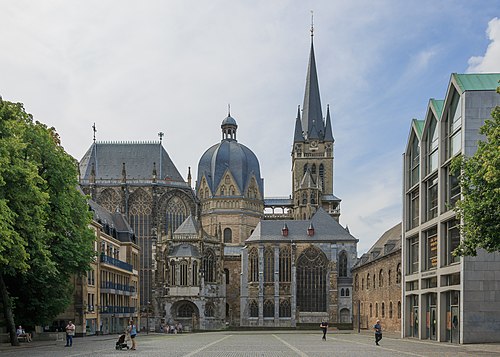
Magdeburg Cathedral (German: Magdeburger Dom), officially called the Cathedral of Saints Maurice and Catherine (German: Dom St. Mauritius und Katharina), is a Lutheran cathedral in Germany and the oldest Gothic cathedral in the country. It is the proto-cathedral of the former Prince-Archbishopric of Magdeburg. Today it is the principal church of the Evangelical Church in Central Germany. The south steeple is 99.25 m (325 ft 7 in) tall, the north tower 100.98 m (331 ft 4 in), making it one of the tallest cathedrals in eastern Germany. The cathedral is likewise the landmark of Magdeburg, the capital city of the Bundesland of Saxony-Anhalt, and is also home to the grave of Emperor Otto I the Great and his first wife Edith. The first church built in 937 at the location of the current cathedral was an abbey called St. Maurice, dedicated to Saint Maurice. The current cathedral was constructed over the period of 300 years starting from 1209, and the completion of the steeples took place only in 1520. Despite being repeatedly looted, Magdeburg Cathedral is rich in art, ranging from antiques to modern art.
The first church was founded 21 September 937 at the location of the current cathedral and was an abbey called St. Maurice ( St. Moritz ), dedicated to Saint Maurice and financed by Emperor Otto I, the Great. Otto wanted to demonstrate his political power after the successful Battle of Lechfeld in 955, and ordered the construction even before his coronation as Emperor on 2 February 962. Furthermore, to support his claim as successor of the Emperor of the Weströmisches Reich, he obtained a large number of antiques – for example, pillars to be used for the construction of the church. Many of those antiques were subsequently used for the second church in 1209. The church had most likely one nave with four aisles, a width of 41 meters and a length of 80 meters. The height is estimated as up to 60 meters.
The wife of Otto, Queen Eadgyth ( grand-daughter of Alfred the Great ), was buried in the church after her death in 946; isotopic analysis of her bones confirms her early life in Wessex. The church was expanded in 955. Hence, the church became a cathedral. In 968, Emperor Otto I selected Magdeburg as the seat of an archdiocese with Adalbert von Trier as archbishop, even though the city was not centrally located but at the eastern border of his kingdom. He did this because he planned to expand his kingdom, and also Christianity, to the east into what is nowadays Poland. This plan, however, failed. Emperor Otto I died soon thereafter in 973 in Memleben and was also buried in the cathedral next to his wife.
The entire cathedral St. Maurice was destroyed on Good Friday in 1207 by a city fire. All but the southern wing of the cloister burned down. Archbishop Albrecht II von Kefernburg decided to pull down the remaining walls and construct a completely new cathedral, against some opposition of the people in Magdeburg. Only the south wall of the cloister is still standing. The exact location of the old church remained unknown for a long time, but the foundations were rediscovered in May 2003, revealing a building 80 m long and 41 m wide. The old crypt has been excavated and can be visited by the public.
The place in the north of the cathedral (sometimes called "new marketplace", Neuer Markt, now: Cathedral square = in German language: Domplatz ) was occupied by an imperial palace ( Kaiserpfalz ), which was destroyed in the fire of Good Friday 1207. In the southeast corner of the Domplatz stood a second large church, the "North Church", which burned down 1207 and was not rebuilt after the fire. The stones of the ruin served for building the cathedral. The presumptive remains of the palace were excavated in the 1960s.
The highly educated Prince-Archbishop Albert I of Käfernburg, having traveled in Italy and France, decided to construct the new cathedral modelled upon the Gothic architecture that had intrigued him in France. The French style was completely unknown in Germany, and the hired craftsmen only gradually mastered it.
The construction of the choir started in 1209, only two years after the fire that destroyed the previous church, but this choir is still in a very Romanesque style, initially still using Romanesque groin vaults, combined with a gothic center stone, which however is not needed for Romanesque groin vaults.
The Gothic influence increased especially between 1235 and 1260 under Archbishop Wilbrand. As the construction was supervised by different people in the span of 300 years, many changes were made to the original plan, and the cathedral size expanded greatly. The people of Magdeburg were not always happy with this, since they had to pay for the construction. In some cases already constructed walls and pillars were torn down to suit the wishes of the current supervisor.
Construction stopped after 1274. In 1325, Archbishop Burchard III. von Schraplau was killed by the people of Magdeburg because of extreme taxes. Folklore says that especially the beer tax increase caused much anger. Afterwards Magdeburg was under a ban, and only after the donation of five atonement altars did the construction of the cathedral continue under Archbishop Otto von Hessen. Otto was also able to complete the interior construction, and formally opened the dome in 1363 in a week-long festival. At this time, the cathedral was dedicated not only to St Maurice as before, but also to Saint Catherine.
In 1360, the construction stopped again after the uncompleted parts have been covered provisionally. Only in 1477 did the construction start again under Archbishop Ernst von Sachsen, including the two towers. The towers were constructed by master builder Bastian Binder, the only master builder of the cathedral known by name. The construction of the cathedral was completed in 1520 with the placement of the ornamental cross on the north tower.
On 31 October 1517 Martin Luther published the 95 Theses in Wittenberg, Germany, an event considered to mark the start of the Protestant Reformation. Luther preached in Magdeburg in 1524, and some smaller churches in the city to adopt Protestantism soon thereafter. The unpopularity of Archbishop Albrecht von Brandenburg also furthered the Reformation, and after his death in 1545 in Mainz there was no successor. Magdeburg became a leading site of the Reformation, and was outlawed by the emperor. The Catholic Church stored the cathedral treasure in Aschaffenburg for safekeeping, but it would later be lost to the Swedes in the Thirty Years' War. The priests of the cathedral also converted to Protestantism, and on Advent Sunday in 1567, the first Protestant worship service was held in the cathedral. The largest bell, the "Maxima" with 10 tons in the south tower, fell down and was destroyed in 1540. Heinrich Compenius built 1604/05 his famous main organ with the "Golden Chick".
In 1631, during the Thirty Years' War (1618–1648) Magdeburg was raided, and only a small group of 4000 citizens survived the murdering, raping, and looting (known as the sack of Magdeburg ) by seeking refuge in the cathedral. The head priest, Reinhard Bakes, begged on his knees for the lives of his people before the conqueror Johan t'Serclaes, Count of Tilly. The cathedral survived the fires in the city, and was dedicated again to the Catholic religion. However, as Tilly's catholic forces left Magdeburg, the cathedral was completely looted, and its colorful windows were shot out. Twenty thousand people of Magdeburg died during the war, and at the end of the war Magdeburg had a population of only 400. Magdeburg became part of Brandenburg, and was transformed into a large fortress. In 1806, Magdeburg was given to Napoleon, and the cathedral was used for storage, and also as a horse barn and sheep pen. The occupation ended in 1814, and the cathedral changed in the ownership of the Prussian state. Between 1826 and 1834 Frederick William III of Prussia financed the much-needed repairs and reconstruction of the cathedral under the leadership from Karl Friedrich Schinkel. A new main organ IV/81 with mechanical key and stop action was built 1856 to 1861 by Adolf Reubke, 1865 a new division with 6 stops was added. The cathedral organist from 1847 to 1885 was August Gottfried Ritter. He designed the stoplist for the Reubke-Organ. The glass windows were all replaced in 1900.
In 1901 a steam heating was installed. In winter a whole railway car with coal was necessary to heat the church up to 57,2 °F = 14 °C. Ernst Röver build a new main organ with pneumatic keys and stop action, three manuals and a hundred stops in 1906.
The frequent Allied bombings of World War II completely destroyed the windows of the cathedral. During the heaviest bomb attacks on 16 January 1945, some vaults were destroyed. In February or March 1945 a firebomb hit the cathedral between the west towers, destroying the facade and the Röver organ. Fire brigades were able to extinguish the flames on the roof structures in time, so damage to the cathedral was only moderate. The steam heating was also destroyed, but wasn't repaired after the war. The cathedral was opened again in 1955, and a new organ with mechanical action and 37 stops from Schuke Orgelbau was installed above the "Paradiestür" in 1969.
With the end of World War II and the eastern part of Germany comprising Magdeburg falling under Soviet control, the communist-led German Democratic Republic was established in 1949. Communist leaders tried to suppress religion as a potential threat to communist doctrine, thus being active in church was a social disadvantage. The eradication of religion could not be accomplished, however, and weekly peace prayers were held in the cathedral beginning in 1983 in front of the Magdeburger Ehrenmal, a sculpture by Ernst Barlach. This led to the famous Monday demonstrations of 1989 (similar to those in Leipzig ), which played a significant role in the German reunification process.
The cathedral is currently undergoing a reconstruction phase that began in 1983 under the East German Government. In 1990, a number of solar cells were installed on the roof, marking the first solar cell installation on a church in East Germany. The solar cells provide energy for use in the church, with excess energy being added to the regional power network. The maximum output was 418 watts. In 2004, a funding drive started in 1997 for a new main organ was completed, collecting €2.2 million. The new main organ was built by the firm of Alexander Schuke Potsdam Orgelbau from Werder (Havel) and was completed in May 2008 and dedicated on Trinity Sunday, 18 May 2008. Specs: ~36 tonnes, 4 manuals, 93 stops and 6193 pipes.
Barry Jordan of Port Elizabeth, South Africa was appointed as Organist and Choral director of the cathedral in August 1994.
The Magdeburger Ehrenmal (Monument) in the cathedral is once again the starting point of many Monday demonstrations, but this time the demonstrations are aimed against social reforms reducing government welfare. However, these demonstrations occur on a much smaller scale, so comparisons to the Monday demonstrations of 1989 are made mainly for publicity reasons.
In the next time the small Schuke-organ will be restored: New case and new facade pipes, new trumpets in the Great und the Pedal, and a new Vox Humana.
The first church was founded 21 September 937 at the location of the current cathedral and was an abbey called St. Maurice ( St. Moritz ), dedicated to Saint Maurice and financed by Emperor Otto I, the Great. Otto wanted to demonstrate his political power after the successful Battle of Lechfeld in 955, and ordered the construction even before his coronation as Emperor on 2 February 962. Furthermore, to support his claim as successor of the Emperor of the Weströmisches Reich, he obtained a large number of antiques – for example, pillars to be used for the construction of the church. Many of those antiques were subsequently used for the second church in 1209. The church had most likely one nave with four aisles, a width of 41 meters and a length of 80 meters. The height is estimated as up to 60 meters.
Closest places in our Germany guide.
More places to explore in Germany.