Italy
Portonaccio
Archaeological site · Rome
Archaeological site

Veii (also Veius; Italian: Veio) was an important ancient Etruscan city situated on the southern limits of Etruria and 16 km (9.9 mi) north-northwest of Rome, Italy. It now lies in Isola Farnese, in the comune of Rome. Many other sites associated with and in the city-state of Veii are in Formello, immediately to the north. Formello is named after the drainage channels that were first created by the Veians. Veii was the richest city of the Etruscan League. It was alternately at war and in alliance with the Roman Kingdom and later Republic for over 300 years. It eventually fell in the Battle of Veii to Roman general Camillus's army in 396 BC. Veii continued to be occupied after its capture by the Romans. The site is now a protected area, part of the Parco di Veio established by the regional authority of Lazio in 1997.
The city of Veii lies mainly on a tuff plateau 190 hectares (470 acres) in area.
The Valchetta flows a few miles eastward to join the Tiber River on the south side of Labaro along the Via Flaminia and Veii's territory included this area.
Its proximity to the Tiber and the trade route to the interior, which became the Via Flaminia, augmented its prosperity. The Veiians were known to trade with the Greeks and Phoenicians. Many Grecian pottery shards have been found throughout the site, dating from as far back as the 8th century BC. Although the river brought wealth and affluence to Veii, it also placed it in competition with Rome for the domination of Latium.
The temple of Juno was the greatest and most honoured in the city.
The largest visible monument is the sanctuary of Minerva from the 7th c. BC, situated along an important route just outside the city (at modern Portonaccio). Prior to their influx of wealth around the 7th century BC, the people of Veii preferred to worship their gods and goddesses in the open air. Early "temples" consisted of small shrines surrounded by foliage. Due to their affinity to the stars, many Veiians preferred to worship under the night sky. Once the city began to prosper, an official temple was built of wood and stone. The sanctuary was one of the oldest and most revered in Etruria, standing out for its sumptuous polychrome terracotta decorations, many of which can be seen today in the Villa Giulia. The sanctuary included the temple of Apollo of about 510 BC to which belonged the Apollo of Veii (now in the National Etruscan Museum).
The impressive thermal baths and the forum built under Augustus have been partially excavated in recent years.
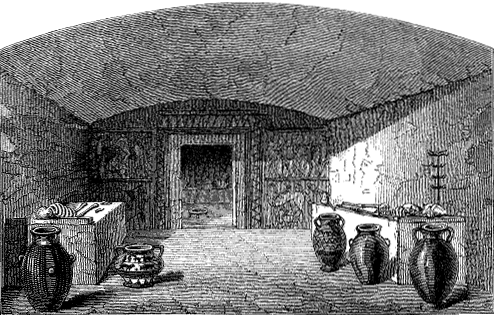
Many rich Tumuli and chamber tombs have been found. The most famous is the Grotta Campana uncovered in 1843, a chamber tomb with the oldest known Etruscan frescoes.
There are also long tunnels leading into the plateau of the city, which may corroborate Livy 's account of the Roman victory in the Battle of Veii.
The walls of Veii, of which small sections remain, bordered the two intersecting streams using the streambeds as a ditch, with a wall across the plateau closing the triangle.
Every Etruscan stronghold was built on an elevation, and Veii was no exception. Its arx, or citadel, was placed on a bluff delineated by cliffs within the angle of confluence of the two streams, nearly separated from the main ridge by a gully, through which ran a road in the Roman period. An archaeological site, Piazza d'Armi ("military square"), marks the location today.
Veii was the southeasternmost city of the Dodecapolis, the 12 cities of central Etruria commonly referred to as the Etruscan League. The league allowed the leaders of each city to come together and discuss a variety of topics. The city-states shared common religious practices, as well as different variations of the same language. The leaders met on a yearly basis at the Fanum Voltumnae Sanctuary in Velzna, or Volsinii near modern Orvieto.
Veii's sculptures and statues were made of terracotta. Most ceramic vessels were decorated with intricate details. Depictions of the everyday life of Etruscans were very common. Many uncovered vases and bowls portray images of farmers harvesting crops and raising animals, as well as blacksmiths in the midst of working in a raging fire. Battle victories, as well as other accomplishments, were very popular subjects in funerary ceramics.
As population and wealth flourished within the city, the use of bronze became more and more common. The people of Veii first used metal for horse harnesses, weapons, fans, jewelry, and mirrors.
The use of burial and cremation altered depending on the stability of the settlement. In the early years, most citizens were cremated. As affluence increased, individuals were freer to bury their loved ones close by in order to visit them regularly. Burial sites dating back to the 9th century BC have been uncovered. As inhumation became more and more popular, the sarcophagi became more and more intricate. Through the use of terracotta, local sculptors began using their talents to add adornments around the coffins, creating detailed accounts of the deceased's life, as well as the deities that meant the most to them. Tombs were commonly decorated with sentimental objects, as well as items they may need in the afterlife.
During times of war or economic difficulty, the use of cremation rose. Unlike their ancestors, however, the people of Veii continued the tradition of burial by keeping the urns of their loved ones in miniature tombs. Like the sarcophagi, the urns were made of terracotta and depicted varying scenes important to the diseased individual. Items were still placed in the small tombs; however, the value of the objects steadily dropped as times of financial crisis continued.
Over 10,000 Etruscan written pieces are known. Varying examples of Etruscan script have been uncovered all over the ancient world.
The city of Veii lies mainly on a tuff plateau 190 hectares (470 acres) in area.
The Valchetta flows a few miles eastward to join the Tiber River on the south side of Labaro along the Via Flaminia and Veii's territory included this area.
Its proximity to the Tiber and the trade route to the interior, which became the Via Flaminia, augmented its prosperity. The Veiians were known to trade with the Greeks and Phoenicians. Many Grecian pottery shards have been found throughout the site, dating from as far back as the 8th century BC. Although the river brought wealth and affluence to Veii, it also placed it in competition with Rome for the domination of Latium.
Closest places in our Italy guide.
More places to explore in Italy.