Austria
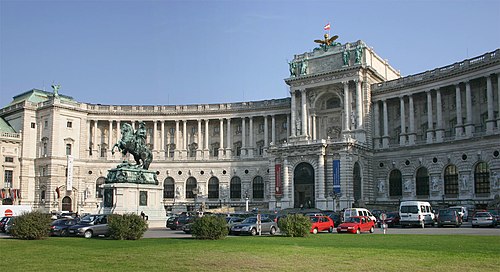
Maria Theresa Monument
Monument · Vienna
Natural history museum

The Natural History Museum Vienna (German: Naturhistorisches Museum Wien) is a large natural history museum located in Vienna, Austria. The NHM Vienna is one of the largest museums and non-university research institutions in Austria and an important center of excellence for all matters relating to natural sciences. The museum's 39 exhibition rooms cover 8,460 square meters and present more than 100,000 objects. It is home to 30 million objects available to more than 60 scientists and numerous guest researchers who carry out basic research in a wide range of topics related to human sciences, earth sciences, and life sciences. The Index Herbariorum code assigned to this museum is W and it is used when citing housed herbarium specimens.
The earliest collections of the Natural History Museum Vienna date back more than 250 years. It was the Holy Roman Emperor Francis I, Maria Theresa ’s husband, who in 1750 purchased what was at the time the world's largest collection of natural history objects from the Florentine scholar and scientist Jean de Baillou. This was the first step on the road to creating the Natural History Museum Vienna.
Baillou's collection comprised 30,000 objects, including rare fossils, snails, mussels, and corals, as well as valuable minerals and precious stones.
Emperor Francis, who founded the Schönbrunn zoo in 1752 and the botanical garden in 1753, also organized the first scientific overseas expedition. In 1755 he commissioned Nicolaus Joseph Jacquin to travel to the Caribbean, the Antilles, Venezuela, and Colombia. Jacquin returned from this expedition with many live animals and plants for the zoo and the botanical garden, as well as 67 cases full of other items of interest from the natural world.
After the Emperor's death, Maria Theresa gave the natural science collection to the state and opened it up to the general public. Thus she created the first museum in line with the principles and visions of the Enlightenment.

It was Maria Theresa who brought the mineralogist Ignaz von Born to Vienna. Born, who had developed a new method of extracting precious metals, was tasked with classifying and expanding the collections. To this end he had minerals from many different regions sent to Vienna, where they were added to the collection. Under the leadership of Ignaz von Born the cabinet of natural history quickly developed into a center of practical research.
To mark the marriage of his daughter Leopoldine to the heir to the Portuguese throne, Dom Pedro, Emperor Francis II sponsored a scientific expedition to her new home country of Brazil in 1817. Two Austrian frigates accompanied the archduchess on her journey to Rio de Janeiro.
Those taking part in the expedition, carried out under the scientific direction of the head of the history collection, included the researchers Johann Mikan and Johann Emmanuel, as well as the taxidermist Johann Natterer and the landscape painter Thomas Ender. The expedition lasted 18 years and aimed to collect all plants, animals, and minerals of scientific interest and bring them back to Vienna.
The most ambitious Austrian expedition was carried out by the SMS Novara, a frigate which sailed the world between 1857 and 1859. The scientific responsibility for this expedition was shared by the Academy of Sciences and the Geography Society. The man behind the project was Archduke Ferdinand Maximilian, Commander in Chief of the Austrian Navy.
Among the advisors was the naturalist and researcher Alexander von Humboldt. Many scientists took part in the two-year journey, including the geologist Ferdinand von Hochstetter, ethnologist Karl von Scherzer and zoologist Georg Ritter von Frauenfeld. The entire journey was documented in hundreds of sketches and paintings by the landscape artist Josef Selleny. The scientists returned home with a vast haul of minerals, animals, plants and items of ethnological interest.

The Admiral Tegetthoff travels into the ice
The last significant research expedition of the 19th century was the Austro-Hungarian North Pole expedition (1872–1874) led by Julius von Payer and Carl Weyprecht. On August 30, 1873, the participants on board discovered Franz Joseph Land.
With the main ship, the 220-ton Admiral Tegetthoff, at risk of breaking up under the pressure of the ice, the members of the expedition were forced to leave the ship. On May 20, 1874, they began their long retreat to the south, transporting their equipment and provisions on sleds and boats. Despite many sacrifices and great danger, the scientists returned to Vienna with both their invaluable travel journals and observations of the landscape, as well as a number of natural history items of interest welded into metal cases.
The Imperial Natural History Museum or Imperial-Royal Natural History Court Museum of Austria-Hungary was created by ( Kaiser ) Emperor Franz Joseph I during an extensive reorganization of the museum collections, from 1851 to 1876, and opened to the public on August 10, 1889. Located in Vienna, the Museum was named in German as " K.k. Naturhistorisches Hofmuseum" (with "Hofmuseum" translated as "Court Museum").
In the mid-19th century, there was much interest in the natural sciences, and the encouragement of this interest was a concern of the young sovereign, Franz Josef I : The newly built museum was inscribed: "Dem Reiche der Natur und seiner Erforschung —Kaiser FRANZ JOSEF I" ("To the realm of nature and its exploration —Emperor FRANZ JOSEPH I"). The new Imperial-Royal Natural History Court Museum thus documented the benevolent sentiment of the Imperial Household. Excavations for the construction of the new Museum of Nature started in the fall of 1871, and construction was completed more than ten years later.

On April 29, 1876, Emperor Franz Joseph I signed the document certifying the Natural History Court Museum, and Ferdinand von Hochstetter was appointed as the managing director of the museum. Hochstetter proposed a new organization for the museum and its collections. Four departments having far-reaching autonomy were created as successors to the older Cabinets; the Imperial-Royal Mineralogical Court Cabinet was divided in an Imperial-Royal Mineralogical-Petrographical Department and an Imperial-Royal Geologic-Paleontologic Department. The petrologist and meteorite specialist Aristides Brezina became director of the former and was supported by scientific colleagues: Friedrich Berwerth, with Felix Karrer and Rudolf Koechlin providing voluntary unpaid services. Felix Karrer became Secretary of the Wissenschaftlicher Club (Science Club) and founder of the Mineralogy collection of the department. By 1886, Rudolf Köchlin became scientific assistant and, later, maintained an inventory of the collection and even kept a diary.
Hochstetter died on July 18, 1884, and did not live to see the completion of the building for whose founding he had been so actively engaged. His successor as superintendent was Franz Ritter von Hauer, a geologist and paleontologist.
In the presence of the Emperor, the new "K.k. Naturhistorisches Hofmuseum" (Imperial-Royal Natural History Court Museum) was inaugurated on August 10, 1889. Initially, it was open to visitors four days per week—free on Thursdays, Saturdays and Sundays, on Tuesdays for an admission price of one florin. The museum building and the collection it contained were popular: from August 13, 1889, to the end of December 1889 the museum counted 175,000 visitors, of which most (134,000) visited the museum during the 19 Sundays over this time span alone.
During 1889, the "Mineralogisch-Petrographische Abteilung" (Department of Mineralogy-Petrography) was under the directorship of Aristides Brezina.
In 1889, the museum purchased the collection of William Earl Hidden from Newark, New Jersey ( USA ) for a sum of ƒ 15,000 with the aid of an advance from the "All-highest Family Fund" of the Imperial Household. This loan had to be repaid in a series of complicated transactions, effected within a timeframe of ten years (i.e. through the sale of mineral doublets, meteorite sections, and precious-metal redemptions). These redemptions also included samples of silver and gold from the former "Ambrasian Collection" of Archduke Ferdinand II, a loss and impairment to the collection.
Closest places in our Austria guide.
More places to explore in Austria.