.jpg?width=1200)
Australia
Macquarie Grove
Heritage site · New South Wales
Church building

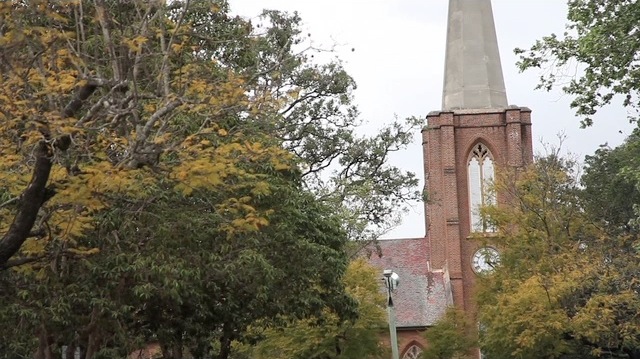
St John's Anglican Church Precinct, also known as St John's Camden, is a heritage-listed Anglican church and associated precinct at 6–22 Menangle Road, Camden, Camden Council, New South Wales, Australia. The precinct comprises the church, rectory, cemetery, two church halls and grounds that provide a rural landscaped environment to the group. The dominant feature of the precinct is the historic St John's the Evangelist Anglican Church. Its architects are unknown, and could be the cumulative work of Mortimer Lewis, John Cunningham and Edmund Blacket. It was built from 1840 to 1849 with Richard Basden responsible for the nave and John Le Fevre adding the spire. 1874 saw the addition of the chancel and vestry, their builder is unknown and the design is likely the work of Sir George Gilbert Scott and Blacket. A feature of the church is an organ manufactured by J. Bates & Son, London. The Anglican Church Property Trust of the Diocese of Sydney holds the property in trust, under the Anglican Church of Australia Trust Property Act 1917 (NSW). The precinct was added to the New South Wales State Heritage Register on 24 August 2018. St John's Anglican Church and its precinct are one of the most...
Few records exists of the people who inhabited the area before the arrival of the British, there is little doubt the Camden area saw extensive use. The Camden district sits on the boundaries of three groups. The Gandangara were the people of the Camden town and the areas to the west and south, the Dharawal/Tharawal to the south and east and the Darug to the north. The naming and grouping of the people is complex and uncertain. The plight of the traditional owners is poorly documented as contemporary accounts record the events from the settler's perspective. There are reports of 70% mortality due to a smallpox epidemic. The cemetery contains graves of a number of indigenous people and some plots were provided by the Macarthur family.
The first recorded trip by the colonists to the area was in August 1790, when Marine Captain-Lieutenant Watkin Tench, William Dawes and George Bouchier Worgan undertook a seven-day expedition to the south-west of Rose Hill (renamed Parramatta in June 1791) travelling until they reached Mt Prudhoe on the Razorback Ridge. Except for the discovery of a river, they reported nothing very interesting.
First hints of the potential of the district surfaced in 1795 when rumours of the existence of the missing first fleet cattle reach the colonists. So Governor Hunter dispatched Henry Hacking to confirm the reports. Hacking's report was so satisfactory that on 18 November 1795 Hunter set out to the district. On 20 November, Hunter in company with Captain Waterhouse, George Bass, David Collins and others crossed the Nepean and found a herd of over forty cattle. The next morning, they sighted the full herd of over 60 head and conclusively determined the herd were descendants of the missing cattle. The party reported "The country where they were found grazing was remarkably pleasant to the eye; every where the foot trod on thick and luxuriant grass; the trees were thinly scattered, and free from underwood, except in particular spots; several beautiful flats presented large ponds, covered with ducks and the black swan, the margins of which were fringed with shrubs of the most delightful tints, and the ground rose from these levels into hills of easy ascent."
Hunter decided it was best to leave the herd undisturbed for future consumption and export and resolved to guard the herd against any attempt to destroy it. unter's successors continued the policy of protection. However, by 1819 the preservation became too troublesome and Governor Macquarie decided to incorporate as many as possible into tame Government herds and open the whole area for settlement. In 1826, Governor Brisbane gave the order to slaughter the remnants.

On a 1796 sketch of the area, Hunter labeled the district as ‘Cow Pasture Plains’. Good reports of the area continued, following a visit by Governor King and his wife in December 1803, the area was described as ‘Exclusive of the very fine pasturage, the soil appears equally well calculated for tillage as are the Banks of the Hawkesbury’. The area first attracted tourists as early as 1804.
In 1789 John Macarthur joined the New South Wales Corps as a lieutenant with "every reasonable expectation of reaping the most material advantages". On 28 June 1790, Macarthur arrived in the colony on the Scarborough. He was accompanied by this wife Elizabeth (née Veale) and infant son, Edward. A daughter born on the voyage did not survive, Edward and John barely survived. Macarthur was the only officer to bring his family to the colony. The family focused on improving their situation and in 1800 Macarthur valued their holdings of more than 526 hectares (1,300 acres) acres at £ 4,000. Macarthur's family consisted of his wife Elizabeth, sons Edward (now at school in England), John, James and William and daughters Elizabeth and Mary. Another son, James, passed in 1794.
In 1801, Governor King sent Macarthur to England to face a court-martial for wounding Lieutenant-Colonel Paterson in a duel. Macarthur arrived in England in December 1802 with his son John and his daughter Elizabeth. Britain was at war and short of good quality wool. Macarthur seized the opportunity. He promoted his ability to solve the wool problem, resigned his commission, gained the patronage of the British Government and backing from Lord Camden. He returned to the colony in his ship, the Argo, on 5 June 1805 with merino sheep from the King's flock and documents requiring Governor King to grant him 2,023 hectares (5,000 acres) in Cowpastures and convict labour. The choice of this land likely the result of correspondence with Captain Waterhouse.
On 16 January 1806 Macarthur wrote to Governor King acknowledging receipt of the grant and the creation of what was to become known as Camden Park Estate.
Main article: Camden Park Estate Working together, the family continued ‘improving their situation’. Macarthur estates at Camden reached their maximum extent of ten separate grants totalling some 11,209 hectares (27,698 acres) acres in 1837 and were valued at £200,000 in early 1840s. The Macarthur family's other land holdings were extensive that extended beyond Camden Park including interests in all Nineteen Counties such as 7,284 hectares (18,000 acres) at Taralga and 24 hectares (60 acres) freehold in Sydney. The Precinct and the township of Camden are part of 2,185 hectares (5,400 acres) purchased by John Macarthur on 5 October 1825 for an annual rent of £135 for 20 years.
In 1831, the family turned their attention to the construction of house for the estate. The design is a sequence of commissions and abandoned designs, traced through a series of unbuilt schemes and houses at Camden, Parramatta and Pyrmont by Henry Kitchen and Henry Cooper, James Smith and John Verge, the cottages orné Belgenny and Hambledon, and the design of Elizabeth Farm at Parramatta, to the final Palladian architecture house. John Macarthur took an active interest in the construction which finished in 1835, shortly after his death in 1834. His sons James and William Macarthur took up occupancy in the new house, while their mother Elizabeth continue to reside at Elizabeth Farm in Parramatta. The house remains in the hands of a direct descendant of John Macarthur. On John Macarthur's death in April 1834, his Camden estate passed to William and James as tenants in common, Elizabeth Farm was retained by Elizabeth, and Edward inherited the rest of the Macarthur estates. Elizabeth and her unmarried daughters (Emmeline and Elizabeth) were to receive annuities paid by their brothers. Around this time, the security of the Macarthur estates from public access diminished. The main route between the County of Cumberland and the southern counties passed through the Macarthur estates. In April 1833 James Macarthur complained of the damage done to fencing, by fire and trespass and the infection of his valuable flocks by scabby sheep passing through the property.
The property division on John's death, the considerable expenses of the construction of the homestead, security, the cessation of the assignment of convicts to private service, drought, and poor economic conditions caused a significant upheaval in operation and financing of the estate. James and William responded by bringing free labourers out to the Colony using Governor Bourke's bounty system. With the introduction of these immigrants, the demographic structure of the Camden Park workforce changed dramatically from an almost exclusively male domain to one with families. The model of management turned to estate tenants on small farms of about 12–16 hectares (30–40 acres) with incentives and opportunities for individuals to improve their situation. James and William established a model of paternalistic benevolence and management typical of English gentry. Their superior wealth and social standing enable him to dominate their community, a system entirely at odds with the entrepreneurial spirit of the Colony.
In 1836 a plan for the private town of Camden went to the Surveyor-General 's office. The project provided for the erection of a church, "the situation of which will be highly picturesque and commanding." The position of the Church was deliberate with clear sight lines to the main house.
James and William were intelligent and capable men and their interests and morals were to characterise the development of the Camden Park Estate. [ citation needed ] Of the many things which they were fond of, such as theatre and history, they had a special interest in a well-made or picturesque landscape that could encapsulate and frame the works and lives of men and women. Consequently, during the early development of the estate they spent much time and money on developing the beauty of its landscape, which in time incorporated the township of Camden. James and William saw to the construction of three well-made and purposefully placed structures, St John's Anglican Church, Camden Park House, and the monument on John Macarthur's grave, that helped to form a triangular arrangement of subtle and elegant picturesque vistas. This was especially when they were contrasted with the intrinsic beauty of the surrounding "natural" landscape. Form the earliest trespasses of Europeans into this region they had considered the Camden landscape to be beautiful, almost a work of art, and satisfactory to the aesthetic notions of the time that valued the combination of the natural and the artificial (the works of man - anthropogenic ). Adapting or improving this original canvas with the works of men could only add to its beauty in the minds of the Macarthurs and their contemporaries.
The establishment of the Township of Camden

- Main article: Camden, New South Wales The construction of the Great South Road with a river crossing over the Nepean River along the north boundary of the Camden Park Estate in the early 1820s ultimately served as the goad for the establishment of a Township in the area. In 1826 this crossing was replaced by a bridge which more effectively opened up the land to the south for settlement and the mere existence of the bridge encouraged the development of a settlement. The fact that there were no major settlements along the Great South Road for considerable distances each way from the Cowpastures also encouraged the establishment of a police lock-up at Camden that could patrol the road and protect settlers against bushrangers.
Consequently, in December 1830 a group of local residents petitioned Governor Darling for the establishment of settlement, comprising a police station, court-house, goal, and church, near the Cowpastures Bridge. Darling liked this idea and began arranging for the establishment of a 130-hectare (320-acre) township to serve as a local administrative centre. However, due to most of the land along the Nepean being a flood plain and nearly all of it also having been granted away the NSW Government had no existing Crown Land on which to establish a township. The Surveyor-General Thomas Mitchell recommended the land on the south bank of the Nepean on a rise close to the river being the most ideal choice, but this location was part of the Camden Park Estate. As John Macarthur had not signed the petition and was not amenable to the idea of giving away any of his Estate for this purpose, the plan was shelved at this time.
James and William Macarthur were of the same opinion as their neighbours that a township would be to the benefit of the district, but they were unable to change their father's mind. Following John's death and their establishment as the official heads of the Estate they were able to re-commence the plans for a township. In the interval the government had chosen Campbelltown as the main administration centre in the southern districts, but this allowed James and William to develop their own private township in accordance with their own ideals. They were keen to promote public order (along with a keen social order) that reflected a spiritual one that could encourage and regulate the minds and souls of the people. To this end an Anglican church was to form the imposing and commanding centrepiece of their new township.
The Macarthur brothers had the 8-hectare (20-acre) area for their township cleared during the winter of 1835. On this foundation they desired that the first building to be constructed should be a church. To this end they appealed to their neighbours and employees for assistance and subscriptions to fulfil this goal. James was the main force behind this scheme. He was more religious than William and convinced that religious progress was beneficial, but that it should not be forced on the lower classes by the gentry, but rather be the result of the combined effort and initiative of all classes. This was to encourage a collective and mutual dependence among the population that was in keeping with Christian teachings and tenets. In this way, James pictured this church as growing from the land from the combined effort of the people so that it could be a focus of their moral behaviour and a symbol of the inter-reliance of society for its common good. However, he still demanded that it be an Anglican church, in accordance with its status as the Established Faith, despite the fact that people of a number of different denominations resided in the area.
James and William had amassed A£ 644 in subscriptions by September 1835 for the construction of an Anglican church. Of this total they had promised A£500, while their employees had offered A£43, and their neighbours the remainder. This allowed them to write to the government outlining their plans for a township and offering a copy of the subscription list as evidence of the commitment of the local population. They envisioned that the town would include reserves for a police station and lock-up, courthouse, post-office, and for churches of the several denominations: Anglican, Catholic, and Presbyterian, that flourished in the area.
Closest places in our Australia guide.
More places to explore in Australia.


.jpg?width=1200)
.jpg?width=1200)

.jpg?width=1200)

.jpg?width=1200)
.jpg?width=1200)
.jpg?width=1200)


