
New Zealand
TSB Stadium
Stadium · New Plymouth
Park
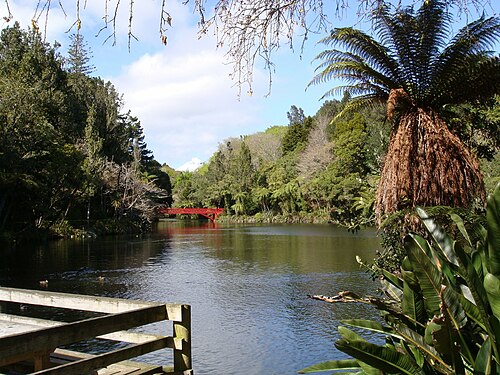
Pukekura Park is a Garden of National Significance, covering 52 hectares in the heart of New Plymouth, Taranaki, in New Zealand.
The gala opening of New Plymouth's 15 hectare Recreation Ground was held on 29 May 1876. During the day the first trees were ceremonially planted by Miss Jane Carrington, the daughter of surveyor Frederic Alonzo Carrington : an oak for Great Britain, a pūriri for New Zealand, a Norfolk Island pine for the South Pacific Islands and a Pinus radiata for America. The ceremonial spade used to plant the trees is held in the Puke Ariki collection in New Plymouth. The Recreation Grounds were renamed "Pukekura Park" in 1907.
The park contains a diverse range of native and exotic plants. Various easy walking trails cross the park and meander along the lake sides, taking in the features of the park. Among these are the picturesque Poet's Bridge, which was opened on 11 March 1884. There is also a man-made cascading waterfall and a fountain in the Fountain Lake. Row boats can be hired on the main lake.
Four Heritage New Zealand historic places are found in the park: Queen Victoria Monument, Band Rotunda, Kiosk and the Poet's Bridge.
The Queen Victoria Monument is a Historic Place Category 2 Drinking Fountain erected to commemorate Queen Victoria's Diamond Jubilee in 1897. Located near the Band Rotunda at the base of Cannon Hill, this marble structure features a lion's head spout and remains a functional drinking station for park visitors today. The monument reflects the Victorian era 's influence on the park's early development.

The Band Rotunda in Pukekura Park reflects a decade of civic determination, progressing from Henry Edmonds’ 1882 proposal through continued fundraising, substantial earthworks on Cannon Hill, and phased construction. Completed in 1891 with cast iron elements manufactured by Scott Bros. in Christchurch, it was inaugurated during the Taranaki Jubilee before an audience of more than 5,000. Restored in 2013, it remains a central fixture for concerts, community events and seasonal festivals.
The Kiosk, now widely known as The Teahouse, is an iconic historic café situated alongside the main lake in the park. The Teahouse began in 1905 as a small ladies’ meeting and tearoom designed by J. A. Maisey, and supported by community fundraising and donated labour. By the late 1910s, the building was considered inadequate, but full replacement was delayed due to limited funds. A new Tea House was finally constructed in 1931, funded largely by Mr and Mrs Burgess as part of their Golden Wedding celebrations. Earlier structures on the site were relocated to accommodate the new building.
Built in 1884 after James T. Davis won £500 on a sweepstake horse named "The Poet", the bridge opened with lanterns, bunting, and celebration beside the old Bathing Shed. The original structure stood until 1936, when it was deemed unsafe. It was replaced in 1938 with a similar design funded by the Sanders bequest. The new bridge’s now iconic red colour came from a suggestion inspired by Japan’s Shinkyo Bridge.
Four Heritage New Zealand historic places are found in the park: Queen Victoria Monument, Band Rotunda, Kiosk and the Poet's Bridge.
The Queen Victoria Monument is a Historic Place Category 2 Drinking Fountain erected to commemorate Queen Victoria's Diamond Jubilee in 1897. Located near the Band Rotunda at the base of Cannon Hill, this marble structure features a lion's head spout and remains a functional drinking station for park visitors today. The monument reflects the Victorian era 's influence on the park's early development.

The Band Rotunda in Pukekura Park reflects a decade of civic determination, progressing from Henry Edmonds’ 1882 proposal through continued fundraising, substantial earthworks on Cannon Hill, and phased construction. Completed in 1891 with cast iron elements manufactured by Scott Bros. in Christchurch, it was inaugurated during the Taranaki Jubilee before an audience of more than 5,000. Restored in 2013, it remains a central fixture for concerts, community events and seasonal festivals.
The Kiosk, now widely known as The Teahouse, is an iconic historic café situated alongside the main lake in the park. The Teahouse began in 1905 as a small ladies’ meeting and tearoom designed by J. A. Maisey, and supported by community fundraising and donated labour. By the late 1910s, the building was considered inadequate, but full replacement was delayed due to limited funds. A new Tea House was finally constructed in 1931, funded largely by Mr and Mrs Burgess as part of their Golden Wedding celebrations. Earlier structures on the site were relocated to accommodate the new building.
Built in 1884 after James T. Davis won £500 on a sweepstake horse named "The Poet", the bridge opened with lanterns, bunting, and celebration beside the old Bathing Shed. The original structure stood until 1936, when it was deemed unsafe. It was replaced in 1938 with a similar design funded by the Sanders bequest. The new bridge’s now iconic red colour came from a suggestion inspired by Japan’s Shinkyo Bridge.
The Queen Victoria Monument is a Historic Place Category 2 Drinking Fountain erected to commemorate Queen Victoria's Diamond Jubilee in 1897. Located near the Band Rotunda at the base of Cannon Hill, this marble structure features a lion's head spout and remains a functional drinking station for park visitors today. The monument reflects the Victorian era 's influence on the park's early development.
The Band Rotunda in Pukekura Park reflects a decade of civic determination, progressing from Henry Edmonds’ 1882 proposal through continued fundraising, substantial earthworks on Cannon Hill, and phased construction. Completed in 1891 with cast iron elements manufactured by Scott Bros. in Christchurch, it was inaugurated during the Taranaki Jubilee before an audience of more than 5,000. Restored in 2013, it remains a central fixture for concerts, community events and seasonal festivals.

The Kiosk, now widely known as The Teahouse, is an iconic historic café situated alongside the main lake in the park. The Teahouse began in 1905 as a small ladies’ meeting and tearoom designed by J. A. Maisey, and supported by community fundraising and donated labour. By the late 1910s, the building was considered inadequate, but full replacement was delayed due to limited funds. A new Tea House was finally constructed in 1931, funded largely by Mr and Mrs Burgess as part of their Golden Wedding celebrations. Earlier structures on the site were relocated to accommodate the new building.
Built in 1884 after James T. Davis won £500 on a sweepstake horse named "The Poet", the bridge opened with lanterns, bunting, and celebration beside the old Bathing Shed. The original structure stood until 1936, when it was deemed unsafe. It was replaced in 1938 with a similar design funded by the Sanders bequest. The new bridge’s now iconic red colour came from a suggestion inspired by Japan’s Shinkyo Bridge.
Main article: Festival of Lights (New Plymouth) The "TSB Festival of Lights" is an annual, free summer event held in Pukekura Park. With light installations illuminating the park, the festival typically runs for five to six weeks from mid-December through late January. The multi-award-winning festival has a daytime and nighttime programme of events for people of all ages.
Pukekura Park’s Fernery and Display Houses comprise three glass‑roofed caverns cut directly into the hillside. Positioned below the natural ground level, they maintain a moderated, temperate environment that supports the cultivation and exhibition of a diverse range of plant species from around the world.
The Fernery originated from a 1918 proposal to safeguard native ferns, but only realised in 1926 after extensive fundraising efforts. Over the next eighteen months, the hillside was excavated by hand, with the removed soil used to form the lawn in front of the complex. Planting began in July 1927, introducing 2,340 ferns across 145 species, and the Fernery opened to the public on 28 January 1928, funded entirely through community subscription and donations. Initially focused on New Zealand ferns, the collection expanded in 1934 with the addition of plants from the Brooklands estate glasshouses. Ongoing improvements to both the structures and displays were supported by further bequests, including a major 1969 gift that enabled the rebuilding of a fourth house dedicated to exotic species such as begonias and orchids.
Closest places in our New Zealand guide.
More places to explore in New Zealand.


