
Australia
Treasury Hotel
Historic site · Queensland
Park

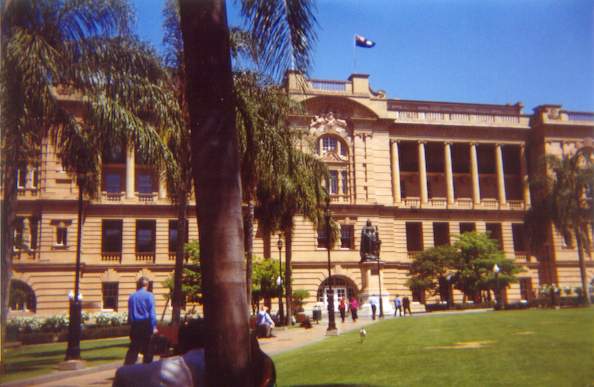
Queens Gardens is a heritage-listed park located on a city block between George Street, Elizabeth Street and William Street in the Brisbane CBD, City of Brisbane, Queensland, Australia. It was built from c. 1905 to 1990s. It is also known as Executive Gardens and St Johns Church Reserve. It was added to the Queensland Heritage Register on 21 October 1992. Queens Gardens are adjacent to the former Land Administration Building (now the Heritage Hotel of the Treasury Casino). On the opposite side of William Street is the Old State Library Building and on the opposite side of Elizabeth Street is the former Treasury Building (now the Treasury Casino).
As an early penal colony the site was originally home to a cottage, lumber yard, engineer's store and workshops.
Queens Gardens was established in several stages between 1905 and 1962, on a site which has been associated both with the earliest phase of the penal settlement at Moreton Bay, and with the establishment of the Church of England in Queensland.
During the convict era the engineer's weatherboard cottage stood on part of the site, at the corner of William and Elizabeth Streets. It appears to have been both the first house and the first sawn timber building to be erected in Brisbane Town.
Occupying most of the remainder of the site was a lumber yard, erected c.1825, which contained the engineer's stores and workshops. By 1838 the lumber yard had been moved, and the cottage had been converted into offices. The section of the present park along George Street was part of the chaplain's garden from 1840 at least.
In 1848 the site was acquired by the Church of England. A parsonage was constructed at the corner of William and Elizabeth Streets in 1850–1851, and St John's Church was erected on the site, further along William Street, in 1850–1854. In 1868 it was extended. A detached bell tower was erected in 1877, and in 1879–1880 a building which served as church school, synod hall, library and committee rooms was built in the eastern corner of the site.
In the 1880s the Church proclaimed the square a future cathedral site, and a new Church Institute and Synod Hall was erected in the northern corner of the square in 1897.
Following church protests at the 1899 announcement of plans to erect a new lands and survey building adjacent to the pro-cathedral, the government offered to purchase the church square, and acquired it the same year.
In 1901 the Church Institute building was occupied by the Police Department and later served as offices for the Criminal Investigation Branch.
In 1904 the pro-cathedral, belltower, church school and parsonage were demolished and a 0.25 hectares (0.62 acres), 30-metre (98 ft) wide strip between William and George Streets, adjacent to the new Executive Building, was proclaimed as the Executive Gardens.

A bronze statue of Queen Victoria, a replica by English sculptor Thomas Brock of the original in Portsmouth, was erected in mid-1906. The purchase was arranged by local artist Godfrey Rivers, and was funded by public subscription and subsidies from state and local government. The pedestal was designed by the Public Works Department and crafted by local stonemason William Kitchen, at a cost of £ 567.
The statue was an expression of Queensland's loyalty to the British Empire. On Empire Day veterans from the Crimean, Sudan and South African wars gathered in what became known as the Queens Gardens, which became also an assembly point for state occasions such as funeral or celebratory processions. The monument remains the only statue of Queen Victoria in Brisbane.
In late 1906 the reserve was extended to an area of 0.37 hectares (0.91 acres), with the inclusion of the site of the former parsonage.
In 1917 a Krupp 77mm field gun, captured from the German army in France in 1915 during World War I, was placed in the gardens. It was a gift from King George V and presented to Queensland by Lord Kitchener as a Trophy of British Valour on 18 August 1917, at the request of Thomas Joseph Ryan, lawyer, anti-conscriptionist and Queensland Labor Premier 1915–1919.
A bronze statue of TJ Ryan, designed by Australian sculptor Bertram MacKennal and erected by public subscription, was unveiled in the gardens in 1925. The sandstone base was provided by the Brisbane City Council.

In 1962 the CIB building at the northern corner of the site was demolished and the park was extended to occupy the entire square, with a total area of 0.48 hectares (1.2 acres). A new layout for the gardens was prepared as a joint state and local government scheme in preparation for the visit of Queen Elizabeth II to Brisbane in March 1963. Brisbane City Council landscape architect, horticulturalist and author, Harry Oakman, was responsible for the design and landscaping, and architectural detailing was undertaken by Department of Works architect Graham De Gruchy.
In 1990 the Queensland Service Women's Association erected a Monument of Memories in the park, honouring the 70,000 service women.
Queens Gardens is a public park, square in plan, that is bounded by William, Elizabeth and George Streets on the southwestern, northwestern and northeastern sides and by the Lands Administration Building (now Heritage Hotel) on the southeastern edge. Located around the perimeter of the Gardens are a number of important government buildings including the Lands Administration Building, the Treasury Building (now the Treasury Casino ), the Old State Library and the Family Services Building.
The main elements of the design are: an asphalt area in front of the Lands Administration Building which connects George and William Streets; a diagonal path leading from the northern corner to the centre of the asphalt area; and a large lawn bounded by Elizabeth Street, the diagonal path, the asphalt area and garden beds along William Street. A lily pond, recently rebuilt, is located adjacent to the intersection of the diagonal path and the asphalt area. On the southwestern side of the pond is a converted fountain, now a sandstone and concrete planter box. The diagonal path is emphasised by a row of colvillea trees ( Colvillea racemosa ). A coral tree ( Erythrina spp. ) marks the entrance to the park from George Street.
With the exception of specimen trees most of the planting in the park is kept at a low level so as not to divide the space visually. Barriers to movement, if not vision, are created along George Street by a zig-zag hedge ( Acalypha ) and along William Street by a chain wire fence, hedge and garden bed.
Closest places in our Australia guide.
More places to explore in Australia.


.jpg?width=1200)


.jpg?width=1200)
.jpg?width=1200)
.jpg?width=1200)


