Romania
Castra of Târsa
Castrum · Târsa
Archaeological site

Sarmizegetusa Regia (also known as Sarmisegetusa, Sarmisegethusa, Sarmisegethuza; Ancient Greek: Ζαρμιζεγεθούσα, romanized: Zarmizegethoúsa) was the capital and the most important military, religious and political centre of the Dacians before the wars with the Roman Empire. Built on top of a 1200 m high mountain, the fortress, consisting of six citadels, was the core of a strategic and defensive system in the Orăștie Mountains (in present-day Romania). The archaeological site of Sarmizegetusa Regia is located in the village of Grădiștea de Munte in Hunedoara County. Sarmizegetusa Regia should not be confused with Ulpia Traiana Sarmizegetusa, the Roman capital of Dacia built by Roman Emperor Trajan some 40 km away, which was not the Dacian capital. Sarmizegetusa Ulpia was discovered earlier, was known already in the early 1900s, and was initially mistaken for the Dacian capital, a confusion which led to incorrect conclusions being made regarding the military history and organization of the Dacians.
The pronunciation in the Dacian language is not known for certain, nor is the meaning of the word. Several hypotheses have been advanced to explain the origin of the name Sarmizegetusa. The most important of these ascribe the following possible meanings to the city's name:
- ‘Citadel built of palisades on a mountain peak’ from zermi (*gher-mi ‘mountain peak, top’, cf. *gher ‘stone; high’) and zeget (from the Indo-European *geg(H)t ‘branch, pillar (for palisade)’ and ending with a determinant which has the meaning of "The Citadel on the Rock," "The High Citadel," "Palisade Citadel (built) on a height (or rock)." Since Sarmizegetusa was not initially a military fortification initially, but a religious and civil settlement, the etymology must be considered with certain reservations. It may be that the name indicated the sacrality of that place, or the fact that it was a royal citadel, at its origin.
- ‘City of the warm river’ from zarmi ‘warm’ (cognate with Sanskrit gharma ‘warm’) and zeget ‘flow’ (cognate with Sanskrit sarj- in sarjana- ‘flow’ and Bactrian harez- in harezâna ‘id.’), the city being named after the nearby river Sargetia
- 'Center where horse-mounted archers meet' from sar 'horse' (Getian and Sarmatian) combined with gethusa 'arrow' (cognate with Sarmatian sageta ) and gethate 'center' (cognate Sarmatian cetate )
- ‘Palace illuminating the world of life’ from zaryma ‘palace’ (cf. Sanskrit harmya ‘palace’), zegeth ‘world of life’ (cf. Sanskrit jagat - ‘go’, and jigat - ‘mobility; world of life’) and usa ‘illuminating, enlightening; burning’)
- 'The capital of the Sarmatians and Gets' from the Latin terms: sarmis et getusa. 'SARMIS.E[T].GETUSA REGIA' is an alternate spelling of the full Latin name of the location.. Getae and Dacians were interchangeable terms. The -A after GETUS is part of the genitive case in Latin, indicating ownership. This is plausible as the Dacians were allied with the Sarmatians (e.g., Roxolani) during the Dacian Wars in the early first century CE.
- 'The home of the Getic nation'. Vasile Pârvan proposed reading it as Sarmiz-egetusa in the sense of "Egetusa of Sarmos" or "Zarmos,", noting that Zarmos/Zermos was a known Thracian name cited by the Austrian researcher Wilhelm Tomaschek in his ethnological study Die alten Thraker (The Ancient Thracians). Pârvan's opinion was shared by the Bulgarian scientist and Thracologist Dimitar Dechev, who brought up for comparison the names of people from Lycia: Zermounsis, Ro-zarmas, Ia-zarmas, Troko-zarmas and the Thracian variant based on Zermos, Xermo-sígestos or Zermo-sígestos. Tomaschek had proposed in that 19th-century work the reading Zermi-zegétousa, comparing the first part with harmyá from Sanskrit "hearth; home; family" and the Armenian word zarm(i) "family, offspring," the final meaning supposed by Tomaschek being "the house of the (Getic) nation."
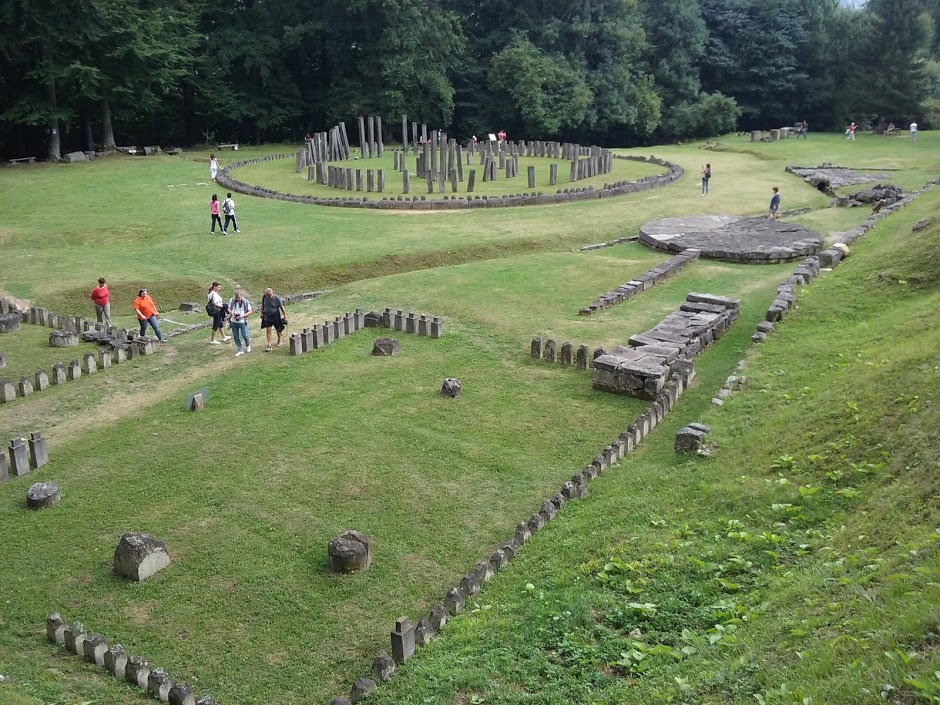
Sarmizegetusa Regia contained a citadel, the largest of the Dacian fortifications, and residential areas with dwellings and workshops as well as a sacred zone.
- The fortress, a quadrilateral formed by massive stone blocks ( murus dacicus ), was constructed on five terraces, on an area of almost 30,000 m².

- The sacred zone — among the most important and largest circular and rectangular Dacian sanctuaries – includes a number of rectangular temples, the bases of their supporting columns still visible in regular arrays. Perhaps the most enigmatic construction at the site is the large circular sanctuary or calendar. It consisted of a setting of timber posts in the shape of a D, surrounded by a timber circle which in turn was surrounded by a low stone kerb. The layout of the timber settings bears some resemblance to the stone monument at Stonehenge in England.
- An artifact referred to as the “Andesite Sun" seems to have been used as a sundial. Since it is known that Dacian culture was influenced by contact with Hellenisitic Greece, the sundial may have resulted from the Dacians' exposure to Hellenistic learning in geometry and astronomy.
- Civilians lived below the citadel itself in settlements built on artificial terraces, such as the one at Feţele Albe. A system of ceramic pipes channeled running water into the residences of the nobility. The archaeological inventory found at the site demonstrates that Dacian society had a relatively high standard of living.
The citadel wall was 3 m thick and about 4 – 5 m high at the time of its completion. Because the wall, which encloses an area of about 3 ha, is built to follow the edges of the height, the citadel has a more unusual configuration, that of a hexagon with unequal sides. Nearby, to the west, there is an extensive civil settlement covering an area of 3 km, where many dwellings, workshops, warehouses, barns, and water reservoirs can be observed. 100 meters to the east, right at the citadel gate on the same cardinal point, are the sanctuaries, which have varied shapes and sizes. The sanctuaries were located on a terrace, which had been connected to the aforementioned gate by a paved road. It is not known whether there were seven or eight quadrilateral sanctuaries, as they were destroyed by the Romans during hostilities and it cannot be determined whether it was a single large sanctuary or two smaller ones built very close together. There are only two circular sanctuaries.
Historical records show considerable variation in the spelling of the name of the Dacian capital:

- Zarmigethusa, Sarmisegethusa ( Ptolemy, Geography, 2nd century AD)
- Zermizegethusa ( Dio Cassius 2nd-3rd century)
- Sarmazege ( Anonymous Geographer from Ravenna, around 700 AD)
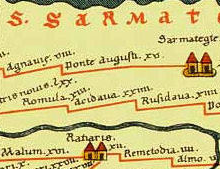
- Sarmategte ( Tabula Peutingeriana, 13th century)
- Zarmizegetusa and Sarmizegetusa (from inscriptions)
Closest places in our Romania guide.
More places to explore in Romania.