Netherlands
Vrouwekerk
Church building · Leiden
Science museum

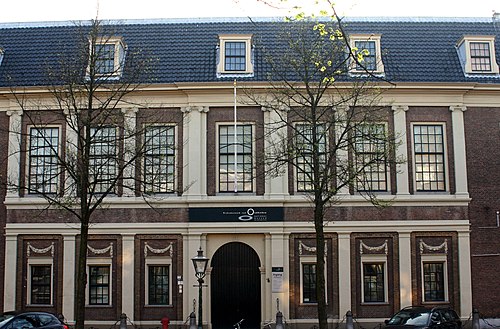
Rijksmuseum Boerhaave is a museum of the history of science and medicine, based in Leiden, Netherlands. The museum hosts a collection of historical scientific instruments from all disciplines, but mainly from medicine, physics, and astronomy. The museum is located in a building that was originally a convent in central Leiden. It includes a reconstructed traditional anatomical theatre. It also has many galleries that include the apparatus with which Heike Kamerlingh Onnes first liquefied helium (in Leiden), the electromagnet equipment used by Wander Johannes de Haas (a Leiden physicist) for his low-temperature research, and an example of the Leiden jar, among many other objects in the extensive collection. The museum is named after Herman Boerhaave, a Dutch physician and botanist who was famous in Europe for his teaching at Leiden and lived to a great age, receiving brilliant students from all over Europe, including Peter the Great, Voltaire and Linnaeus.
Boerhaave Museum's history began in 1907, when a Historical Exhibition of Natural Science and Medicine was held in the Academy Building [ nl ] of Leiden University. The many objects in the exhibition came from all the learned corners of the country. It was a great success and there were immediately calls to set up a permanent science history exhibit.
In 1928 a foundation was initiated by physicist Claude August Crommelin, who worked at Leiden university, for a museum for the history of natural sciences. The aim of the museum was described in the preliminary statutes of the foundation: "the collection of instruments, tools, slides and specimens, documents and other objects, which are important for the history of the natural sciences; to look after these objects, describe them and keep them in a museum which is to be located in Leiden". The sciences to be represented included: Astronomy, Physics, Chemistry, Botany, Zoology, Pharmacy, all medical sciences – including Physiology, Anatomy et cetera, and Mathematics.
In 1931 the museum opened as "The Dutch Historical Museum of the Natural Sciences" ( Het Nederlandsch Historisch Natuurwetenschappelijk Museum ). To the view of Crommelin, the museum was to become a national museum: the 's Gravesande-Musschenbroek collection would form the starting point, to which collections from other institutes were to be added.
In 1947 the museum, which was in fact a private foundation, became formally a national museum. It was renamed to "The Dutch National Museum for the History of the Natural Sciences" ( Rijksmuseum voor de Geschiedenis van Natuurwetenschappen ). An advisory board was installed in which members of Dutch universities would take seat. It underlined the ambition to become a national museum, not a museum solely connected to the Leiden University.

Before moving in 1991, the museum was located in the former Boerhaave Laboratory at the Steenstraat 1, Leiden, a building which belonged to the Leiden Academic Hospital ( Leiden Academisch Hospital ), now part of LUMC, Leiden University Medical Center. This location of the museum now houses the National Museum of Ethnology.
To create better housing the former nunnery of Saint Cecilia was bought by the Government Buildings Agency ( Rijksgebouwendienst ). This historic building has had various functions over time. The building dates from the early 15th century. The building had become municipal property after the Protestant Reformation and shortly before 1600 was converted into a pest house and lunatic asylum. The Leiden Academic hospital was founded in this location between 1636 and 1639. In 1967, with the prospect of a new location the name of the museum was changed to "Museum Boerhaave". However, it took more than twenty years before the museum finally moved. After extensive restoration and expansion, the building is in use as a museum since 1991.
Rijksmuseum Boerhaave was elected European Museum of the Year 2019. Founded in 1977, this is the oldest and most prestigious museum award in Europe. The international jury praised the completely renewed science and medicine museum in Leiden: "The exceptional public quality of this museum results from its artful approach to communicating science. Important and beautiful objects are interpreted using the latest technologies and the personal stories of those driven by a passion for the pursuit of knowledge. The result is science with a human face, inspiring curiosity and amazement as well as engaging a wide public in debates on important scientific and ethical questions issues of our time."
The Boerhaave Museum is running a project to document approx. 3000 objects in its collection online, with pictures and descriptions for every single object. In April 2010 the site featured over 1750 objects, ordered by room and showcase. This overview is in large part based on the museum's online documentation.
The museum has 25 galleries, which are by and large organised chronologically, with thematical subgroupings per gallery.

Gapers (wooden heads miming the swallowing of pills) and other shop signs for pharmacies and druggists. Also a 'dictionary of health': a tall book-shaped wooden chest (1660) filled with simples (basic substances used in medicine).
The room shows a reconstruction (1988) of the Theatrum Anatomicum ( anatomical theatre ) (built 1596). A richly decorated instrument chest (1670) which belonged to the Leiden surgeon 's guild. A small collection of objects (largely Egyptian antiquities) that survived from the now gone Leiden Theatrum (one of the oldest museums of Europe [ citation needed ] ) are shown as well. On the wall three paintings: one depicting the magistrates of the Catharina and Caecilia Hospitals (the latter now houses the museum), a second showing a Prussian peasant from whom a 10-inch sword, swallowed in a drinking bout, has surgically been removed, a third showing renowned surgeon and designer of medical instruments Cornelis Solingen (1680). One of Solingen's inventions (part of the collection) was a screw to unindent a soldiers skull who had been hit by a bullet. Often in those days bullets did not fully penetrate a skull, merely deformed it.
2 Drawn from life Four large allegoric paintings (± 1610) show in stages how the appreciation of a patient for his physician declines, from being a true savior when the illness is at its height, towards being a devil when the bill has been delivered. Three solid figures of Saints Cosmas and Damian, patrons of doctors and pharmacists. Six anatomical books and drawings (1520–1570) and six books on herbs (1480–1590) testify how in the Renaissance there was an urge to study life diligently and not take traditional beliefs for granted. A large collection of baked and painted apothecary jars (1550–1650) and (often ornamented) cast-iron and bronze mortars (1350–1700).
The following two rooms are dedicated to an era of blossom for the University of Leiden, the oldest university of the Netherlands (founded in 1575).
4 Leiden University: Boerhaave and ‘s Gravensande

This large room is dedicated to physician, botanist and chemist Herman Boerhaave, physicist Willem 's Gravesande and instrument-maker Jan van Musschenbroeck. On display are large globes and a tiny pocket globe (all ~1700), each depicting heaven and earth. A table size planetarium by clock-maker Steven Tracy Mercury shows Venus, Earth with its moon, Mars, Jupiter with four moons and Saturn. There is also a large star atlas.
Air pumps (1670–1730) and demonstration devices, notably several Magdeburg hemispheres, were made to explore the properties of the newly discovered vacuum. Other devices did the same for centrifugal force, collisions and laws of momentum, and gravity.
Hydrometers, an aerometer, a hydrostatic bellows, a balance and steam pump, several table-top fountains all were used to look into hydrostatic pressure, and capillary attraction.
Also shown are a large set of mathematical instruments to measure angles: sectors, a protractor and beam compass.
A collection of balances, levers, tackles demonstrate laws of statics.
Closest places in our Netherlands guide.
More places to explore in Netherlands.