Germany
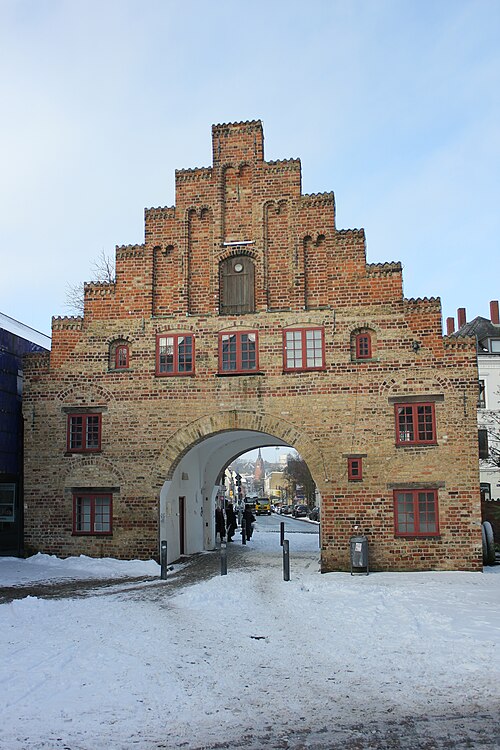
Nordertor
City gate · Flensburg
Museum

Glücksburg Castle (German: Schloss Glücksburg, Danish: Lyksborg Slot) is one of the most significant Renaissance castles in Northern Europe.
The castle was the headquarters of the ducal lines of the house of Glücksburg and temporarily served as the primary residence of the Danish monarch. The building is in the town of Glücksburg, located in Northern Germany on the Flensburg Firth. The structure is a water castle. The ducal house of Glücksburg derived its name from the castle and its family members are related to almost all European dynasties. Nowadays, the castle is one of the most famous sights in the German state of Schleswig-Holstein. Within the castle is a museum which is open to the public.
The history of today's castle grounds began in Schleswig in 1192, when the double monastery of St. Michael auf dem Berge was dissolved. The nuns then moved to the St. John's Monastery [ de ] in Schleswig, which still exists today, while the monks left the place and went to Guldholm on Langsee. Between 1209 and 1210 the monks founded a new Cistercian monastery in Glücksburg. In the vicinity of the monastery was an older motte-and-bailey castle, parts of which have been preserved to this day. The so-called Ryd Abbey and the extensive estates were inhabited and managed by the monks in the following centuries. At the same time, the neighboring town Flensburg still had several castles, as well as the large, militarily important Duburg fortress, built in 1411. In the course of the Reformation, the Rüdekloster was secularized in 1538 and came into the possession of the Danish King Christian III in 1544. The monastery buildings served as the administrator's residence. In the beginning of the 16th century, the condition of the Duburg fortress in Flensburg began to decline.
The history of the castle itself begins in 1582. The Danish King Frederick II encumbered his brother John, known as Hans the Younger, with the lands of Sundewitt, the Reinfeld monastery and the old Ryd Abbey, amongst other things. John, who already had considerable possessions, acquired additional areas. The government of the duchy was largely in the hands of John's brother. Although John was a partitioned-off duke, because the estates refused him homage, he tried to increase his fortune and his reputation in other ways. He worked successfully as an early mercantilist entrepreneur. As a typical duke of his time, he expressed his wealth with various buildings and founded, among other things, the castles in Reinfeld and Ahrensbök, which have since been demolished. He modernized the Sønderborg Castle and in 1582 began building Glücksburg castle, where the Ryd Abbey used to be. The castle was built to serve as a comfortable country castle for himself and his family. [ citation needed ]
After John's death in 1622, the duchy of Schleswig-Holstein-Sonderburg was divided amongst his heirs. John's son Philipp received the castle and the lands of Glücksburg and thus founded the first, the elder line of the House of Schleswig-Holstein-Sonderburg-Glücksburg. The castle remained the seat of the Dukes of Glücksburg for over 150 years, but the small titular duchy itself remained relatively insignificant. Apart from the fact that the members of the house repeatedly married into other noble families, they played no role in the history of the country. During this time, the Glücksburg castle was more of a continuously inhabited noble family seat and less of a courtly residence. In the middle of the 17th century, the palace and its outbuildings housed a court of an average of 80 people.
Descendants of John († 1622) who lived in Glücksburg Castle after his death:
- Philipp (Schleswig-Holstein-Sonderburg-Glücksburg), † 1663
- Christian (Schleswig-Holstein-Sonderburg-Glücksburg), † 1698
- Philipp Ernst (Schleswig-Holstein-Sonderburg-Glücksburg), † 1729
- Friedrich. (Schleswig-Holstein-Sonderburg-Glücksburg), † 1766
- Friedrich Heinrich Wilhelm (Schleswig-Holstein-Sonderburg-Glücksburg), † 1779 With the death of the childless Friedrich Heinrich Wilhelm in 1779, the older branch of the family went extinct and the Glücksburg fief went back to the Danish royal family. Until 1824 the wife of the last Duke, Anna Carolina, used the castle as a widow's residence.
in 1825, The Danish King Frederik VI handed over the fief and thus the castle and title to his brother-in-law Friedrich Wilhelm from the Holstein-Beck family. Friedrich Wilhelm assisted the Danish king during the Congress of Vienna and was accordingly rewarded with the Ducal title. Raised in Denmark and Prussia, the new duke was a direct descendant of the palace's builder, John III. Together with his wife, Louise Caroline, a daughter of the ducal governor Prince Charles of Hessen-Kassel, he founded the younger line of the House of Glücksburg. Friedrich Wilhelm no longer lived in the castle himself; however, his wife resided here until the first Schleswig War. Among their ten children was the later Danish king Christian IX. – the progenitor of today's Glücksburg line on the Danish throne.
The Danish royal family often used their relatives' castle as a summer residence. From 1854, King Frederik VII occasionally resided at Glücksburg, until he died childless here in 1863. According to the London Protocol of 1852, Christian IX. of the Glücksburg line became his successor. Under him, the castle gained a reputation as the cradle of Europe, and the new king was often referred to as Europe's father-in-law. From Christian's marriage to Princess Louise of Hesse-Kassel, three daughters were married into the imperial and royal houses of Hanover (and Brunswick), Russia and the United Kingdom: The youngest daughter Thyra with Ernst August, Crown Prince of Hanover, the middle Dagmar with Emperor Alexander III and elder Alexandra with King Edward VII. The second son became King George I of Greece and the grandson Carl became King of Norway. From this time forward, the House of Glücksburg is related to almost all major European dynasties.
During the Second Schleswig War in 1864, the castle served as quarters for Charles von Prussia and was later even used as a hospital and barracks. With the war, the long personal union of the Danish royal family and the Schleswig-Holstein duchies ended, and the castle passed into Prussian ownership. On September 16, 1868, the Prussian King Wilhelm I visited the castle during a visit to Flensburg to decide on its future fate and use.
The Flensburger Nachrichten newspaper reported on September 22: "[...] Glücksburg had festively adorned itself for the arrival of the king; There were three gates of honor, one at Ruhethal, the second in front of the entrance to the town, the third at the driveway to the castle, and flags and floral decorations in abundance. The king arrived the 16th, at 3 p.m., at the second gate of honor, Pastor Vogel gave a brief address, which the monarch graciously returned. A few peasant girls had gathered at the castle to offer the father of the country butter, bread, cheese and fruit as well as fishing products. [...] The whole stay in the village and at the castle lasted only a small hour. "
King Wilhelm I showed no further personal interest in the property and the War Ministry no longer needed it. In 1869, King Wilhelm I transferred the castle back to the ducal family by means of a "highest decree".
Duke Karl, a brother of King Christian IX, used the palace again as a permanent residence from 1871. When he moved in, he and his wife Wilhelmine were welcomed by the Friedrichsgarde. Since then, the castle has remained in the possession of the Glücksburg family and was inhabited by the family and relatives at almost all times.
The following resided here as descendants of Duke Karl († 1863):
- Friedrich (Schleswig-Holstein-Sonderburg-Glücksburg), † 1885
- Friedrich Ferdinand (Schleswig-Holstein-Sonderburg-Glücksburg), † 1934 One of the most famous regular guests was Auguste Viktoria, the last German Empress, who came from the closely related house of Schleswig-Holstein-Sonderburg-Augustenburg. Auguste Viktoria stayed at Glücksburg frequently, because her sister Caroline Mathilde was married to Friedrich Ferdinand and Auguste Viktoria visited her often. A series of rooms on the first floor are named after the Empress. Even Wilhelm II was a frequent guest, but rarely spent the night, instead sleeping on his yacht during his stays. From 1907 to 1910, Wilhelm II had the Mürwik Naval School built in the neighboring Mürwik. The School, built for the Imperial Navy, was nicknamed the Red Castle and was based on the model of the Malbork Castle.
Closest places in our Germany guide.
More places to explore in Germany.