Norway
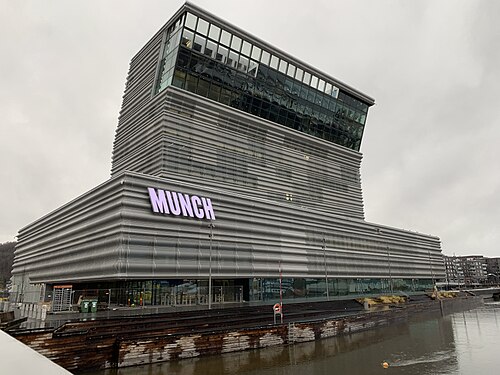
MUNCH building
Tourist attraction · Oslo Municipality
Art museum

Munch Museum (Norwegian: Munch-museet), marketed as MUNCH since 2020, is an art museum in Bjørvika, Oslo, Norway, dedicated to the life and works of the Norwegian artist Edvard Munch. The Munch Museum exhibits the full breadth of Edvard Munch’s artistry, along with contemporary art and world-class international exhibitions. They also offer a vibrant programme of music, performances, talks, and activities for children and young people. MUNCH aims to expand the idea of what a museum can be and to open new perspectives and experiences. The history of the Munch Museum began at Tøyen, when it was decided in 1951 that this would be the museum’s location. During his lifetime, Edvard Munch was already involved in discussions about establishing a museum, but it was not until 1963—one hundred years after his birth—that the museum finally opened. In 2021, the museum moved to a new building in Bjørvika, now known as MUNCH. In 2025, the museum recorded 775,000 visitors.
Edvard Munch’s bequest to the municipality of Oslo comprises one of the world’s largest collections of works by a single artist. MUNCHs collection consists of almost 28 000 artworks and more than 42 000 unique museum objects.
The museum is also home to the collections of Rolf Stenersen, Amaldus Nielsen and Ludvig O. Ravensberg. Together, the four collections, which were all donated by private individuals, provide insight into a unique period of art history extending over almost 100 years.
Find everything from unknown works to world-famous paintings in the digital Catalogue Raisonné of Edvard Munch.
MUNCH conducts bold, creative and pioneering research across art history, conservation, curatorial practice and mediation. They carry a particular responsibility for the field of knowledge around Edvard Munch, which they are constantly developing with academic curiosity and critical inquiry.
At MUNCH, you can experience five collection exhibitions at any given time, showcasing the breadth of Edvard Munch’s artistic practice.
In addition, the museum presents 6–7 temporary exhibitions each year, featuring modern and contemporary art by artists other than Munch.
Edvard Munch’s sometimes untraditional use of materials and experimental techniques give his pictures a completely unique appearance. They also pose a number of challenges for the Museum’s Conservation Department, which is responsible not only for the care of the collection, but also for conducting research about it.
Today MUNCH has a well-equipped Conservation Department, in which paintings conservators, paper conservators, art technicians and museum scientists work to care for, and conduct research into, Munch’s art. These professionals devote a great deal of time to assessing the condition of works and deciding whether they can be exhibited or loaned to another museum. There is great interest in exhibiting Munch’s art, and some paintings are out on loan almost continually. Finding a balance between looking after the artworks and putting them on display is something the Museum must constantly take into consideration.
The research at MUNCH primarily covers conservation, art history, curatorial practice, and mediation.
With the results of our research, we can generate new insights into Edvard Munch, modernism, contemporary art, museum practice and our audiences – as well as wider social issues. These insights are shared through research-based exhibitions, popular science platforms, and academic publications.
For MUNCH, innovation is first and foremost about making art meaningful and relevant to a diverse audience. At the same time, the museum make space for artistic collaborations where ideas, forms of expression, and formats can be explored.
MUNCH has a research library that manages the collection, including all documentation and accrued knowledge about Edvard Munch, and makes it available for in-house as well as external research.
The library’s collection consists amongst other things of literature pertaining to Edvard Munch, literature pertaining to visual art, Edvard Munch's private library and transcriptions of Munch's correspondence, journals and notes. It is possible to visit the library upon request.
MUNCH conducts bold, creative and pioneering research across art history, conservation, curatorial practice and mediation. They carry a particular responsibility for the field of knowledge around Edvard Munch, which they are constantly developing with academic curiosity and critical inquiry.
At MUNCH, you can experience five collection exhibitions at any given time, showcasing the breadth of Edvard Munch’s artistic practice.
In addition, the museum presents 6–7 temporary exhibitions each year, featuring modern and contemporary art by artists other than Munch.
Edvard Munch’s sometimes untraditional use of materials and experimental techniques give his pictures a completely unique appearance. They also pose a number of challenges for the Museum’s Conservation Department, which is responsible not only for the care of the collection, but also for conducting research about it.
Today MUNCH has a well-equipped Conservation Department, in which paintings conservators, paper conservators, art technicians and museum scientists work to care for, and conduct research into, Munch’s art. These professionals devote a great deal of time to assessing the condition of works and deciding whether they can be exhibited or loaned to another museum. There is great interest in exhibiting Munch’s art, and some paintings are out on loan almost continually. Finding a balance between looking after the artworks and putting them on display is something the Museum must constantly take into consideration.
The research at MUNCH primarily covers conservation, art history, curatorial practice, and mediation.
Closest places in our Norway guide.
More places to explore in Norway.


