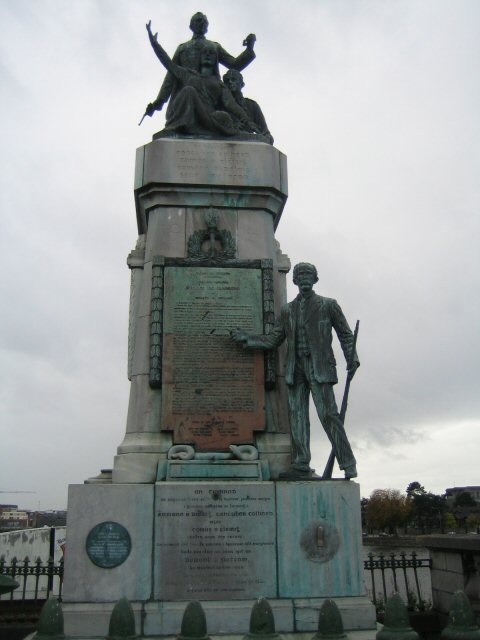
Ireland
St. Bride's Church, Dublin
Church building
Anglican or Episcopal cathedral

Saint Patrick's Cathedral (Irish: Ard-Eaglais Naomh Pádraig) in Dublin, Ireland is the national cathedral of the Church of Ireland. Christ Church Cathedral, also a Church of Ireland cathedral in Dublin, is designated as the local cathedral of the Diocese of Dublin and Glendalough.
Unusually, St Patrick's is not the seat of a bishop, as the Archbishop of Dublin has his seat in the nearby Christ Church Cathedral ; the two cathedrals are about 400 metres apart. Since 1870, the Church of Ireland has designated St Patrick's as the national cathedral for the whole of Ireland, drawing chapter members from each of the 12 dioceses of the Church of Ireland. The dean is the ordinary for the cathedral; this office has existed since 1219. The most famous office holder was Jonathan Swift.
Some believe it was intended that St Patrick's, a secular (diocesan clergy who are not members of a religious order, i.e. under a rule and, therefore, "regular") cathedral, would replace Christ Church, a cathedral managed by an order.
A confrontational situation persisted, with considerable tension, over the decades after the establishment of St Patrick's, and was eventually settled, more or less, by the signing of a six-point agreement of 1300, Pacis Compositio. Still extant, and in force until 1870, it provided that:
- The consecration and enthronement of the Archbishop of Dublin was to take place at Christ Church – records show that this provision was not always followed, with many archbishops enthroned in both, and at least two in Saint Patrick's only

- Christ Church had formal precedence, as the mother and senior cathedral of the diocese
- Christ Church was to retain the cross, mitre and ring of each deceased Archbishop of Dublin
- Deceased Archbishops of Dublin were to be buried alternately in each of the two cathedrals, unless they personally willed otherwise
- The annual consecration of chrism oil for the diocese was to take place at Christ Church
- The two cathedrals were to act as one and shared equally in their freedoms. Over the following centuries, the two cathedrals functioned together in the diocese, until in the period of disestablishment of the Church of Ireland, the current designation of one as the cathedral of Dublin and Glendalough, and one as the national cathedral, was developed.

Some believe it was intended that St Patrick's, a secular (diocesan clergy who are not members of a religious order, i.e. under a rule and, therefore, "regular") cathedral, would replace Christ Church, a cathedral managed by an order.
A confrontational situation persisted, with considerable tension, over the decades after the establishment of St Patrick's, and was eventually settled, more or less, by the signing of a six-point agreement of 1300, Pacis Compositio. Still extant, and in force until 1870, it provided that:
- The consecration and enthronement of the Archbishop of Dublin was to take place at Christ Church – records show that this provision was not always followed, with many archbishops enthroned in both, and at least two in Saint Patrick's only
- Christ Church had formal precedence, as the mother and senior cathedral of the diocese
- Christ Church was to retain the cross, mitre and ring of each deceased Archbishop of Dublin

- Deceased Archbishops of Dublin were to be buried alternately in each of the two cathedrals, unless they personally willed otherwise
- The annual consecration of chrism oil for the diocese was to take place at Christ Church
- The two cathedrals were to act as one and shared equally in their freedoms. Over the following centuries, the two cathedrals functioned together in the diocese, until in the period of disestablishment of the Church of Ireland, the current designation of one as the cathedral of Dublin and Glendalough, and one as the national cathedral, was developed.
In 1192, John Comyn, first Anglo-Norman archbishop of Dublin, elevated one of the four Dublin Celtic parish churches, this one dedicated to Saint Patrick, beside a holy well of the same name and on an island between two branches of the River Poddle, to the status of a collegiate church, i.e., a church with a body of clergy devoted to both worship and learning. The new collegiate church fell outside the city boundaries, and this move created two new civic territories, one under the archbishop's temporal jurisdiction. The church was dedicated to "God, our Blessed Lady Mary and St Patrick" on 17 March 1191.
Comyn's charter of 1191 or 1192, which allowed for a chapter of thirteen canons, of which three held special dignities (as chancellor, precentor and treasurer), was confirmed by a papal bull (of Pope Celestine III ) within a year. The thirteen prebendaries attached to the church were provided with archepiscopal lands.
Closest places in our Ireland guide.
More places to explore in Ireland.