
Italy
Sallustian obelisk
Obelisk · Rome
Tourist attraction
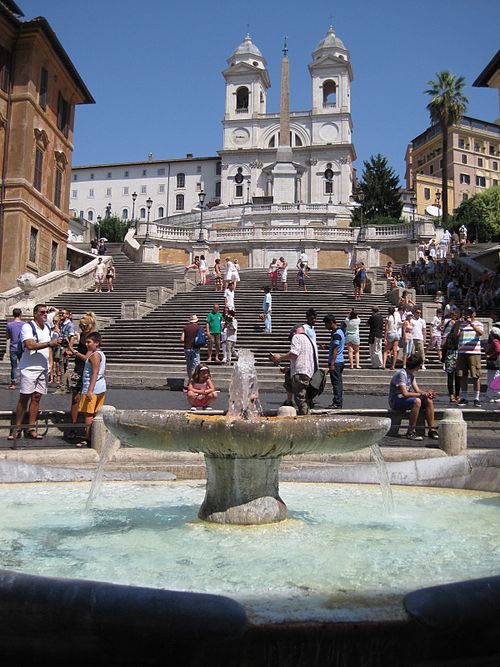
The Spanish Steps (Italian: Scalinata di Trinità dei Monti) in Rome, Italy, climb a steep slope between the Piazza di Spagna at the base and the Piazza Trinità dei Monti, dominated by the Trinità dei Monti church, at the top. The monumental stairway of 135 steps is linked with the Trinità dei Monti church, under the patronage of the Bourbon kings of France, at the top of the steps and the Spanish Embassy to the Holy See in the Palazzo Monaldeschi at the bottom of the steps. The stairway was designed by the architects Francesco de Sanctis and Alessandro Specchi.
Generations of heated debate over how the steep, 29-metre (95 ft) slope to the church on a shoulder of the Pincio should be urbanized preceded the final execution. Archival drawings from the 1580s show that Pope Gregory XIII was interested in constructing a stair to the recently completed façade of the French church.
French diplomat to the Holy See Étienne Gueffier died in 1660, leaving part of his fortune for the construction of the stairs. The Roman-educated Cardinal Mazarin took a personal interest in the project and entrusted it to his agent in Rome—whose plan included an equestrian monument of Louis XIV of France — an ambitious intrusion that created a furore in papal Rome. Mazarin died in 1661 and the pope in 1667, and so, while Gueffier's will was successfully contested by a nephew who claimed half, the project lay dormant until Pope Clement XI Albani renewed interest in it in the early 18th century.
A competition held in 1717 was won by Francesco de Sanctis, though Alessandro Specchi was long thought to have produced the winning entry. Little is known of the architect, who was favored by the French in the design process. His drawing was engraved by Girolamo Rossi in 1726, with a long dedication to Louis XV.
The solution is a gigantic inflation of some conventions of terraced garden stairs. The first such divided and symmetrical stairs were devised for the Belvedere Courtyard in the 1600s by Donato Bramante, while shaped and angled steps were introduced by Michelangelo in the vestibule to the Laurentian Library. The Bourbon fleur-de-lys and Innocent XIII's eagle and crown are carefully balanced in the sculptural details.

Mid-18th century writers Joseph de Lalande and Charles de Brosses noted that the steps were already in poor condition. They have been restored several times since, including from May to December 1995.
Sponsored by the Italian luxury brand Bulgari (which has its Italian flagship store in the nearby Via dei Condotti) a new renovation commenced on 8 October 2015, with the steps being reopened to the public on 21 September 2016. The restoration of the almost 32,300 square feet (3,000 m 2 ) of travertine stone, as well as brick, marble and plaster employed more than 80 people and cost €1.5 million.
Over the years, several city administrations have tried to dissuade visitors from getting too comfortable on the steps, banning loitering and eating, but the ordinances have not been enforced. However, in July 2019 the administration of Mayor Virginia Raggi, as part of an attempt to get ill-mannered tourists to behave themselves in Rome, introduced more stringent ordinances designed to "guarantee decorum, security and legality". These regulations allow for fines of €250 for sitting down on the steps and up to €400 for dirtying or damaging the steps (including eating on them or pushing a pram up or down them).
In the Piazza di Spagna at the base is the Early Baroque fountain called Fontana della Barcaccia ("Fountain of the longboat"), built in 1627–29 and often credited to Pietro Bernini, father of a more famous son, Gian Lorenzo Bernini, who is recently said to have collaborated on the decoration. The elder Bernini had been the pope's architect for the Acqua Vergine, since 1623. According to a legend, Pope Urban VIII had the fountain installed after he had been impressed by a boat brought here by a flood of the Tiber.
In the piazza, at the corner on the right as one begins to climb the steps, is the house where English poet John Keats lived and died in 1821; it is now a museum dedicated to his memory, full of memorabilia of the English Romantic generation. On the same right side stands the 15th-century former cardinal Lorenzo Cybo de Mari 's palace, now Ferrari di Valbona, a building altered in 1936 to designs by Marcello Piacentini, the main city planner during Fascism, with modern terraces perfectly in harmony with the surrounding baroque context.

At the top, the stairway ramp up the Pincio which is the Pincian Hill. The Villa Medici can be reached from the top of the steps.
During Christmas time, a 19th-century criba manger is displayed on the first landing of the staircase. During springtime, just before the anniversary of the foundation of Rome on 21 April, part of the steps are covered by pots of azaleas, up until early May. In modern times, the Spanish Steps have included a small cut-flower market. The steps are not a place for eating lunch, being forbidden by Roman urban regulations, but they are usually crowded with people.
In March 1986, the opening of Italy's first McDonalds near the Spanish Steps inspired Carlo Petrini and friends to form Arcigola, an organisation that became the Slow Food movement.
In May 2022, a Saudi national drove a rented Maserati through the steps, descending the first flight of steps before stopping. Fractures were subsequently found on the 16th and 29th steps of the right-hand flight rising up from Piazza di Spagna. The man, who abandoned the car and fled the scene, was later apprehended at Milan Malpensa Airport after being identified through surveillance cameras and was charged with inflicting aggravated damage to cultural heritage and monuments.
In June 2022, two American tourists launched a scooter three times down the steps, damaging the third-to-last travertine step of the second ramp and dislodging a 10-centimeter piece of marble that cost €25,000 ($27,000) in repairs. The couple were apprehended by police, fined €400 each and were banned from the vicinity of the site for two days.

In April 2023, climate protestors from Ultima Generazione poured a charcoal-based black powder into the Fontana della Barcaccia, discoloring its water and leaving stains on its marble surface. The protesters were apprehended by authorities and detained.
In June 2025, a man in his 80s drove a gray Mercedes-Benz A-Class halfway down the steps before becoming stuck. The man later tested negative for drugs and alcohol, according to police. The vehicle was removed by the Vigili del Fuoco using a crane at the foot of the steps to lift the vehicle away. The steps were then closed to the public in order for archaeologists to inspect them for any damage which may have been caused during this incident. The man was reported to have told police officers that he was on his way to work. The incident was captured on video and circulated online.
The steps are featured in several literary works. Notable examples include:
- Numerous scenes in Alfred Bester 's novel The Stars My Destination (1956)
- F. Scott Fitzgerald 's novel Tender Is the Night (1933)
Closest places in our Italy guide.
More places to explore in Italy.


