.jpg?width=1200)
Australia
Kelvin
Heritage site · New South Wales
Anglican church building

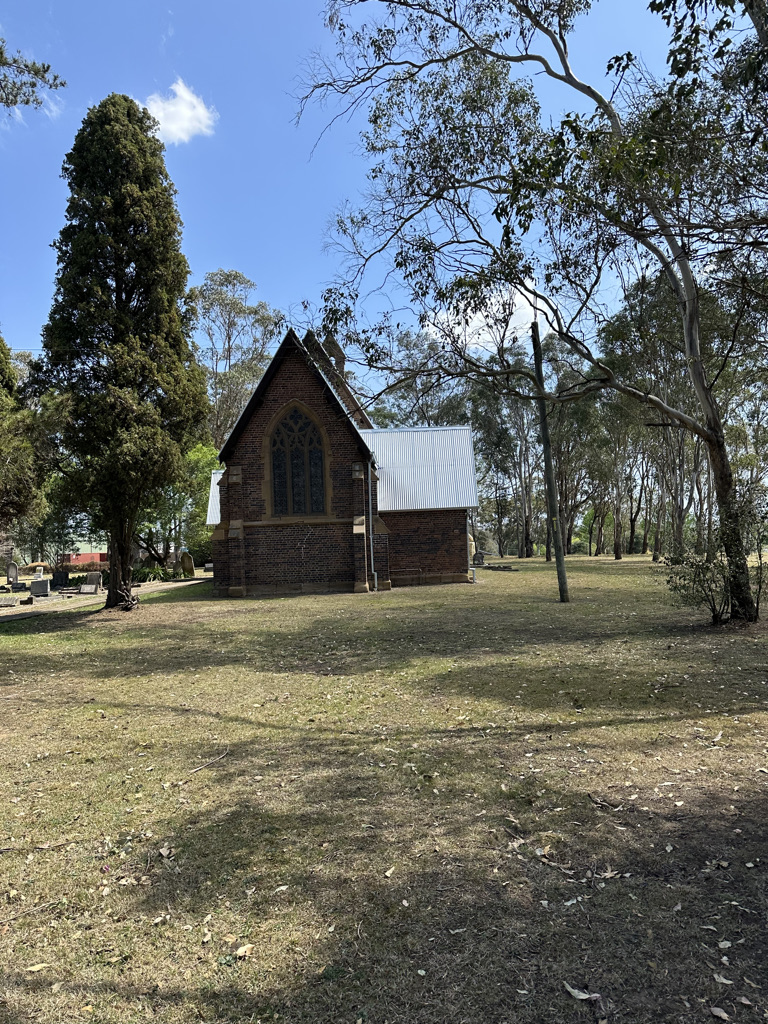
The Church of the Holy Innocents is a heritage-listed Anglican church at 130 Rossmore Avenue West, Rossmore, New South Wales, Australia. It was designed by Richard Cromwell Carpenter and Edmund Blacket and built from 1848 to 1850 by William Munro. The property is owned by Anglican Church Property Trust Diocese of Sydney, though it was added to the New South Wales State Heritage Register on 24 August 2018.
The original inhabitants of the Liverpool area were the Gandangara people. The pre-European landscape of the area consisted of open eucalyptus woodland. Across this country the Gandangara people utilised many of the flora and fauna resources during everyday life. Many aspects of the local landscape would have held spiritual importance for the Gandangara people. It is unknown if the land upon which the Cabramatta village or the church lands associated with the Church of the Holy Innocents was used for any specific economic, settlement, or spiritual/sacred purposes by the Gandangara.
From the early 1800s European settlers began to encroach on Gandangara lands and settle on what they named the Liverpool plains. Directly organised British colonisation of the area commenced in the 1810s during the governorship of Macquarie (1810–1821) through the alienation of land and the imposition of the rule of British law. Land alienation proceeded through the issuing of large land grants to prominent settlers who had the means to establish extensive stock runs. This resulted in the area being sparsely settled with family estates dotted throughout the landscape. These stock runs were often quite isolated with the main meeting and social places being the few local churches or other public amenities such as stores, pubs, and post offices situated along the main thoroughfares of the region.
Colonisation of the area continued during the 1820s and 1830s under Governors Brisbane (1821–1825) and Darling (1825–1831). However, by the mid-1820s there was a change in the surveying system of the colony undertaken under the orders of Lord Bathurst, which took a more progressive outlook to the future of the colony. This was in response to difficulties in the land surveying department in the early and mid-1820s where the surveying of the numerous grants allocated by Governors Macquarie and Brisbane had not yet been carried out. Lord Bathurst's plan required that the colony be systematically surveyed and split up into counties, hundreds, and parishes and that township, village, public road, school, burial ground, and church reserves be situated in appropriate locations for future need as the local population increased and more free settlers immigrated to the colony. This systematic survey of the entire colony, the Nineteen Counties or the Limits of Location, was eventually carried out by Major Thomas Livingstone Mitchell, Surveyor General from 1828. Overall, the imposition of this settlement model on the Australian landscape was one of the early attempts by the British authorities to recreate a British agricultural landscape, dotted with small farms and villages, in the colony.
Lord Bathurst's also ordered that one-seventh of the land of each county, according to extent and value, was to be put aside as the Clergy and School Estate. The purpose of this estate was to fund and support the Established Church of England and its clergy in the colony, as well as the education of the colony's youth in Anglican principals. To manage these grants, Lord Bathurst detailed that a Clergy and School Lands Corporation should be established to manage their sale, which would then provide funds for the religious and educational development of the colony.
During the surveying of the colony a township reserve was situated in the Parish of Cabramatta, within the County of Cumberland, located to the southwest of Liverpool on the east bank of South Creek. This township was also named Cabramatta and formed the only township reserve allocated to this parish, as the remainder had been granted away during the 1810s and early 1820s. This township reserve was close to the estates of Horningsea Park ( Joshua John Moore ) and Cow-de-knaves (John Jamieson) and in 1830 the Bellfield Farm estate was established to its north. A school and church reserve was allocated to the Cabramatta village reserve when it was created around 1827. This reserve was one acre in size and came, over time, to comprise an eastern half for a school and church and a western half for a burial ground.
Due to the excesses of Governor Macquarie with regard to the construction of public buildings in Sydney and other areas of the colony during his period in office, Colonial officials in London dictated that public needs be met more modestly by Governor Brisbane during his tenure. As a result of this and Lord Bathurst's new plan for the surveying of the Colony, Brisbane established the Clergy and School Lands Corporation in 1826 to manage the provision of education and religious needs to the colony. This corporation was run by a committee of Anglicans which included Archdeacon Thomas Hobbs Scott, the Reverend Samuel, and three prominent Anglican laymen. One of its goals was to provide simple schools and rectories for the local populations in rural areas. It was to have been financed by the sale of the Clergy and School Estate lands, as well as other investments, but funds were slow to be amassed via this method since no land was allocated to the corporation until 1828 (due to issues in the colonial surveying department). As a result, the corporation had only limited funds to operate during its early years. Thus, they operated by building modest, often timber, vernacular buildings in places of need that could serve as both schools and churches. To facilitate this the architects, Joshua Thorp and William Aird, provided the corporation with some designs for simple chapels and school-church buildings. Ultimately, the Clergy and School Lands Corporation was not a success and its activities were suspended in 1829, before its charter was finally revoked in 1833, following complaints from the other denominations about the dominance of the Anglicans.
In 1827 the Clergy and School Lands Corporation built a simple slab timber school/church hall on the southeast corner of the church reserve in Cabramatta township. This small building was typical of those constructed by the corporation in rural areas to serve the educational and religious needs of these small communities. The hall had a capacity of 100 people and from its opening the acting school master was the Reverend A. Lideliard. This new hall was located in the vast parish of the Cow Pastures which was under the stewardship of the Reverend Thomas Hassall (1794–1868) from its conception in 1826. It is likely that Hassall occasionally visited this hall to perform services as he toured his parish, with regular services being conducted by a local curate.
Soon after the construction of the school/church hall in 1828 the building required further additions and repairs. These works were carried out by an Edward Pender and consisted of laying flooring and skirting, providing church furniture (sofas, a table, and seating for children), and lining and jams for the windows and doors. By 1829 the building was being used once every Sunday for services and in 1830 Reverend Hassall was noted as being the rector or officiating minister of Cabramatta which still had a population of a 100. This suggests that in the years following its construction the hall was used by the populations of the surrounding estates regularly for worship and teaching, along with perhaps other community purposes. Education was the purview of the Church of England during this period and it is likely that the local minister, Reverend Hassall, arranged for the appointment of a qualified headmaster or mistress of the school.
After the school/church hall at Cabramatta was erected a cemetery was established at the rear of the school and church reserve. The first recorded burial in this cemetery was a four-month old baby boy, William Fox, on 22 November 1829. This burial and several others during the 1830s and 1840s were registered at surrounding churches (such as St Lukes, Liverpool). It is possible that earlier burials from 1825 or 1827 onwards occurred in the church grounds, but these were unregistered. From 1848, when new lands were granted to the Anglican Church under the Church Act for the construction of the Church of the Holy Innocents, this cemetery was officially granted as a burial ground and a register of burials kept from 1851.

Despite the repairs made in 1828, by 1832 the slab timber school/church hall was beginning to fall into disrepair and Archdeacon William Broughton advised Reverend Hassall that the building needed to be repaired or demolished. Consequently, in December 1832, Hassall commissioned substantial repairs to the hall by Joseph Heron to improve the buildings suitability as a church. The documentation for these repairs reveals that the building had a school room and two small "back" rooms. At this time there was still one chaplain (Hassall) servicing Cabramatta and the surrounding region, which was now described as the Cook district and also included Mulgoa, South Creek, Camden, and Stone Quarry Creek.
The following year (1833) Robert Bell, the owner of the estate to the north adjoining the Cabramatta town reserve, petitioned the government to finally establish a township and offer the town allotments at auction. Bell hoped to add to his estate through this process and provide himself with a road access to his property via Bringelly Road. Following this request the government further investigated the site, but the Surveyor General reported to the Colonial Secretary that the reserve was not on the great road, was "ill-watered" and, therefore, not suitable for the establishment of a town. Consequently, it was not until 1840 that the town allotments were put up at auction and Robert Bell was able to purchase the majority to add to his estate.
Plans for a permanent church at Cabramatta
In 1836 the local Anglican community were using the hall (log built school house) for services on a fortnightly basis with its capacity being recorded as 60 people. The passing of the Church Act this year encouraged Bishop Broughton to begin plans to construct a permanent and substantial church at Cabramatta for this district. At this time the populations of the surrounding estates were growing and a need was seen for a more permanent and auspicious church. Two hundred pounds was soon subscribed, mainly by the local population, for the cost of this church. The local community felt that this new church should be dedicated to the Holy Innocents. This name indicates the "high church" leanings of the local congregation and their designs for the church. In contrast "low church" churches are normally named after saints. The Feast of the Holy Innocents, after which the church is named, is more of an orthodox catholic tradition.
Governor Burke's (1831–1837) 1836 Church Act granted state recognition and support for the main denominations operating in Australia: the Church of England, Presbyterian Church, and Catholic Church. It provided extra funding through a pound for pound subsidy for new churches costing between 600 and 2000 pounds. However, before a church could be built the local area was required to prove, through a petition, that at least 150 residents of the particular denomination were present and would use and support the church. This Act was designed to forward the construction of churches of these denominations across the colony while also providing funding for the stipends of ministers and, generally, improve the moral condition of the still largely convict population. To further encourage new church construction the Act also made additional land grants available for churches and schools. However, it required new churches to be designed by a professional architect and approved by the colonial architect. Through recognising and assisting other denominations this Act served to diminish the power of the Church of England in Australia, which had previously been the de facto Established Church of the colony. This was especially so after Bourke later extended the Act to include the Methodist, Wesleyan, and Baptist Christian denominations, as well as Judaism. In this manner, the Act helped to foster a religious pluralism in the colony.

Broughton had arrived in Australia in 1829 to fill the post of Archdeacon of NSW. He was a High Churchman and firm supporter of the Church of England and would not countenance deviation from its established rules in the colony. At the time of his arrival there were only eight parish churches in the colony (of which the majority had been constructed by Macquarie) and Broughton soon sought to remedy this situation. When back in England in 1835–1836 he organised for an annual 1000 pound grant from the English Society for the Propagation of the Gospel, as well as other immediate gifts, that allowed him to bring clergy to Australia and begin the work of building churches and rectories throughout the colony. As an amateur architect and enthusiast in ecclesiological architecture Broughton also procured suitable drawings and working plans for churches. While the 1836 Church Act gave considerable impetus to church expansion, great organisation was required to see a church constructed, and Bishop Broughton was a tireless and long travelling organiser who helped see the construction of many churches. He consecrated or dedicated almost a hundred church buildings throughout his long episcopate career demonstrating his organisational skills and dedication to this cause.
In 1836 Broughton was elevated to the Bishopric of the new see of Australia. Just prior to this, in 1835, he had been exposed to the work of the Oxford scholars that came to be known as Tractarians. Although Broughton never considered himself a Tractarian, he was influenced by their work and sympathised with and supported them by giving them appointments where possible. This support of the Tractarians, and by extension the Cambridge Camden Society, led Broughton to establish Gothic architecture as the most suitable for ecclesiological architecture in the colony. Prior to the mid-1830s gothic ornamentation had only been used on the exterior of new churches in an amateur fashion and it was only just beginning to be seen as a suitable style for "modern" ecclesiological architecture. This state of affairs continued into the early 1840s due to a lack of skilled tradesmen and competent and knowledgeable architects, despite the incentives of the Church Act. It was not until the mid-1840s that an influx of Scottish tradesmen and architects such as Edmund Blacket began to alleviate this situation. Prior to this the Anglican Church Act norm had been small symmetrical churches with almost double cube proportions, symmetrical north and south porches placed midway along the length of the church, western bell-cotes, and detailing such as buttresses, hood-moulds, and pinnacles. From the 1840s there was a definitive move toward medievalism in Anglican ecclesiological architecture as the Gothic Revival movement took hold in the colony and by the mid-1840s there was a definite commitment to archaeological fidelity (a commitment to correct medieval detail) in gothic architecture.
The construction of the Church of the Holy Innocents
Throughout the early 1840s efforts continued towards the construction of a permanent church at Cabramatta, but it appears that funds were slow to be raised due to the collapse of the colonial wool industry. This is likely as many of the local large estates holders were among those who subscribed towards the construction of the church, including the holders of "Vermont (J. J. Riley Esq)", "Berling (Mrs S. Lowe)", "Bellfield (Robert Bell Esq)", "Retreat Farm (Alfred Kennerley Esq)", " Newstead ", " Eastwood ", " Wilton Park (A. J. Lidingtone)", and " Exeter Farms". In 1845 when the Reverend George Vidal was appointed to the Parish of Denham Court and the Cabramatta area was subsumed into this parish it was reported that services at the school/church hall were held fortnightly and attended by an average of 20 people. However, while services were held as Cabramatta regularly, confirmations and marriages were held at St Mary's Denham Court.
Despite the incentive of the Church Act and the assistance of Bishop Broughton it took the local congregation and the Anglican Church until 1846 before the necessary funds (311 pounds) were gathered to commence the design and construction of the new church at Cabramatta. Bishop Broughton chose a Gothic Revival design produced by one of the Cambridge Camden Society's leading architects, Richard Cromwell Carpenter. Carpenter had designed and built St John the Baptist Church at Cookham Dean in Berkshire, England in 1844–45 and it was a copy of this design that Bishop Broughton had acquired through Reverend William Horatio Walsh, a correspondent of the Society's journal. Reverend Walsh had met Edmund Blacket when he had been appointed to finish Christ Church St Laurence in 1843 and been introduced to Gothic architecture by him. They, subsequently, became close friends as Christ Church was Blacket's parish church and Reverend Walsh, therefore, his Rector and one of his great supporters. The finished design of Christ Church in 1845 was unapologetically High Church and Tractarian and caused a great scandal among the Evangelical Anglicans in the colony. Reverend Walsh became a leader among the colonial Tractarians, which explains his promotion of Carpenter's Gothic Revival inspired church design to Bishop Broughton. The Church of St John the Baptist, Cookham Dean, had been described and lauded in the societies' journal "The Ecclesiologist" when it was completed in 1845, to which Bishop Broughton and other members of the colonial clergy subscribed. In this article it was described as a fourteenth century style church of "a very simple" and "most satisfactory design" but "not mean or starved" and "of unpretending but solemn character". It is highly likely that it was these properties of the design that brought it to Broughton's attention and inspired him to acquire copies of the drawings. Previously a copy of this design had been acquired by Bishop Nixon of Tasmania and it was used to construct a church at Buckland, Tasmania between August 1846 and January 1849.
Closest places in our Australia guide.
More places to explore in Australia.
.jpg?width=1200)
.jpg?width=1200)
.jpg?width=1200)


.jpg?width=1200)
.jpg?width=1200)
.jpg?width=1200)
.jpg?width=1200)
.jpg?width=1200)


