Austria
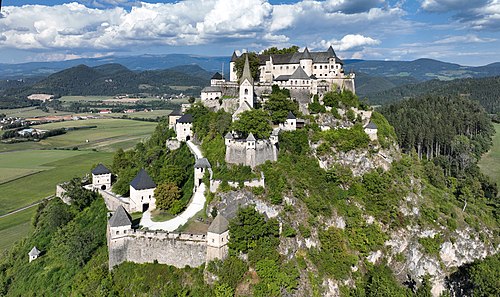
Hochosterwitz Castle
Fortress · St. Georgen am Längsee
Museum

The Stadt auf dem Magdalensberg (lit German: city on the Magdalensberg), is a Noric settlement inhabited from the 1st century BC to the mid 1st century AD, located on the slopes and summit plateau of Magdalensberg on the edge of the Carinthian Zollfeld. It was an important trading hub before and during the initial phase of Roman occupation, particularly for Noric iron. However, with the establishment of the Roman city of Virunum on the Zollfeld, the settlement was ultimately abandoned, with a documented duration spanning approximately 90 years. Notably, one of the most significant discoveries from this site is the Youth of Magdalensberg.
In the 3rd century BC, the Celtic Noric people settled in the area of present-day Carinthia. Due to the rich and high-quality iron deposits ( Ferrum Noricum - Noric iron), a lively trade with the Mediterranean region developed. In 170 BC, the Noricans entered into a hospitality treaty, known as hospitium publicum, with Rome. As trade relations flourished, Roman merchants began to settle on Magdalensberg around the mid 1st century BC and established a market known as an emporium. [ citation needed ]
The choice of site was influenced by the presence of the Noric king's residence on Magdalensberg and the protective sanctuary on the summit. Despite this, there is currently no known Celtic settlement on Magdalensberg, possibly because most excavations have focused on the Roman period. Nevertheless, the site was strategically positioned in close proximity to the iron ore deposits of the Görtschitztal (Hüttenberger Erzberg) and Lölling regions.
In 2006, initial excavations conducted on the hill's northern side revealed several ramparts. One of these ramparts dated to the period between 40 and 30 BC. This rampart resembles the Fécamp type, which is predominantly found in late Celtic central and northern France.
There are limited findings about the initial phase of the Roman market. It may have been mainly smelting sites for the Norse iron and simple accommodation. The significance of the place already at that time becomes clear by the consecration of the Youth of Magdalensberg by two merchants, which fell into this period. [ citation needed ]
Trade between the settlement and Rome experienced a boost during the mid 1st century BC. The surge in trade was attributed to the high demand for weapons and other goods due to Caesar's Gallic campaigns and the subsequent civil wars. Around this time a forum was built within the settlement. The forum was surrounded by tabernas, which served as warehouses, offices, and residences. On the western side, a basilica was built, fulfilling the function of a bathhouse. Adjacent to the basilica, on the eastern narrow side, stood a market basilica measuring 30 × 17 m. This complex on the southern slope below the summit area, reflects Italian influences in its layout and is unparalleled in the inner eastern Alpine region. The construction phases of the complex can be categorized into four periods: pre- and early Augustus, mature Augustus, late Augustus-early Tiberius, and early Claudius. [ citation needed ]
In the 20s BC, the Noricans built a fortification with a central sanctuary of an almost propagandistic-representative shape on the summit plateau. The design of the merchant buildings during this time indicated a period of prosperity, both in terms of materials and cultural aspects. These houses were built using the mortar masonry technique with plastered walls and painted interiors. Notably, frescoes adorned the walls in the second and third Pompeian styles, (around 20 BC). These frescoes depicted captivating mythological and bucolic scenes, adding artistic significance to the structures. [ citation needed ]
The wealth of the merchants is reflected in their overall lifestyle: they adopted Italian customs, as seen in their consumption of imported garum (a spicy fish sauce), olives, and wine, which were served in dishes made of bronze, glass, and terra sigillata (fine pottery vessels). The presence of portrait sculptures, the oldest found in the territory of present-day Austria, suggests the involvement of Roman sculptors. These sculptures, along with the portraits of Noric women and inscriptions with Celtic names indicate that the locals actively embraced Roman culture. In addition to trade, the settlement engaged in extensive production of goods. Workshops for non-ferrous metal processing, particularly brass, were situated in the quarter east of the forum. These workshops manufactured items such as brooches, belt buckles, and other products to meet local demands as well as for export within the Noric region.
The incorporation into the Roman Empire in 16/15 BC took place peacefully in Noricum. As a result, Noric traditions and tribal structures were largely preserved. The integration resulted in a status elevation for the city of Magdalensberg. It became the political center of the Roman eastern Alpine region, resulting in enormous construction activity. It is possible that the existing structures were damaged or destroyed during an earthquake between 10 and 20 AD, which is not documented in the sources. There were significant changes in the area of the forum ; the tabernacles in the northwest were filled in and the Praetorium was built on the site. In the case of the tabernas on the east side, the original basement buildings were complemented by above-ground structures.
During the reign of Tiberius, the podium temple was built on the north side, initially with a four-column façade. During this period, a large fire broke out in the eastern forum region, primarily destroying homes and warehouses. In early Claudian times, the reconstruction of the peripteral temple with a six-columned façade was started but left unfinished. The non-ferrous metal workshops east of the forum were replaced by residential buildings and accessed by a road from the forum leading to a double gate at the eastern edge of the hill hollow.
On the terrace southwest of the Forum, a large bathhouse was built to replace the original bath at the Forum, which had now been converted into a representative building. On the eastern southern slope, large two-story residential buildings with up to 150 m 2 living spaces were built. [ citation needed ]
During this time the city reached an extension of about 3 km 2. The number of inhabitants was probably between 3000 and 5000. [ citation needed ]
Immediately before the middle of the 1st century, archaeological discoveries within the city's boundaries came to an end, except for the sanctuary located on the hilltop, which continued to yield finds until late antiquity. The abandonment of the settlement occurred swiftly, leaving several structures, such as the temple, unfinished. The city was succeeded by the Municipium Claudium Virunum, established directly at the base of the mountain in the Zollfeld, which emerged in the late 40s in place of a small roadside village. The roadside village was strategically positioned along the crucial central Noric road route connecting the Danube to Italy, with the road leading from there to the Magdalensberg. [ citation needed ]
Virunum, like many other similar cities in the new provinces, was a planned foundation as an autonomous Roman city, inheriting the role of capital and possibly its name from the city on the Magdalensberg. [ citation needed ]
In the 3rd century BC, the Celtic Noric people settled in the area of present-day Carinthia. Due to the rich and high-quality iron deposits ( Ferrum Noricum - Noric iron), a lively trade with the Mediterranean region developed. In 170 BC, the Noricans entered into a hospitality treaty, known as hospitium publicum, with Rome. As trade relations flourished, Roman merchants began to settle on Magdalensberg around the mid 1st century BC and established a market known as an emporium. [ citation needed ]
The choice of site was influenced by the presence of the Noric king's residence on Magdalensberg and the protective sanctuary on the summit. Despite this, there is currently no known Celtic settlement on Magdalensberg, possibly because most excavations have focused on the Roman period. Nevertheless, the site was strategically positioned in close proximity to the iron ore deposits of the Görtschitztal (Hüttenberger Erzberg) and Lölling regions.
In 2006, initial excavations conducted on the hill's northern side revealed several ramparts. One of these ramparts dated to the period between 40 and 30 BC. This rampart resembles the Fécamp type, which is predominantly found in late Celtic central and northern France.
There are limited findings about the initial phase of the Roman market. It may have been mainly smelting sites for the Norse iron and simple accommodation. The significance of the place already at that time becomes clear by the consecration of the Youth of Magdalensberg by two merchants, which fell into this period. [ citation needed ]
Trade between the settlement and Rome experienced a boost during the mid 1st century BC. The surge in trade was attributed to the high demand for weapons and other goods due to Caesar's Gallic campaigns and the subsequent civil wars. Around this time a forum was built within the settlement. The forum was surrounded by tabernas, which served as warehouses, offices, and residences. On the western side, a basilica was built, fulfilling the function of a bathhouse. Adjacent to the basilica, on the eastern narrow side, stood a market basilica measuring 30 × 17 m. This complex on the southern slope below the summit area, reflects Italian influences in its layout and is unparalleled in the inner eastern Alpine region. The construction phases of the complex can be categorized into four periods: pre- and early Augustus, mature Augustus, late Augustus-early Tiberius, and early Claudius. [ citation needed ]
In the 20s BC, the Noricans built a fortification with a central sanctuary of an almost propagandistic-representative shape on the summit plateau. The design of the merchant buildings during this time indicated a period of prosperity, both in terms of materials and cultural aspects. These houses were built using the mortar masonry technique with plastered walls and painted interiors. Notably, frescoes adorned the walls in the second and third Pompeian styles, (around 20 BC). These frescoes depicted captivating mythological and bucolic scenes, adding artistic significance to the structures. [ citation needed ]
Closest places in our Austria guide.
More places to explore in Austria.


