Germany
Dorf- und Uhrenmuseum Gütenbach
Museum · Gütenbach
Museum

The German Clock Museum (German: Deutsches Uhrenmuseum) is situated near the centre of the Black Forest town of Furtwangen im Schwarzwald (Germany), a historical centre of clockmaking. It features permanent and temporary exhibits on the history of timekeeping. The museum is part of the local technical college (Hochschule Furtwangen).
The German Clock Museum is devoted to the history of timekeeping devices. A major focus is on clockmaking in the Black Forest, both as a cottage industry and on an industrial scale. The museum has an extensive collection of clocks and other artefacts relating to horology, not just those from the Black Forest, but also clocks and watches from around the world and spanning from prehistoric times to the present. The collection includes early cuckoo clocks from the 18th century as well as the prototypes of the modern Black Forest souvenir. The work of Robert Gerwig formed a primary basis of the museum.
1852: Robert Gerwig, Director of the Grand Ducal Baden Clockmaking School in Furtwangen, began to collect old clocks as witnesses of traditional handicrafts.
1858: The collection is exhibited for the first time at the Black Forest Industry Exhibition in Villingen.
1874: Historical clocks together with contemporary products of the region are put on display in the newly built trade hall.
1925: The first printed collection catalogue of the Adolf Kistner Historical Clock Collection already lists over 1,000 clocks.
1959: A new building is opened on the site of the old wooden building that had fallen into decay.
1975: The state of Baden-Württemberg purchases the important clock collection from the Kienzle clock factories and transfers it to the museum. Due to the expansion of its collection to include pocket watches and Renaissance clocks, the "Historic Clock Collection" is renamed in 1978 to the "German Clock Museum".
1992: The current museum building is opened. Today, the German Clock Museum is part of Furtwangen University.
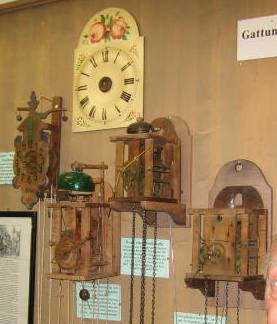
Exhibition of Black Forest clocks and tower clocks
1852: Robert Gerwig, Director of the Grand Ducal Baden Clockmaking School in Furtwangen, began to collect old clocks as witnesses of traditional handicrafts.
1858: The collection is exhibited for the first time at the Black Forest Industry Exhibition in Villingen.
1874: Historical clocks together with contemporary products of the region are put on display in the newly built trade hall.
1925: The first printed collection catalogue of the Adolf Kistner Historical Clock Collection already lists over 1,000 clocks.
1959: A new building is opened on the site of the old wooden building that had fallen into decay.
1975: The state of Baden-Württemberg purchases the important clock collection from the Kienzle clock factories and transfers it to the museum. Due to the expansion of its collection to include pocket watches and Renaissance clocks, the "Historic Clock Collection" is renamed in 1978 to the "German Clock Museum".
1992: The current museum building is opened. Today, the German Clock Museum is part of Furtwangen University.
Exhibition of Black Forest clocks and tower clocks
Since 2010, the museum has put on a permanent exhibition, covering an area of 1,400 square metres, of the development of clocks and the concept of timekeeping in Western countries. In addition to improvements in the accuracy of timepieces, it also demonstrates the various requirements that clocks and watches met in order to satisfy the needs of the time. Thus, in addition to prize exhibits, the museum also displays objects that, despite their low value, were historically very important. This distinguishes the German Clock Museum from clock collections that display objects that were rather rare and expensive compared with those in typical everyday use.
The circular tour is divided into the sections covering the following themes:
Closest places in our Germany guide.
More places to explore in Germany.