Serbia
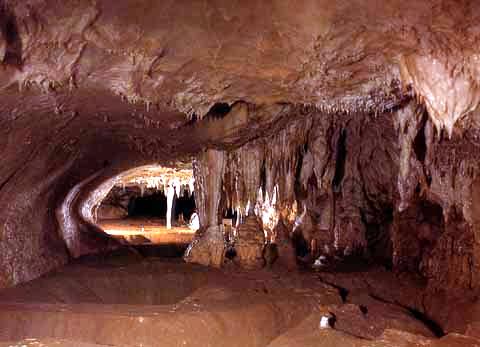
Rajko's Cave
Show cave · Majdanpek
Archaeological site

Lepenski Vir (Serbian Cyrillic: Лепенски Вир, "Lepena Whirlpool"), located in Serbia, is an important archaeological site of the Lepenski Vir culture (also called as Lepenski Vir-Schela Cladovei culture). It includes Mesolithic Iron Gates Hunter-Gatherers period and transition to Early Neolithic Early European Farmers period of the Balkans. The latest radiocarbon and AMS data suggests that the chronology of Lepenski Vir spans between 9500/7200 and 5500 BC, divided into Early–Middle Mesolithic, Late Mesolithic, Transition and Neolithic. There is some disagreement about when the settlement and culture of Lepenski Vir began, but the latest data indicates that it was between 9500 and 7200 BC. The late Lepenski Vir (6300–6000 BC) architectural phase saw the development of unique trapezoidal buildings and monumental sculpture, related with the admixing of Iron Gates Hunter-Gatherers with newly arrived Early European Farmers. The Lepenski Vir site consists of one large settlement with around ten satellite villages. Numerous piscine (fish) sculptures with human-like faces and peculiar architectural remains have been found at the site. Archaeologist Dragoslav Srejović, who first explored the...
Lepenski Vir is located on the right bank of the Danube in eastern Serbia, within the Iron Gates gorge. It is situated in the village of Boljetin, near Donji Milanovac. The view above and across the Danube is wide open and the stable and enduring terrain on the river's bank resists the intensely erosive effects of the Danube. Stability is secured by two or three boulders at the top of the plaz, a rocky cape jutting deeply into the river. The boulders acted as a natural anchor for the terrain on which the settlement developed. Long habitation on the site was also enabled by the proximity of the great river, the natural richness of the hinterland, and the thermic benefits of the accumulated limestone cliffs (considering the ice age which had just ended). Additionally, long-term habitation was facilitated by the presumed knowledge of some birth control practices, given the limited area on which the settlement could grow, even though it is believed that parts of the settlement remain undiscovered.
Whirlpools were created by the protruding rocks, and the swirling waters are more oxygenated, richer in algae and thus abundant in fish. The whirling current makes fishing easier than in the waters which rush through the gorge. Also, the swirling water actually deposited materials on the downstream side of the plaz, known today as Katarinine Livadice, making it stronger and more stable instead of allowing the fast and strong river current to erode it. In the immediate hinterland, there is a slope known as Košo Brdo. Embedded into it is the natural stone niche or rock shelter ( abij ), called Lepenska Potkapina, which was explored by archaeologist Branko Gavela [ sr ].
Downstream from Lepenski Vir, in the direction of Vlasac, and half-way to the mouth of the small Boljetinka or Lepena river, the vertical 40 m (130 ft) high Lepena Rock rises over the river. At the foot of the rock, the Romans built a road that is today submerged at a depth of 13.5 m (44 ft) under the waters of Lake Đerdap, together with a road plaque commemorating Emperor Tiberius. The slope above the Danube between the Lepena Rock and the mouth of the Lepena river is also called Lepena, as is the bight where the slope ends.
The site was discovered on 30 August 1960, on a lot owned by a local farmer, Manojlo Milošević.
Subsequently, after almost three years of inactivity, archaeological exploration of the region was organized by the Belgrade Institute for Archaeology. Construction of the Iron Gate I Hydroelectric Power Station, which would flood the bank regions with its artificial lake, was slated to begin, so archaeologists wanted to explore the area as much as possible before that happened. The head of the project at the time was Dušanka Vučković-Todorović, a fellow at the institute. The area to be investigated was between the villages of Prahovo and Golubac. Archaeologist Obrad Kujović explored the Lepenski Vir section with his assistant Ivica Kostić, following the work of previous visitors and archaeologists such as Felix Philipp Kanitz and Nikola Vulić. The location appeared ideal for a settlement, so Kujović and Kostić surveyed it. They found many ceramic fragments that it was like uncovering a ceramics workshop. Kujović recognized it as an important archaeological site, collected fragments, dated them as being part of the Starčevo culture and made a report for the institute. Srejović, intrigued by the findings, contacted Kujović in 1961 for detailed information.
Srejović managed to acquire the necessary funding and on 6 August 1965 began exploration of the site with Zagorka Letica, which continued with excavations through 1966 and 1967. Probing of the terrain in 1965 grew into protective excavations in 1966 and developed into fully systematic excavations in 1967 as they dug deeper. The cultural-archaeological layer starts below the surface layer of humus, 50 cm (20 in) thick.
It was only in 1967, after the discovery of the first Mesolithic sculptures, that the site's importance was fully understood. These findings were publicly announced on 16 August 1967. The excavations ended in 1971 when the whole site was relocated 29.7 m (97 ft) higher to avoid flooding from the newly formed Đerdap Lake, created by the construction of the Iron Gate I Hydroelectric Power Station. The main exploration of this site was the work of professor Dragoslav Srejović of the University of Belgrade. Exploring up to the depth of 3.5 m (11 ft), 136 or 138 buildings, settlements and altars were found in the initial excavations in 1965–1970. A necropolis was discovered in 1968.
The main site comprises several archeological phases starting with Proto-Lepenski Vir, then Lepenski Vir Ia through Ie, Lepenski Vir II and Lepenski Vir III, whose occupation spanned 1,500 to 2,000 years, from the Mesolithic to the Neolithic period, when it was succeeded by the Neolithic Vinča culture and Starčevo culture, both upstream the Danube, 135 km (84 mi) and 139 km (86 mi) from Lepenski Vir, respectively. A number of satellite villages belonging to the same culture and time period were discovered in the surrounding area. These additional sites include Hajdučka Vodenica, Padina, Vlasac, Ikaona, Kladovska Skela, and others. Found artifacts include tools made from stone and bone, the remains of houses, and numerous sacral objects including unique piscine (fish) with human-like face stone sculptures.
It is assumed that the people of Lepenski Vir culture represent the descendants of the early European population of the Brno - Předmostí ( Czech Republic ) hunter gatherer culture from the end of the last ice age. Archeological evidence of human habitation of the surrounding caves dates back to around 20,000 BC. The first settlement on the low plateau dates back to 9500–7200 BC, a time when the climate became significantly warmer.
Trescovăț, a bare porphyritic cliff (679 m (2,228 ft) high) rises on the left bank of the Danube opposite Lepenski Vir like a giant sentinel of the prehistoric settlement. Trescovăț may have been important to the inhabitants of Lepenski Vir as a solar observatory. The development of the settlement was strongly influenced by the topology of the surrounding area. It sat on a narrow promontory on the bank of the river, hemmed between cliffs and the flow of the Danube. As such it offered only limited resources in terms of food, raw materials and living space. This is reflected in the findings from the earliest layer. Proto-Lepenski Vir represents only a small settlement of perhaps four or five families with a population of less than one hundred. The primary food source of the inhabitants was probably fishing. Fishing communities of this type are typical for the wider Danube valley region during this period.
In later periods, the problems of overpopulation of the settlement became evident and led to important sociological changes.
Archaeological findings in the surrounding area show evidence of temporary settlements, probably built for the purpose of hunting and gathering of food or raw materials. This suggests a complex semi- nomadic economy with managed exploitation of resources in the area not immediately surrounding the village, something remarkable in terms of the traditional view of Mesolithic people of Europe. More complexity in an economy leads to occupational specialization and thus to social differentiation.
These developments are clearly evident in the layout of the Lepenski Vir I-a through I-e settlement. The village was well planned. All houses were built according to a single complex geometric pattern. The remains of these houses constitute the distinct Lepenski Vir architecture. The main layout of the village is clearly visible. The dead were buried outside the village in an elaborate cemetery. The only exceptions were apparently a few notable elders who were buried behind the fireplaces (hearths) of houses.
The complex social structure was dominated by a religion which probably served as a binding force for the community and a means of coordination of activity for its members. Numerous sacral objects that were discovered in this layer support this theory. The most remarkable examples are piscine sculptures, unique to the Lepenski Vir culture, which represent one of the first examples of monumental sacral art on European soil.
Lepenski Vir gives us a rare opportunity to observe the gradual transition from the hunter-gatherer lifeways of early humans to the agricultural economy of the Neolithic. An increasingly complex social structure influenced the development of the planning and self-discipline necessary for agricultural production.
Once agricultural products became a commodity, a new way of life replaced the old social structure. Distinct characteristics of Lepenski Vir culture, such as its house architecture and piscine sculptures, gradually disappeared. Lepenski Vir III is representative of a Neolithic site and is more typical of other comparable sites across a much wider area. The exact mechanism of this transition remains unclear, but the evidence suggests development through evolution rather than invasion from without.
A group of 80 institutes and 117 researchers, including archaeologists Andrej Starović and Dušan Borić from Serbia, published the results of their archaeogenetic - genomic research in Nature magazine in February 2018 (as Mathieson et al.). Genomes of 235 ancient inhabitants were studied. In terms of the area surrounding Lepenski Vir (localities of Starčevo, Saraorci-Jezava, Lepenski Vir, Padina, and Vlasac), it was established that the region's original population, the Hunter-Gatherers, inhabited the area for an extended time. Then, starting from c.7500 BC, a new population began to settle the Balkans and the Danube valley. Evidence shows that these Neolithic newcomers mixed with the indigenous population in Lepenski Vir. Arriving from Asia Minor, the Early European Farmers had a completely different lifestyle. They brought the first grain crops, knowledge of agriculture, and the husbandry of sheep, cattle, and goats. Based on their research, Starović concluded that the blending of the populations occurred almost immediately, during the first immigrant generation, which was unique, as in other parts of Europe two such different communities would initially live in proximity to each other. He believes that this melting pot was a keystone of human development in Europe. It produced the burgeoning of the Lepenski Vir culture, establishing the Balkan Neolithic, the most original occurrence in the entire prehistory in Europe. This was the foundation of the concepts of village, (village) square, family - which then took hold across the continent. The modern Serbian population still incorporates some 10% of their genes from this original mix.
In Mathieson et al. (2018) were analysed a male and three females from Lepenski Vir dated to 6000-5700 BC, the male carried Y-DNA haplogroup haplogroup R1b1a, while mtDNA haplogroups were HV, H13, H40, and J2b1. In a two-way autosomal DNA admixture model, two were Early European Farmers (with isotope analysis showing that they were migrants that did not grow up at Lepenski Vir), one of mixed Western Hunter-Gatherer -EEF and one of WHG-ancestry. Marchi et al. (2022) analysed two males samples, they had Y-DNA haplogroup C1a2b and G2a2b2a1a1c with mtDNA haplogroups K1a1 and H3v. Brami et al. (2022) re-examined and reviewed many male and female samples from the Lepenski Vir culture including from Hofmanová et al. (2017–2022), finding also Y-DNA haplogroups C2c and I2, but mtDNA haplogroups were initially predominantly U5 and H but with Neolithic transition (~ 5900 BC) prevalent became mtDNA lineages J, X, T, N1a. Autosomally it is concluded that the "individuals from the Mesolithic or Proto-Lepenski Vir phase (~ 9500–7400 BC) at the eponymous site of Lepenski Vir are well modelled as 100% Iron Gates HGs, without Aegean ancestry, which arrives only after 6200 BC", and since then were admixed or 100% of Aegean-Early European Farmer ancestry.
A group of 80 institutes and 117 researchers, including archaeologists Andrej Starović and Dušan Borić from Serbia, published the results of their archaeogenetic - genomic research in Nature magazine in February 2018 (as Mathieson et al.). Genomes of 235 ancient inhabitants were studied. In terms of the area surrounding Lepenski Vir (localities of Starčevo, Saraorci-Jezava, Lepenski Vir, Padina, and Vlasac), it was established that the region's original population, the Hunter-Gatherers, inhabited the area for an extended time. Then, starting from c.7500 BC, a new population began to settle the Balkans and the Danube valley. Evidence shows that these Neolithic newcomers mixed with the indigenous population in Lepenski Vir. Arriving from Asia Minor, the Early European Farmers had a completely different lifestyle. They brought the first grain crops, knowledge of agriculture, and the husbandry of sheep, cattle, and goats. Based on their research, Starović concluded that the blending of the populations occurred almost immediately, during the first immigrant generation, which was unique, as in other parts of Europe two such different communities would initially live in proximity to each other. He believes that this melting pot was a keystone of human development in Europe. It produced the burgeoning of the Lepenski Vir culture, establishing the Balkan Neolithic, the most original occurrence in the entire prehistory in Europe. This was the foundation of the concepts of village, (village) square, family - which then took hold across the continent. The modern Serbian population still incorporates some 10% of their genes from this original mix.
Closest places in our Serbia guide.
More places to explore in Serbia.


