Germany
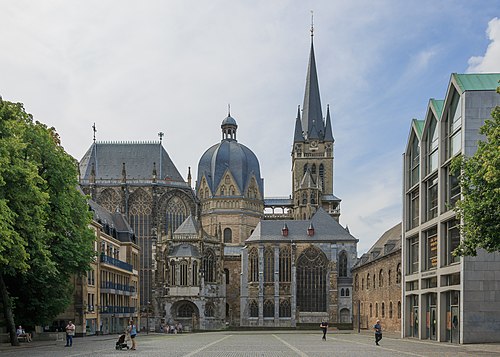
Merseburg Cathedral
Lutheran cathedral · Merseburg
Archaeological site
The Frankleben hoard is a significant hoard deposit of the European Bronze Age, associated with the Unstrut group (associated with the Tumulus or early Urnfield culture (ca. 1500–1250 BC). The site is in the Geisel valley, formed by a minor tributary of the Saale River. It was discovered in 1946 in a brown coal pit near Frankleben, now a part of Braunsbedra municipality, Saxony-Anhalt, Germany. The hoard consists of three ceramic vessels, buried alongside one another. One of the vessels was destroyed by a coal dredger at the time of discovery. The finds consist of a total of about 45 kg of bronze artefacts, most of them sickles, alongside some axeheads. The discovery was made by the operator of the coal dredger, Anton Wesp, in the "Michael Vesta" pit (now flooded and part of Runstedter See south of Frankleben, just off the BAB 38 highway). Wesp's dredger destroyed the first vessel almost completely in June 1946 (find I). Wesp returned to the site on 5 July 1946 and discovered a second vessel (find II), from which he was able to save 93 sickles and two axeheads. Wesp examined the site and found a third vessel (find III), containing 130 sickles and 12 axeheads. Find III is thus the...
An analysis of the Frankleben hoard found that markings on the sickles constituted a numeral system related to the lunar calendar. According to the Halle State Museum of Prehistory :
“Many sickles carry line-shaped markings. The scope and order of these brands follow a defined pattern. This sign language can be interpreted as a pre-form of a writing system. There are two types of symbols: line-shaped marks below the button and marks at the angle or the base of the sickle body. The archaeologist Christoph Sommerfeld examined the rules and realized that the casting marks are composed of one to nine ribs. After four left-hand, individually counted strokes there follows a bundle as a group of five on the right side. This creates a counting system that reaches 29. The Synodic Moon orbit lasts 29 days or nights. This number and the lunar shape of the sickle suggest that the stroke groups should be interpreted as calendar pages, as a point in the monthly cycle. The sickle marks are the oldest known sign system in Central Europe.”
The sickles also feature other marks or symbols which the archaeologist Christoph Sommmerfeld (1994) suggests may represent 'conceptual signs', or a type of proto-writing. Markings on sickles and tools from across Bronze Age Europe have been interpreted by other authors as ownership marks, sign systems, number systems or "units of information" of unknown meaning.
The archaeologist Mikkel Hansen (2019) has suggested that the Frankleben sickle-numeral system may be related to 'hand signs' found among petroglyphs from the Nordic Bronze Age, which may have a similar numerical and calendrical meaning.
- Wilhelm Albert von Brunn, Der Schatz von Frankleben und die mitteldeutschen Sichelfunde, Prähistorische Zeitschrift 26 (1958), 1-70.
- Bettina Stoll-Tucker: Mondsicheln in der Erde. In: Landesamt für Archäologie Sachsen-Anhalt, Landesmuseum für Vorgeschichte (Hrsg.): Schönheit, Macht und Tod. 120 Funde aus 120 Jahren Landesmuseum für Vorgeschichte Halle. Begleitband zur Sonderausstellung vom 11. Dezember 2001 bis 28. April 2002 im Landesmuseum für Vorgeschichte Halle/Saale.
- Marco Chiriaco, Der Hortfund von Frankleben: Ein Sichelmassenhort im chronologischen und geographischen Kontext sowie seine Bedeutung (2009),
Closest places in our Germany guide.
More places to explore in Germany.