Greece
Archaeological Museum of Nicopolis
Archaeological museum · Preveza municipality
Archaeological site

Nicopolis (Ancient Greek: Νικόπολις, romanized: Nikópolis, lit. 'City of Victory') or Actia Nicopolis was the capital city of the Roman province of Epirus. Its site, near Preveza, Greece, still contains impressive ruins. The city was founded in 29 BC by Octavian in commemoration of his victory in 31 BC over Antony and Cleopatra at the Battle of Actium nearby. It flourished through commerce and imperial patronage, obtaining its capital status in the early second century AD when Trajan created the province of Epirus. Nicopolis survived the turmoil of the third century and was made capital of a different, smaller province, Epirus Vetus, during the reforms of Diocletian. Bishops of Nicopolis appear in the historical record as early as the reign of Constantine, but Christianity did not predominate in the region until the late fourth century. A series of basilicas were constructed during the ensuing period. Between the reigns of Zeno and Justinian Nicopolis was repeatedly damaged by warfare, declining in size and receiving new fortifications. The city died out sometime after the eighth century. Its site was first discovered and excavated by Greek archaeologist Alexander Philadelpheus.
In 29 BC, 2 years after his victory in the naval battle of Actium, Octavian founded a new city which he called Nicopolis (the City of Victory), located on the southernmost promontory of Epirus, and across the mouth of the harbour from the ancient town of Actium. This foundation echoed a tradition dating back to Alexander the Great, and more recently illustrated by Pompey, founder of Nicopolis in Little Armenia (63 BC). Symbolically, the new city represented one example of his successful unification of the Roman Empire under one administration. Geographically, it constituted a major transportation and communications link between the eastern and western halves of the Mediterranean. Economically, it served to reorganise and revitalise the region, which had never recovered from its destruction by Lucius Aemilius Paullus Macedonicus in the Third Macedonian War (171–167 BC), or the further destruction under Sulla in 87–86 BC. It also established an important commercial centre and port at this strategic position on the Mediterranean sea routes.
On a hill north of Nicopolis where his own tent had been pitched, and north of the present village of Smyrtoula, Octavian also built a monument and sanctuary to Apollo, considered his patron god, and trophies to two other gods, Neptune and Mars for their contribution to its victory. This monument was adorned with the rams of captured galleys. In further celebration of his victory he instituted the quadrennial Actian games in honour of Apollo Actius.
In 27 BC, Octavian implemented an Empire-wide administrative reform. The new polis was considered capital of the territories of southern Epirus including Ambracia, most of Akarnania, and western Aetolia. Many inhabitants of the surrounding areas – Kassopaia, Ambracia, parts of Acarnania (including Leukas, Palairos, Amphilochian Argos, Calydon, and Lysimachia ) and western Aetolia – were forced to relocate to the new city. Among other things, it obtained the right to send five representatives to the Amphictyonic Council. As a city in a senatorial province, Nicopolis began minting its own copper coins (until 268).
During the first five years or so of the city's foundation, local authorities supervised the construction of the city walls, the majority of the public buildings, including the theatre, stadium, gymnasium, odeion, and the aqueduct. The city's western gate was connected by a road to the Ionian harbour Komaros. The city eventually occupied a site of around 375 acres.
Although the exact legal status of Nicopolis is the subject of some dispute, unlike other Roman foundations in Greece contemporary with Nicopolis such as Patras, Philippi and, also in Epirus, Buthrotum and Epidamnus, the city was not, or was not only, a Roman colony (implying that Roman military veterans also settled there) but also a free city ( civitas libera Nicopolitana ) i.e. a polis (Greek city), free and autonomous, having the characteristics of civitas libera and civitas foederata, linked to Rome by a treaty ( foedus ).
Thus provided with considerable assets by its founder, the new city developed rapidly in Roman times; Augustus adorned it with monuments financed by the spoils of war, but it also owes much to the patronage of Herod the Great. The two ports, one on the Amvrakikos Gulf, probably Vathy, and one at Komaros on the Ionian Sea (Fig. 4), ensured the commercial development of the city which was built on the Roman orthogonal grid distinguished by its considerable size (about 180 ha).
Germanicus, nephew and adopted son of Augustus, visited the city en route to Syria and celebrated his second consulship there in 18 AD. In 30–31, the Roman consul Poppaeus Sabinus visited Nicopolis.
In the winter of 65–66, the Apostle Paul decided to spend the winter at Nicopolis and in his Epistle to Titus 3:12 invited his co-worker Titus to join him there from Crete. Apparently a Christian community existed in the city.
In 66, in the wake of a terror campaign and financial constraints in Rome, Emperor Nero made a more modest trip to Greece in lieu of a planned great journey to the east. He visited Nicopolis during his tour of Greece to take part in the Actian games and was crowned winner of the chariot race, as is indicated on coins minted in Nicopolis in his honor.
Around 94 Emperor Domitian expelled philosophers from Rome, including the prominent Stoic philosopher Epictetus of Hierapolis, who went to Nicopolis and founded his own school. In the reign of Trajan the school's students included Arrian, whose notes preserved the teachings of Epictetus into the modern age. Epictetus died in Nicopolis around AD 135.
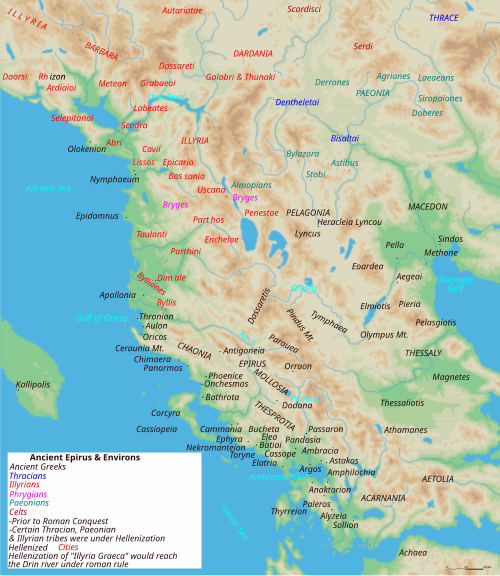
Around 110, under Emperor Trajan, the Roman government carved out parts of Macedonia and Achaia to make a separate province of Epirus. It had been decided that the territory needed a stricter government to yield higher revenues. The new province included Acarnania to the south as far as the Achelous, but not Apollonia to the north, plus the Ionian Islands – Corfu, Leukas, Ithaca, Cephalonia, and Zacynthus. It was governed by a procurator Augusti headquartered at Nicopolis, together with other special procuratores, including a procurator of the purple fisheries, whose sphere of office, however, extended to Achaea and Thessaly. This administrative set up appears to have remained intact through the reforms of Emperor Septimius Severus (193–211) and up until Emperor Diocletian (284–305).
In 128, Emperor Hadrian visited Nicopolis with his wife Vibia Sabina during his second voyage to the East (128–134). The imperial couple were received with the highest honours: small altars in the city attest to the worship of Hadrian and Sabina, respectively assimilated to Zeus Dodonaios, the most important deity of Epirus, and Artemis Kelkaia, a manifestation of the goddess unknown outside Nicopolis. Hadrian took advantage of his stay to build a temple to his late protégé, Antinous.
Around this time the city's western gate was constructed, several hundred metres north of the south gate, becoming the main gate of Nicopolis.
Around 180, the next mention of Nicopolis in Church history concerns a bishop of Rome, Pope Eleutherius, who reigned from around 174–189. He was born in Nicopolis, according to the Liber Pontificalis, and served as a deacon in Rome. During his term in office as Bishop of Rome, the Church was involved in the Montanist controversy.
Around 193–198, Emperor Septimius Severus, based in Syria, campaigned in Mesopotamia, with indirect consequences for Achaea and Epirus: to help pay for these campaigns, Severus apparently required several cities to mint special coins, including Nicopolis, Patrae, Epidaurus, Apollonia, Thuria, Plautilla, and the Thessalian koinon.
The late third century was a time of troubles for the whole Empire: the city was attacked by the Goths and Heruli, but managed to avoid looting thanks to makeshift fortifications.
In 268, the Goths launched a combined land-sea invasion against the Roman Empire, assisted by Heruli sailors and other tribesmen. Their naval forces ravaged Byzantium and Chrysopolis, though the imperial fleet successfully counter-attacked on the Propontis. Meanwhile, the land forces overran Thrace and continued into Achaea as far south as Sparta ; the invading Goths and Heruli sacked Athens, crossed the isthmus, sacked and burned the lower part of Corinth, and advanced to Argos and Sparta, ravaging the countryside along the way and burning the two cities. Here imperial land and sea forces counter-attacked, and the invaders wandered their way through Boeotia, Acarnania, Epirus, Macedonia, and Thrace on their way back to Moesia.
In Epirus, while the inhabitants of Nicopolis made hasty repairs to fortifications and managed to avert the danger, the leaders of Corfu organised their own army, crossed over into Epirus and defeated the Goths on land.
The Roman army chased the Goths and their allies and defeated them at Naissus. It seems that the city then lost much of its importance and reputation by becoming only a provincial centre. In 293, as part of Diocletian's reforms, the province of Epirus became known as Epirus Vetus (including Adrianopolis, Phoenice, Onchesmos, and Buthrotum as the most northerly major cities, and Acarnania and the islands of Corfu, Ithaca, and probably Leucas to the south). The capital was Nicopolis.
Closest places in our Greece guide.
More places to explore in Greece.