
Italy
Church Santa Maria della Celestia
Church building · Venice
Church building
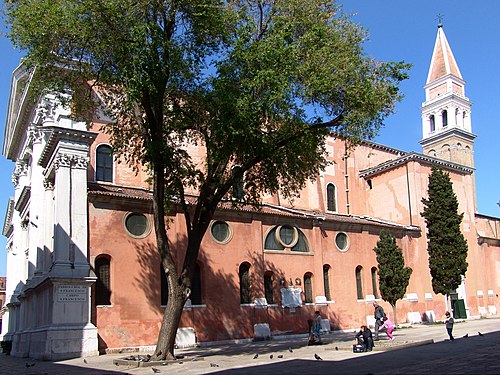
San Francesco della Vigna is a Roman Catholic church in the Sestiere of Castello in Venice, northern Italy.
Along with Santa Maria Gloriosa dei Frari, this is one of two Franciscan churches in Venice. The site, originally a vineyard ( vigna ), was donated by Marco Ziani in 1253 for construction of the monastery. A tiny chapel already on the site recalled the spot where an angel supposedly had pronounced Pax tibi Marce, evangelista meus to the shipwrecked Saint Mark, patron of Venice.
The first church at the site was a triple-nave Gothic church by Marino da Pisa. A monastery housed the Frati Minori dell'Osservanza, while the Conventuali occupied the Frari across town. By the 16th century, the church building was in need of repair. Two main impulses led to the reconstruction of this church; one was the reform sweeping the order of the Franciscan Observants, and the other was the wishes of Doge Andrea Gritti, whose family palace neighboured the church. In 1534, this Doge laid the foundation stone for the new church. The nave was roofed over by 1554.
The church was designed in sober Renaissance style by Jacopo Sansovino in 1554, with the advice of the Franciscan friar, Fra Francesco Zorzi. Fra Zorzi based the sizing of the various elements on the number three, because of its association with the Trinity : the nave should be nine paces wide and 27 paces long, each side chapel three paces wide. However, the white marble façade (1564-1570) was not based on Sansovino's design, but on Andrea Palladio 's instead. It is thought that the patrician Daniele Barbaro lobbied for the commission to be switched by Giovanni Grimani from Sansovino to Palladio in 1562. Palladio addressed the challenge of linking the central nave with the side aisles in the façade in an innovative manner. The Corinthian columns in both the center and the sides are perched on the same high plinth, though the central four columns are taller and wider than the lateral ones. The lateral columns support half-pediments that mimic the angle of the central full pediment. Above the central portal is a hemicircular window, interrupted superiorly by a bracket and subdivided into three parts. The façade contains two large bronze statues of Moses and Saint Paul (1592), actively stepping forward from their shallow niches, sculpted by Tiziano Aspetti.
At the top of the tympanum, an eagle unfolds a banner stating Renovabitur (It will be renewed). Below, a frieze dedication of the church states: Deo utriusque templi aedificatori ac reparatori (God, builder and restorer of both temples) is engraved. Four marble plaques state: Accede ad hoc / ne deseras spirituale / non sine iugi exteriori / interiorique bello (Enter here / not abandoning the spirit / nor without external yoke / and internal conflict). Inside the church, each chapel was sold for 200-350 ducats to aristocratic donors, raising much needed construction funds, granting the rights to place their coat-of-arms in the chapel and to bury their family there. For the right to be buried in the floor of the chancel in front of the high altar, Doge Andrea Gritti paid 1000 ducats. In 1542, Vettor Grimani and his brother Cardinal Marino acquired rights to build the facade for the church. The three sarcophagi for two cardinals and a patriarch from the Grimani family are no longer in place. The facade of the church was ultimately commissioned from Andrea Palladio (1562) by Giovanni Grimani.
In the 1950s were cast the 5 bells in B rung with the Veronese bellringing art.
The interior of the church has a simplicity and severity befitting a Franciscan church, with plain Istrian stone Doric pilasters. The choir, which in the past was occupied by the monks during services, is behind the altar. The interior contains an alabaster sculpture of St. Louis of Toulouse and an early 15th-century Gothic painting of the Madonna of humility.
The Grimani chapel (first in the left aisle) is decorated with ceiling paintings by Battista Franco, and murals and altarpiece by Federico Zuccari. The chapel has been restored by the British charity Venice in Peril, which also restored Palladio's facade in the 1990s.
The chapels of the church house masterpieces that both were made for this church or were moved here mainly in the 19th century from shuttering churches, oratories, and monasteries. They belong to some of the most prominent aristocratic families in Venice. Among the chapels, and works therein, are the following (starting from the entrance):
1st, Bragadin or of St Catherine of Alexandria First chapel on the right, dedicated to the Bragadin family, and patronized by Saint Catherine of Alexandria. The chapel was acquired in 1537 by Girolamo Bragadin, Procurator Procurator of St. Mark, the coat of arms of the Bragadin family are placed on either side of the altar. The painting of the altarpiece depicts Catherine of Alexandria with Saints Jerome, John the Baptist, and the Apostle James (Middle of the 16th century) by Giuseppe Porta. On the right, a painting depicting "the Last Supper" by Francesco Rizzo da Santacroce. On the left, the "Resurrection of Christ" by Giovanni da Asola. In the middle of the chapel, the tombstone of Bragadin Girolamo Bragadin (1545).
"Resurrection of Christ" by Giovanni da Asola
Catherine of Alexandria with Saints Jerome, John the Baptist, and James Giuseppe Porta
"the Last Supper" by Francesco Rizzo da Santacroce
2nd, Badoer-Surian or of the Immaculate Conception The chapel was dedicated in 1535 to the Virgin by Piero Badoer, Procurator of San Marco. It also contains the tombs (1563) of Surian family. The chapel has four flanking 18th-century canvases, originally from the Oratory of the Stimmate, depicting on the right the Sacrifice of Isaac by Pittoni and Rebecca at the Well with Eleazar by Nicola Grassi ; and on the left, the Samaritan at the Well by Francesco Polazzo and the Healing the Congenitally Blind by Angelo Trevisani.
3rd Contarini dalla Porta The chapel contains an alabaster statue of St Louis of Toulouse, and a canvas by Palma Giovane depicting the Virgin with Saints (1628). The ceiling (completed 1789) depicts the Scenes of Life and Death of St Peter of Alcantara including the Saint on the City Walls, St Theresa of Avila, St Peter, and Queen Isabel of Spain, the Death of the Saint, and Glory of the Saint, all by Francesco Fontebasso. In the walls are allegorical depictions of Faith, Hope, and Charity (right) by Jacopo Marieschi ; and Religion and Meditation (left) by Francesco Maggiotto. It houses the tomb of two doges: Alvise, doge from 1676 to 1684, and Francesco, doge from 1623 to 1624. Both busts are the work of Antonio Gai.
4th Malipiero Badoer The chapel contains an altarpiece depicting The Resurrection by Paolo Veronese. 5th Barbaro The chapel has the heraldic shield of the Barbaro family, a red circle on a white background, granted to admiral Marco Barbaro after his 12th-century victory in Jaffa. The painting of the altarpiece is by Battista Franco, it is an oil on canvas representing the baptism of Christ between Saint Francis and Bernardin of Siena. These two figures, appearing well on either side of the central group, are masked by the two columns.
It was erected at the expense of Matteo Goretto with an underlying altar dedicated to St. Matthew with a painting depicting the apostle of Francesco Montemezzano. Above the pulpit is another painting by the same author "La Vergine Assunta" (late sixteenth century).
Matthew the Apostle by Francesco Montemezzano
The assumption of the Virgin by Francesco Montezzano
1st left, The Grimani chapel is dedicated to the Grimani family under the patronage of the Magi. It was purchased in 1537 by Vettor Grimani procurator of San Marco. The vault is richly decorated by fifteen medallions known as "Roman" (circular boxes alternated with square boxes). The seven angelic virtues are found in the squares and in the eight circles the human virtues by Battista Franco called Semolei (1561). The altar whose altarpiece shows the "Adoration of the Magi" in 1564 by Federico Zuccari, was painted in oil directly on the marble. This choice explains the state of the work. On both sides in niches of the allegory of the Peace in bronze by Tiziano Aspetti who is the author of the statues of the Palladian facade of the church. Above the altar are three frescoes with the center: "The resurrection of Christ", right: "Elijah cured the son of the widow" and left: "Elijah and the chariot of fire", by Battista Franco. On the right side a fresco framed with gypsy "Resurrected Lazarus" (Resurrezione di Lazzaro) (1561) Federico Zuccari.
Closest places in our Italy guide.
More places to explore in Italy.


