
Italy
Marsala Cathedral
Church building · Marsala
Archaeological site

Motya was an ancient and powerful city on San Pantaleo Island off the west coast of Sicily, in the Stagnone Lagoon between Drepanum (modern Trapani) and Lilybaeum (modern Marsala). It is within the present-day commune of Marsala, Italy. Many of the city's ancient monuments have been excavated and are visible today. Motya has become known for the marble statue of the Motya Charioteer, found in 1979 and on display at the local Giuseppe Whitaker museum.
Motya is the latinization of the island's Greek name, variously written Motýa ( Μοτύα ) or Motýē ( Μοτύη ). In Punic, the name is attested on coins as ʾmṭw ( 𐤀𐤌𐤈𐤅 ), - mṭwʾ ( 𐤌𐤈𐤅𐤀 ), or - hmṭwʾ ( 𐤄𐤌𐤈𐤅𐤀 ), the last of which includes the definite article - h- ( 𐤄 ). From these attestations, the pronunciation has been approximated as Motúwa, or similar.
The origin of the name is uncertain. One proposed Semitic derivation associates it with spinning or weaving, yielding interpretations such as “spinners’ town” or “the weaving mill”; a non-Semitic origin, possibly Sicanian or Elymian, has also been suggested.
The Greeks claimed the place was named for a woman named Motya whom they connected with the myths around Hercules. The town's Italian name appears as both Mozia and Mothia ; its Sicilian name is Mozzia. [ citation needed ]
The island first received the name San Pantaleo in the 11th century from Basilian monks. [ citation needed ]
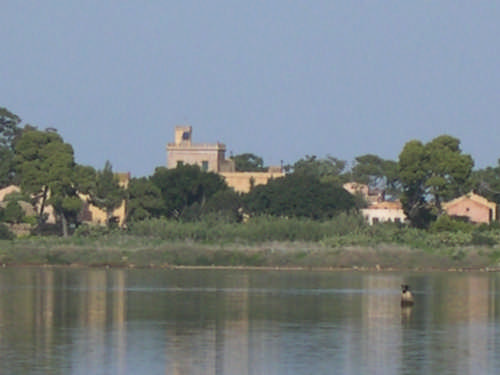
Between the promontory of Lilybaeum (Capo Boéo) and that of Aegithallus (San Teodoro), the coast forms a deep bight, in front of which lies a long group of low rocky islets, called the Stagnone. Within these, and considerably nearer to the mainland, lies Motya island formerly called San Pantaleo, on which lie the remains of the ancient city. The island is nearly 850 m (2,790 ft) long and 750 m (2,460 ft) wide, and about 1 km (0.62 mi) (six stadia ) from the mainland of Sicily. It was joined to the mainland in ancient times by a causeway, over which chariots with large wheels could reach the town.
The confined space on which the city was built agrees with the description of Diodorus that the houses were lofty and of solid construction, with narrow streets ( στενωποί ) between them, which facilitated the desperate defence of the inhabitants. Much of the walls, with those of two gateways, can be seen whose circuit is about 2.5 kilometres (1.6 mi).
The island of Motya is owned and operated by the Whitaker Foundation (Palermo), known for Marsala wines. The museum has artifacts that display Egyptian, Corinthian, Attic, Roman, Punic and Hellenic influences.
The Tophet, a type of cemetery for the cremated remains of children, possibly (but not entirely proven) as sacrifice to Tanit or Baʿal Hammon is exposed. Many of the ancient residences are open to the public.
The foundation of the settlement dates from the first half of the eighth century BC. Like Carthage, it was originally a Phoenician colony, who were fond of choosing similar sites, and probably was originally merely a commercial station or emporium, but gradually rose to be a flourishing and important town. The Phoenicians transformed the inhospitable island into one of the most affluent cities of its time, naturally defended by the lagoon.

By 650 BC the settlement had grown into a busy port-city with maritime trade extending to the central and western Mediterranean. This prosperity caused rivalry with powerful Carthage nearby on the North African coast, despite their ancient common ancestry. Towards the middle of the sixth century BC, Carthaginian forces led by General Malchus destroyed Motya. The city soon recovered and the population quickly rebuilt the city on a monumental scale and built the first defensive walls, some of the earliest in the central Mediterranean.
Motya is first mentioned by Hecataeus of Miletus, and Thucydides notes it among the chief colonies of the Phoenicians in Sicily at the time of the Athenian expedition in 415 BC. A few years later (409 BC) when the Carthaginian army under general Hannibal Mago landed at the promontory of Lilybaeum, he laid up his fleet for security in the gulf around Motya, while he advanced with his land forces along the coast to attack Selinus. After the fall of the latter city, we are told that Hermocrates, the Syracusan exile, who had established himself on its ruins, laid waste the territories of Motya and Panormus. During the second expedition of the Carthaginians under Hamilcar (407 BC), these two harbours became the permanent stations of the Carthaginian fleet.
In common with the other Phoenician settlements in Sicily, it passed under the government or dependency of Carthage, since Diodorus calls it a Carthaginian colony, but this may not be strictly correct.
As the Greek colonies in Sicily increased in numbers and importance, the Carthaginians gradually abandoned their settlements in the east and concentrated themselves in the three principal colonies of Soluntum, Panormus (modern Palermo ), and Motya. Motya became one of the chief Carthaginian strongholds, as well as one of their most important commercial cities in Sicily due to its proximity to Carthage and its opportune situation for communication with North Africa, as well as the natural strength of its position.
Main article: Siege of Motya The important status of Motya led Dionysius I of Syracuse in 398 BC to invade Carthaginian territory in Sicily. The Motyans, supported by Carthage, made preparations for vigorous resistance and, by cutting off the causeway which linked them to the mainland, compelled Dionysius to repair it or build a new causeway. When the military engines of Dionysius (among which the formidable catapult made its appearance for the first time) were brought up to the walls, the Motyans continued a desperate resistance and after the walls and towers were breached by the overwhelming forces of the enemy, they still defended from street to street and from house to house. Their struggle only increased the hatred of the Sicilian Greeks for the Carthaginians and when the troops of Dionysius were victorious, they put the whole population, men, women, and children, to the sword.

Dionysus garrisoned it under an officer named Biton, while his brother Leptines of Syracuse made it the base of his fleet. But the next spring (396 BC) Himilcon, the Carthaginian general, having landed at Panormus with a large force, recovered possession of Motya with comparatively little difficulty. Motya was not destined to recover its former importance for Himilcon was struck with the superior advantages of the promontory of Lilybaeum and founded a new city there to which he transferred the few remaining inhabitants of Motya.
From this period Motya disappears from documented history. Although we have no account of Motya having received any Greek population or having fallen into the hands of the Greeks before its conquest by Dionysius, there exist coins of the city with the Greek legend "ΜΟΤΥΑΙΟΝ". They are, however, of great rarity and imitated those of the neighbouring city of Segesta.
Archaeology has shown (e.g. the House of the mosaics) that it continued to be inhabited, including by wealthy Greeks.
In 2006 archaeological digs uncovered a house built against the town's walls, the finds from which have shown that the town had a "thriving population long after it is commonly believed to have been destroyed by the Ancient Greeks." Discovered items include cooking pans, Phoenician-style vases, altars, and looms.
During the Middle Ages, Basilian monks settled on the island and renamed it San Pantaleo, and in 1888 it was rediscovered by Joseph Whitaker.
Closest places in our Italy guide.
More places to explore in Italy.


