Ireland
14 Henrietta Street
Museum · County Dublin
Fountain

The town developed at a fording point on the River Brosna. Evidence of ancient settlement within Mullingar include records of a motte-and-bailey castle, a tower house known as Mullingar Castle, a number of fortified houses and several water mills. The town's Irish name, An Muileann gCearr meaning a "wry or left-handed mill", refers to one of these mills.
Former monastic settlements, founded in Mullingar, included the Augustinian Priory of St. Mary (established by the Bishop of Meath in 1227) and a Dominican friary (reputedly established by the Nugent family in 1237). The sites of these two monasteries, which were " dissolved " in the 16th century, were in ruin by the late 17th century.
When County Westmeath was formed in the 1540s, with the passing of the Counties of Meath and Westmeath Act 1543, Mullingar became the " shire town " for the newly formed county. It was also a garrison town, following the completion of Wellington Barracks (later Columb Barracks) in the early 19th century.
The current cathedral in Mullingar, the Cathedral of Christ the King, was built in the 1930s on the site of a former 19th century cathedral.
Westmeath County Council is the local authority for Westmeath. The county council comprises two constituencies or "municipal districts". Mullingar town is in the Mullingar Municipal District, which comprises thirteen members.
The town is part of the Longford–Westmeath constituency for elections to Dáil Éireann.
Mullingar's Ruth Illingworth, a local historian and Fine Gael politician, was Ireland's first female openly LGBTQ+ mayor, elected in 2009.
There is a Chamber of Commerce in Mullingar, and Mullingar is one of the three towns that forms the Midlands Gateway region, along with Athlone and Tullamore, set up as part of the Government's National Spatial Strategy 2002–2020.
Mullingar's tourist attractions include its lakes – Lough Owel, Lough Derravaragh and Lough Ennell – which are visited by anglers. The Royal Canal also flows through the town. Belvedere House and Gardens, Mullingar Golf Club and the Bloomfield House Hotel are all located nearby.
The town has a handful of hotels, including the Newbury Hotel, Annebrook House Hotel, Mullingar Park Hotel and the Greville Arms Hotel. The latter holds the two Brit awards presented to Niall Horan, and a large granite monument, which formerly stood at Dominick Street, which was presented to the town by Lord Greville. [ citation needed ]
One of Mullingar's notable buildings is the cathedral of Christ the King Mullingar, the cathedral of the Diocese of Meath. The cathedral was dedicated on the day World War II broke out.
Columb Barracks, which closed in March 2012, was a military base that housed the 4th Field Artillery Regiment, the 4th Field Supply & Transport Company and the HQ of the 54 Reserve Field Artillery Regiment (Army Reserve). [ citation needed ]
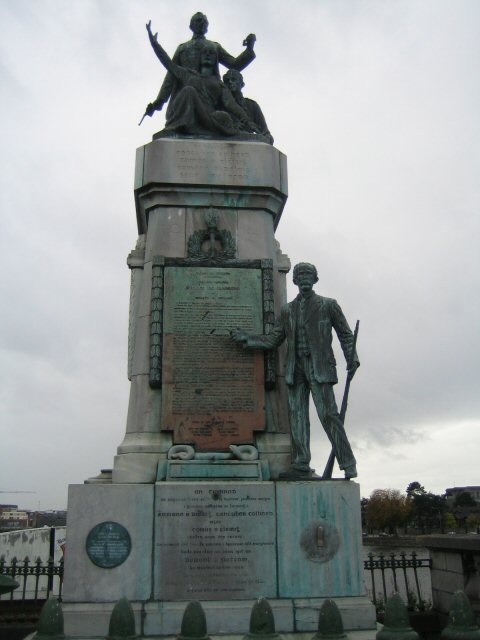
There is a monument, commemorating the centenary of the 1916 Easter Rising, at Green Bridge in Mullingar. The monument, built by the Mullingar Tidy Towns organisation, was officially unveiled on Easter Monday 2017. Other memorials and statues in Mullingar include a statue titled "The Pilgrims" (erected to commemorate the millennium in 2000 at the junction of Austin Friars Street and MacCurtain Street), a memorial to the Great Famine (erected in 1997 on The Square in Mullingar), and a statue of Joe Dolan (unveiled in 2008 on the Market Square).
Mullingar Town Park is a public park situated in the centre of the town, and it includes a wide variety of playgrounds, a swimming pool and a large pond near the centre. On 22 July 2016, the park became one of 22 public spaces in Ireland to be awarded a Green Flag.
Among Mullingar's exports are items of pewterware produced by Mullingar Pewter. Also associated with Mullingar is Genesis Fine Art, which produces gift items. The "Pilgrims" sculpture on Mullingar's Austin Friars Street, at which location there once stood an Augustinian Friary, was crafted by Genesis on foot of a commission by the Mullingar chapter of Soroptimists International.
Mullingar's commercial sector has expanded in recent years [ when? ] from just a few shops on the town's main thoroughfares – Oliver Plunkett Street, Austin Friars Street, and Mount Street – to several major shopping areas. There is an out-of-town retail park at Lakepoint (about 1.6 km from the town centre), the Harbour Place Shopping Centre near the town centre, and a development at the Green – on the site of the former Avonmore and Penneys units.
The town has a mix of local retailers and chain stores, and branches of the major banks. The town also has a credit union, Mullingar Credit Union (formerly known as St. Colman's House).
A proposed development, named "Mullingar Central", was to have been located between Mount Street, the railway station and Blackhall Street. Planning permission was granted for retail, commercial and residential units. Phase 1, which included tax offices, library, civic offices and County Council buildings was officially opened on 11 June 2009. Phase 2, however, did not proceed.
Mullingar contains several industrial estates and business parks. As of 2015, only one plot on the Industrial Development Authority (IDA) business park in Marlinstown has been acquired by an employer, Patterson Pumps. At that time, the business was constructing a new plant to which it intended to move its Irish operation from its current location at Mullingar Business Park. Two of the town's manufacturing plants – Penn tennis balls and Tarkett – both closed in the early 2000s causing many job losses. Other local employers include the Midland Regional Hospital at Mullingar, P.E.M. Engineering, Trend Technologies, Taconic International, and Mullingar Pewter.
The town is home to a €25m Lidl warehouse and distribution centre.
More places to explore in Ireland.