Portugal
Igreja da Memória
Church building · Ajuda
Palace
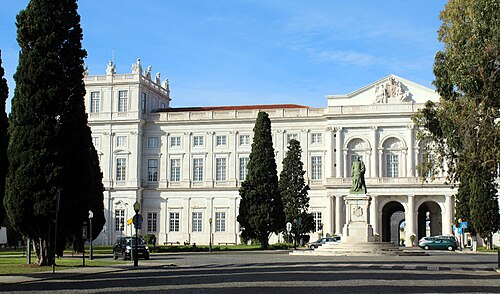
The Palace of Ajuda (Portuguese: Palácio da Ajuda, Portuguese pronunciation: [ɐˈʒuðɐ]) is a neoclassical monument in the civil parish of Ajuda in the city of Lisbon, central Portugal. Built on the site of a temporary wooden building constructed to house the royal family after the 1755 earthquake and tsunami, it was originally begun by architect Manuel Caetano de Sousa, who planned a late Baroque-Rococo building. Later, it was entrusted to José da Costa e Silva and Francisco Xavier Fabri, who planned a magnificent building in the neoclassical style. Over time, the project underwent several periods when the construction was stopped or slowed due to financial constraints or political conflicts. When the royal family had to flee to Brazil (in 1807), following the invasion of Portugal by French troops, the work proceeded very slowly with Fabri taking charge of the project, later followed by António Francisco Rosa. Lack of financial resources would also result in the scaling down of the project. The construction of the Ajuda Palace, which began in 1796 and lasted until the late 19th century, was a project plagued by various political, economic and artistic/architectural problems. It was invaded...
In 1726, King John V of Portugal acquired three estates in the parish of Belém: one became the Belém Palace ; on the second parcel an oratory, which was eventually expanded, becoming the Necessidades Palace ; and the third reserved for a summer residence that never materialized during his reign.
On 1 November 1755, the day of the 1755 Lisbon earthquake, the royal family was in Belém, and escaped the destruction of Lisbon by the earthquake and tsunami. Perturbed by the events, King Joseph refused to live under a residence of masonry, and took refuge in a wooden cabin next to the Palace of the Counts of Óbidos (packed with tapestries from the Quinta de Baixo ). As the royal family continued to fear for the viability of the Ribeira Palace in Lisbon, the King ordered the construction of a more permanent wooden building in the heights of Alto da Ajuda; the architects Petrónio Mazzoni and Veríssimo Jorge began building an elaborate structure from wood collected from the Vale de Figueira pinery. The Real Barraca ( Royal Tent ), or Paço de Madeira ( Wooden Palace ) was completed on 20 September 1761 (and the first baptism was held in its chapel), but, owing to risk of collapse, the theatre (which was considered a risk by architect Giovanni Carlo Galli-Bibiena ) was reconstructed from 1767 to 1786 by Giacomo Azzolini. The court remained at this site for nearly three decades, in a luxurious atmosphere of the golden age of enlightened despotism, until the King's death in 1777. Since his successor, Queen Maria I of Portugal lived with Peter III in the Palace of Queluz at the time of Joseph's death, the Royal Barraca was vacated.
In November 1794, during the reign of Maria I and the Prince Regent, the royal tent was destroyed by fire, although the fire-fighters were able to save the library and church. A more permanent dwelling was conceived by the architect José da Costa e Silva. Starting on 17 July 1795 the rubble and terrain was cleared, which continued on 27 July under the direction of António Vicente. The first cornerstone was laid on 9 November under the direction of Manuel Caetano de Sousa (with a secondary project under the supervision of German Xavier de Magalhães). It was conceived as a Baroque -late Rococo building, but the construction was interrupted shortly after. As of 19 May 1796 the project was supplied by the masons Francisco António and Joaquim Baptista, who brought in stone from Monsanto (Idanha-a-Nova), sand from Alfeite, calcium oxide cooked in Alcântara, tile from the Alhandra, with limestone provided from Pêro Pinheiro, Belas, Vila Chã and Monsanto. The intervention of many architects resulted in a royal decree (9 December 1801) that stated that alterations to the project could only be made in agreement with Manuel Caetano de Sousa, Joaquim de Oliveira, José da Costa e Silva and/or Francisco Xavier Fabri (as long as it economized on the project costs). But, Manuel Caetano de Sousa designed an overcomplicated and intricate Baroque building (which was later criticized by da Costa e Silva and Fabri in 1801). But, with mounting confusion and difficulties between the architects and contractors, on 21 January 1802, da Costa e Silva and Fabri were invited by the Crown to present a new project, in conjunction with António Francisco Rosa and Manuel Joaquim de Sousa, while excluding Manuel Caetano de Sousa.
In 1802 Manuel Caetano de Sousa died, and by 26 June, da Costa e Silva and Fabri were appointed official architects. Da Costa e Silva and Fabri respected what was already constructed, but introduced necessary alterations to change the royal palace into a more dignified, serious and majestic building. Consequently, the plan was simplified and reduced to a core structured around two courtyards, with the same level of ornamentation, but now much more refined.
On 2 July 1802, the monarch solicited the Marquis of Alorna to study the future paintings that would occupy its walls. Domingos Sequeira and Vieira Portuense were contracted to paint the property, accompanied by Joaquim Gregório da Silva Rato, Manuel Prieto, José da Cunha Taborda, Fuschini and Calisto, while Italian decorators Manuel da Costa and Giuseppe Viale were hired to decorate the mansion. Similarly, sculptors Joaquim Machado de Castro (who created three sculptures), Carlo Amatucci (some), João José de Aguiar, and his assistant Gregório Viegas (executed ten statues), Joaquim José de Barros Laborão and Manuel Joaquim Laborão (completed six statues), while Faustino José Rodrigues and his son, Francisco Assis Rodrigues, were contracted to complete three sculptures. In 1803, Carlos Amatucci completed the sculpture of Liberdade.
By 1807, the painters, sculptors and decorators had been contracted, but the arrival of Jean-Andoche Junot 's forces immediately stopped the build as the royal family fled to Brazil ( Rio de Janeiro ). Yet, Junot insisted that the building should continue. But in 1809, the French invasion of the Portuguese territory finally caused the suspension of the project. By 1812, Francisco Fabri returned to chef the project, since José da Costa e Silva had also joined the royal family in Brazil. Fabri's model was based on the Palace of Caserta in Naples, designed by Luigi Vanvitelli. He envisioned an ample palace design, directed South, towards the Tagus River, with four main towers at its angles: the works restarted in 1813.
In 1814 and 1815 work progressed in the rooms and staircases that were completed, with Taborda, Fuschini, Calisto, Cirilo Volkmar Machado (and his assistant Oliveira Góis), and Máximo Paulino dos Reis as painters, while decorator Manuel Piolti took over the interior layout. In 1814, Cyrillo painted the Sala do Dossel. In April 1815, the quarry of Lameiras was appointed to extract rock for the columns of the main floor.
Manuel Caetano da Silva Gaião joined the project in 1815 to assist the team. In 1817, Francisco Fabri died, and was replaced by his assistant, António Francisco Rosa, who was forced by the Royal Treasury to curb the scope of the project. Several individual projects were completed in 1818: Domingos Sequeira returned to direct the painting of the palace; the model for the south tower, authored by José Joaquim de Sousa was completed; on 26 September the vaulted ceiling was erected in the vestibule; and on 12 November, the decorative works in the Sala dos Embaixadores ( Ambassador's Hall ) were cleaned by contractors Severiano Henrique Pereira and Francisco de Paula.
King John VI, still in Brazil, began to show interest in the project, and presented the designs to his local architects Auguste-Henri-Victor Grandjean de Montigny and João da Silva Moniz. When António Francisco Rosa took over the work in 1818, the project progressed at a slightly accelerated pace, on the assumption that the royal family would return. But, the Cortes were insecure about the expenses in completed Ajuda.
On 11 January 1819, ten new flourishments in the Ambassador's Hall were executed by António Joaquim de Faria and the contractors Francisco de Paula, Severiano Henrique Pereira and Leandro Gomes. On 15 February, in the Sala dos Archeiros ( Archer's Hall ), the painters Vicente Paulo Rocha and João de Deus Moreira, painted the base boards, following the designs of Manuel Piolti (since José Francisco Ferreira quit the project). By May, Volkmar Machado proposed a new eastern façade, with a triangular apex and allegorical sculptures, alluding to the expulsion of the French during the Peninsular War, but the project was dropped. Between 1819 and 1920, sculptures of Justice and Prudence were completed by de Aguiar; the ceilings of the Archer's Hall and Cane Concierge's Hall by Taborda (1766–1836) were completed, its doors first started by Piolti (1770–1823); the metal shields on the doors were provided by the Army arsenal; the ceiling of the Hall of Spanish Tapestries by Volkmar Machado, with perspectives by Piolti, figures by Joaquim Gregório da Silva Rato and ornamentation by André Monteiro da Cruz; skirting by bronzer and gilder Pierre-Philippe Thomire (1751–1843); the ceiling of the antechamber of the Sala do Despacho ( Order Room ) was completed by da Cruz and Taborda. In 1820, a new project for the south and eastern façades was authorized, which included a system of ramps and staircases created by Rosa. Metalsmiths João Pereira and Manuel António, and carpenter José Joaquim de Sousa completed the project.
On 27 July 1820, a meeting was held by the royal palace inspector, da Costa e Silva, Volkmar Machado, de Magalhães, Rosa and da Silva Gayão to decide upon the first design for the eastern façade, or a new composition by Volkmar Machado. During these meetings the project for the vestibule was approved; the decoration of the Sala da Tocha ( Torch Room ), its access ramps and staircase; and the painting designs for the rooms by Piolti, which were executed by Anacleto José Narciso, Eugénio Joaquim Álvares, Eusébio de Oliveira, João de Deus, José António Narciso, José Tomás and Vicente Paulo.
By 1821, when John VI of Portugal returned from Brazil, the palace had not yet been completed, and only permitted some state and ceremonial protocols (such as John's investiture in the Order of the Garter in 1823). Consequently, John VI decided to live in the Bemposta Palace. With a new simplification of the plans, architect António Francisco Rosa continued the structural works. During this phase, painters Taborda, Sebastião José Alves, José Joaquim de Sousa, Bernardino de Sena Lemos da Rocha, Arcangelo Fuschini, Máximo Paulino dos Reis, Joaquim Gregório da Silva Rato, Piolti, João Pereira, José Pedro de Carvalho, and mason António Joaquim de Faria worked at the palace. In 1823, the staircase was decorated by painter Norberto José Ribeiro, and in 1825 Joaquim Rafael became head painter.
The palace began to be used as a royal residence in 1826, when the Infanta Isabel Maria, Regent on behalf of the young Queen Maria II, moved in. It was proposed to the architects that the project's scale be reduced, encompassing only one-third of the original design, making the eastern façade the main entrance and erecting a tower at the southern end. Its plan now reduced in half, it included one block, the construction of which was immediately interrupted by the Liberal victory in 1833.
In 1827, Piolti died, leaving behind the decorative painter António Inácio Vieira in charge of the interior design. Work on site began, and quickly ended in 1828, by the English mason John Johnston. He was responsible for the English staircase, but was mysteriously removed from the project to be replaced by Nicolau Pires. In 1830, António Joaquim de Faria, responsible for many of the stonework within the palace, also died. Similarly, three years later, Sebastião José Alves died, being succeeded by Joaquim José Ventura Alves.
During the second half of the 19th century, new works in the palace were specifically done to adapt the existing space to a permanent royal family residence: the windows in the antechamber of the Sala do Despacho were completed by Paul Sormani; new lace draperies from Switzerland were hung in the windows; the Quarto de D. Luís ( D. Luís Room ) was partitioned, with a lowered ceiling, and used as an office space with washroom; the Sala de Trabalho do Rei ( King's Study ) was decorated with a new rug, produced by the English firm Thomas Bontor & Company, which also produced new rugs for the Sala Chinesa ( Chinese Hall ); also, the older Sala de Bilhar ( Billiard Room ) was divided into two rooms: the Sala Chinesa ( Chinese Room ) and the Sala Império ( Imperial Hall ).
These changes were primarily due to the increase use of the palace. In 1828 Miguel of Portugal was acclaimed by the Portuguese Cortes in the Cortes Hall (today the Dining Room ). Miguel also inhabited the palace for six months as the royal residence, the Necessidades Palace, underwent remodelling.
The move of the Royal Court to Queluz Palace in 1829, and the death of the architect Rosa, resulted in a slowing of the project, and the affected the north wing which fell into ruin.
With the start of Liberal and Absolutist factionalism, the country entered into a period of fragile stability, and the project, already moving slowly, stopped in 1833 with the entry of liberal forces in Lisbon.
With the restored Liberal regime, Peter IV took over as Regent until his daughter 's age of majority, swearing allegiance to the Constitutional Charter in the throne room on 30 August 1834. Peter attempted to complete the palace, under the revised plan of Joaquim Possidónio Narciso da Silva, but was unsuccessful. Yet, some projects continued inside the building: in 1836, the antechamber of the Sala do Despacho with scenes of Diana by André Monteiro da Cruz was completed; in 1837, several paintings were repaired by Joaquim Rafael; in 1844, busts of the monarchs in wax were ordered, by Joaquim Rafael; and the sculpture of Inocência by Benedetto Delisi was executed in 1860.
Closest places in our Portugal guide.
More places to explore in Portugal.