Italy
House of the Faun
Roman villa · Pompei
Archaeological site

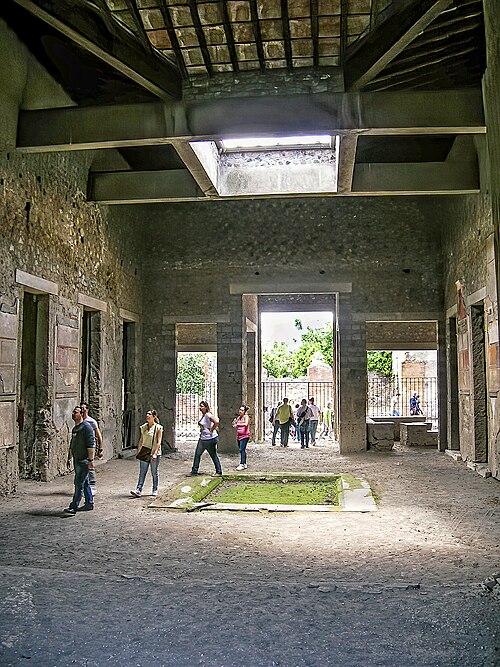
The House of the Small Fountain (Casa della Fontana Piccola, VI.8.23), aka House of the Second Fountain or House of the Landscapes, is located in the Roman city of Pompeii and, with the rest of Pompeii, was preserved by the eruption of Mount Vesuvius in or after October 79 CE. It is located on the Via di Mercurio, a street running north from the Arch of Caligula, at its crossroads with Via delle Terme, and Via della Fortuna, to Pompeii's fortification tower XI in the northwest part of the city. The street is named after a public fountain at VI.8.24 with a relief of the god, Mercury. Insula 8 is on the west side of the street. The house is named after a mosaic fountain adorned with shells at the rear of its peristyle. The property is immediately adjacent to the House of the Large Fountain (VI 8,22,1), a structure with an even larger mosaic fountain adorned with shells and marble sculptures of theatrical masks excavated earlier in 1826. So the size difference between the fountains was used to distinguish the two structures.
In addition to the House of the Large Fountain, other significant structures nearby included the lavishly decorated fullonica and House of L. Veranius Hypsaeus with its stately, pillared atrium where frescoes depicting the cleaning process were found. Across the street is the House of the Five Skeletons, sometimes known as Cassandra's Vatican House, decorated with scenes of characters from the Iliad, The House of Pomponius with remains of an oil press, and the multilevel House of the Anchor with its expansive lower garden accessed through numerous arched entrances. Sprinkled between the grander residences are shops and thermopolia, some with residences attached. The proximity of other upper merchant-class homes created a nexus for social activities for the residents of the House of the Small Fountain within their appropriate social class.
The presence of the fullonica as well as the shops with residences attached suggests a diverse workforce in the neighborhood that included women and children.
"...paintings from fullonica VI 8, 20–21.2 at Pompeii show men, women and children performing various tasks related to the fulling process (Fröhlich 1991; Clarke 2003). Three women and a girl are shown performing relatively light tasks in the finishing phase, such as checking the quality of the work done and folding clothes, while three of the four stall workers seem to be little boys." As family-based businesses, including the fullonica built into an atrium-style house, two or more generations may have worked side by side. Within the fullonica workshop, though, ultimately the division of labor based on different responsibilities determined the social status of groups or individuals within the work environment.
The presence of the public fountain just outside entrance 24 would have also produced a gathering place for all local residents and a communications hub for the immediate vicinity.
The house was originally two Samnite period structures merged during the Roman period to create a double atrium house. Remnants of stairs in both fauces and in the service wing attest to the existence at one time of an upper floor. At the time of the eruption, the home was being repaired because of damage sustained in the earthquake of 62 CE.
The exterior walls of the merged structures primarily consist of opus incertum supported by limestone ashlar pillars except at the southern end where the opus incertum leans against the tufa ashlar facade of the Casa della Fontana Grande. Up to an average height of 3 meters, the opus incertum consists of black lava. Limestone chunks compose the material above that height. An exception is west of a recess outside Room 15 where the opus incertum becomes almost pure limestone with few lava fragments. The western end of the facade is supported by a pillar of opus mixtum with a repeating pattern of two rows of brick between one row of ashlars made of Sarno lime and tuff.
Although part of the facade of the house may have been exposed in December 1826 while work progressed on the House of the Large Fountain, the earnest excavation of the House of the Small Fountain did not begin until February 1827 and continued in March and April. Records from finds in the atrium (2) area are dated April 13, 1827. By May 1, atrium (2), fauces (1), staircase (28), cubicula (3) and (9), tablinum (8) and corridor (16) were exposed. The peristyle had been discovered but not yet cleared. By May 29, 1827, excavators had cleared all rooms west of the atrium.
On June 5, 1827, a show excavation was staged for Francesco I and the royal family in which the mosaic fountain with its statuary was revealed in the peristyle. Finds recorded in the Pompeianarum Antiquitatum Historia (PAH) indicate the excavators finished clearing the exposed rooms and contents in the following months. Excavations of the small annexed house at entrance 24 and the rooms on the north side of the peristyle did not begin until September 14, 1827. When the king visited again at the end of October, he was shown additional finds from the house. The last finds were recorded on November 5 and 6 and a complete plan of the house was submitted to the Real Museo Borbonico IV.
German archaeologists Thomas Frolich and Volker Michael Strocka, in their publication "Häuser in Pompeji: Band 8: Casa della fontana piccola" (VI 8, 23.24), point out that some previous scholars misinterpreted later reports in the PAH dated August 20, 1839, claiming additional excavations took place in the "della nuova fontana a musaico". Citing Margareta Staub-Gierow they state, "in 1839 the nuova fontana no longer meant the fountain of the Casa della Fontana Piccola, but rather that of the Casa del Granduca, Pompeji VII 4,56, which had been discovered in 1833." Soon after excavations were completed in 1827, modern roofing was constructed over rooms 7, 9, 10, 19, 24 and 25 that contained paintings deemed worthy of preservation. A thorough restoration in 1971 provided all rooms with modern concrete ceilings and both atriums received modern roofing. The ancient walls had to be fortified to support the additional weight and this work resulted in the loss of their original surface. The 19th century roof over the garden that had sparked controversy was removed but this action exposed the landscape paintings to the elements. So in 1985–86, a new protective roof of polycarbonate was rebuilt over the garden, all paintings restored, and the fountain repaired.
Fauces – Entrance 23 (1): The fauces, once secured from the street by a double-leaf door, is paved with gray lava pesto studded with regular rows of white almost square tesserae. Its plastered walls were decorated in the Fourth Style with a black dado, red-paneled middle zone and a white upper zone. Only traces of small flowers, a large candelabra and hints of architectural framework remain. On the right side near entrance 23 are stairs leading to an upper floor.
Atrium – (2): The Tuscan-style atrium, with impluvium, fountain, and puteal (well head), is paved with gray lava pesto matching that of fauces (1). The floor appears to have been cut after it was laid and marble thresholds were installed for adjoining rooms. Wall plaster is fragmented but was painted in the Fourth Style. A red dado is topped by a middle zone featuring red panels with white border stripes on a yellow ground. Two floating pairs of dancing satyrs and maenads once copied by 19th century architect Niccolini are now no longer visible.
Room 3 : Plastered, barrel-vaulted chamber decorated in the Fourth Style with white ground middle and upper zone over a red dado. It is paved with fine gray lava chips with slightly larger red brick pieces in a geometric pattern. Small white tesserae form a carpet of not quite regular hexagons. In the center of each hexagon is a cross star consisting of four white and one central black stone. This small room may have served as a vestibule for waiting visitors. According to Fausto and Felice Niccolini writing in 1854, the walls were once decorated with architectural elements and floating figures of dancing fauns and Bacchantes on a red ground. (See drawings by 19th century Swiss artist Frauenfelder.)
Room 4 : This chamber provides access to both Atriums, 2 and 17, of the integrated structure. A wide door at the west end of the north wall opens into Atrium 17 while the room itself opens full width into Atrium 2. The room was last paved with gray lava pesto with brick inclusions. A little north of the center of the room is a square arrangement of granite slabs from Egypt, Turkey, the island of Elba, and north Africa. Scholars suggest the larger slabs are Egyptian "granito bianco e nero" (black and white) and "granitello bigio" (gray) from Elba. They think the smaller slabs are white-purple pavonazzetto from Asia Minor and yellow " giallo antico " from Tunisia. Plaster was once decorated in the Fourth Style, but colors have almost completely faded although traces appear to remain of a red base and white middle and upper zones with delimiting stripes and faint traces of palmettes and rosettes.
Room 5 : Storage room with access from Atrium 17; the original smooth layer of the pavement is not preserved. The existing floor is now a layer of a highly calcareous, light gray, crumbly screed lying on a bedding of brick and plaster rubble. The walls have retained only remnants of plaster including a pink base with a white zone above it.
Room 6 : Storage room with access from Atrium 2; the walls were plastered and painted with a red dado with a white zone above it, although only fragments remain. Rows of square holes indicate there was once shelving. Exposed masonry reveals the walls were constructed of opus vittatum mixtum with repeating layers of two brick courses and one ashlar course of limestone and tuff. The original smooth layer of pavement no longer exists. The exposed flooring is a coarse, light gray, strongly calcareous screed.
Room 7 – Ala: the south wall is completely open to Atrium 2. Exposed construction reveals the remaining walls are composed of opus incertum in the western section until an opus vittatum mixtum structure begins near the west corner with repeating layers of two brick and one ashlar courses. The floor pavement is divided into a northern and southern section. The plastered north wall facing a visitor from the atrium 2 entrance is decorated in the Fourth Style with an ochre dado with floral elements and peacocks and white ground middle and upper zones embellished with architectural structures populated by human figures. The central floating figure is a female, possibly a deity ( Ceres ?), holding a staff. In the left upper zone a woman with a lyre peers down from a balcony decorated with a small landscape panel painting. In the right upper zone a woman with a ewer and serving tray also peers down from a balcony decorated with a small landscape panel painting. The central figure in the upper zone appears to be a garlanded female with serving tray above a small panel painting of a sieve and sheaf of grain. (see gallery)
A floating figure on the east wall, bearing her signature torch, is Ceres, goddess of agriculture and fertility. Both the east and west walls continue the scheme of an ochre dado with white ground middle and upper zones decorated with architectural frames and aediculae containing nude satyrs as well as fluttering swans and candelabras. Both east and west dados have small landscape panel paintings and images of birds.
Room 8 – Tablinum: this tablinum has a full-width eastern entrance into atriium (2). A doorway in the west wall provides direct access to the peristyle garden (10). The atrium floor is slightly lower than the floor within the tablinum so a marble step bridges the difference and is decorated with a marble relief. At the center of the relief is a bearded head with Ammon-like curled horns. Acanthus leaves and flowers extend to the left and right. The room's pavement is a black and white mosaic. The center portion has been replaced in modern times. It is bordered by an ancient meander pattern that has been patched by restorationists. The plastered walls are badly faded. They appear to have been decorated in the Fourth Style with a yellow-ground base, a red-ground middle zone interspersed with white ground panels. The middle panel of the south wall retains a barely perceptible sea monster moving to the left but its head turned to the right preceded by a diving dolphin. The PAH indicates images in other fields were small pictures of birds and fruits.
Room 9 : Barrel-vaulted chamber with plastered walls, topped with a once colorful stucco cornice, decorated in the Fourth Style with white-ground middle and upper zones over a red dado. Fields are defined by paintings of architectural elements interspersed with aediculae topped with mythological creatures. In the center panels of the north and south walls are floating landscape paintings. The left and right panels feature small scenes with animals including cavorting goats, birds, and panthers, typical Bacchic iconography. The upperzone includes small landscape panel paintings. The red dado is embellished with green and yellow floral elements. The room is paved with coarse-grained gray lava pesto punctuated by an opus sectile mosaic in the center of the room consisting of seven rows of colorful marble running in an east–west direction.
Closest places in our Italy guide.
More places to explore in Italy.