Italy
House of the Vettii
Roman villa · Pompei
Archaeological site

The House of the Prince of Naples is a Roman domus (townhouse) located in the ancient Roman city of Pompeii near Naples, Italy. The structure is so named because the Prince and Princess of Naples attended a ceremonial excavation of selected rooms there in 1898. The house is painted throughout in the Pompeian Fourth Style and is valued because its decoration is all of a single style and single period, unlike many others that are often a mix of styles from different periods. It is located in Regio VI, Insula XV of the city.
The house was formed from two earlier houses being joined together. The house had two floors but the upper one almost completely collapsed following the eruption.
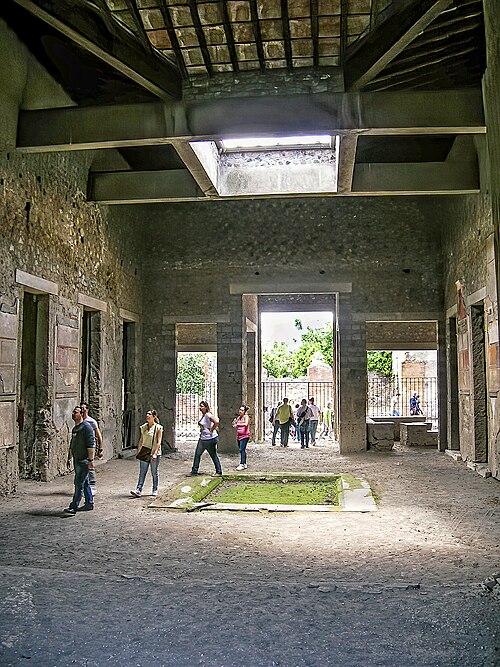
The atrium was of Tuscan order, with a central impluvium : it was probably restored shortly before the earthquake of 62 which caused damage to the structure. The atrium area preserves the frescoes from the last phase of decoration.
The rear part of the domus consists of richly decorated rooms around the portico and the central garden.
The house fronted the Viccola dei Vetti and the spaces on either sides of the main entrances appear to have been shops. The holes on the outside of the north facade indicate the fixings for a canopy.
The house was inhabited at the time of the eruption as demonstrated by the discovery of a skeleton, remains of food and domestic possessions in most rooms.
The initial excavation began in October 1896 after the entrances were discovered following the excavation of the expansive House of the Vettii. The excavation team entered through the fauces into the atrium and finds were reported in rooms (c), (d), and (n). The work continued until the end of December 1896 with further finds discovered in (d), (n), (e), (g) and (l). Excavations did not resume until February 1897 when the kitchen and two cubiculums were finally cleared.
Excavations where artifacts were expected were reserved for a formal royal visit in the spring of 1898 and at this official naming excavation rich finds were made in two cubiculums, the tablinum, the triclinium and the exedra. Another ceremonial excavation in front of the Grand Duke of Saxe-Weimar in 1898 resulted in finds in the pantry and the room accessed through entrance 7 that housed a staircase to the upper floor, at which point the excavation was officially ended.
Protective roofs were eventually erected. In 1972, much of the ancient walls of the upper story were removed to install flat concrete ceilings over the ground floor and tiled roofs over the atrium and Porticus.
The house was originally constructed during the limestone period (3rd century BC) since the entrance consists entirely of opus incertum with cruma and lava. The limestone framework of the southern wall of the garden also demonstrates it belonged to this earlier period. The absence of limestone posts in the dividing wall between the atrium and the portico indicates it was a subsequent modification.
During the late 2nd century BC, Pompeii experienced a major population expansion and the insulae of Region VI became dotted with establishments engaged in urban commerce. Furthermore, the upper floor of this structure, demolished in the 1970s, above (a), (b), (c) (e), (f), (i),(k) and (l) is thought to have contained rooms that were possibly rented out as apartments.
The construction of the impluvium is of the early 1st century BC in part because of the surrounding floor pavement of punteggiato regolare, a signinum featuring spaced travertine tesserae used widely in Pompeii beginning about 100 BC. This improvement is thought to have been part of an overall renovation of the northern portion of the structure at that time.
This activity may have been initiated to repair widespread damage and reflect a possible change of ownership that coincided with the aftermath of the Social War. Pompeii was one of the Campanian cities that rebelled against Rome in this conflict. In 89, BC, the general, and later dictator, Lucius Cornelius Sulla, laid siege to Pompeii, bombarding Region VI's Porta Ercolano with his artillery, as evidenced by impact craters from thousands of sling bullets and ballistae bolts still visible on the ancient city wall.
The nearly 4 foot-square impluvium is slightly south of the entrance axis to make it parallel to the room's south wall. A large marble table (cartibulum) supported by winged griffins found at the site has been placed at the impluvium's west edge since 1977.
The off-centred axis of the impluvium served to focus the attention of visitors to the left side of the atrium where doorways to public reception rooms were located. This differentiation of space also guided attention away from the dimly illuminated utility areas of the house positioned in the right half of the atrium, the undecorated cubiculum of the ostiarius (a), with narrow stairs possibly leading to slave quarters on the upper floor, and the undecorated kitchen, latrine, and pantry (g) and (h). The pantry or storage room could have also been used as an eating area for the household slaves as well.
This off-centered arrangement reflects the influence of Greek architectural designs of Hellenistic houses and palaces where visiting males were purposefully directed away from female-inhabited interior spaces. But, where the Greeks used the arrangement to create privacy, the Romans used it to contrast space for invited as opposed to uninvited visitors.
The next major renovation took place In the 1st half of the 1st century, when the passageway between the atrium accessed through entrance 8 and the space that would become the porticus in the structure accessed through entrance 7 was cut. A new partition with windows was constructed to separate the space southwest of the atrium, that would become the barrel-vaulted tablinum with adjoining barrel-vaulted cubiculum and provide views of the garden.
This essentially created a "master suite" with views of the garden from both rooms and the provision of extra light augmented by the oculus in cubiculum (f). Scholars point to a persistent pattern in Roman architecture like this whereby a larger reception room, the tablinum in this case, is juxtaposed to a smaller room of suitable proportions for a bedroom, confirmed by the presence of a bed, denoting a hierarchy of intimacy where a guest could progress from the tablinum to the bedroom and, perhaps, to the bed recess itself.
The windows also provided a framed view into the garden for visitors in the left half of the atrium and provided supplemental lighting. Both Cicero and Pliny the Elder, familiar with the precepts of famed Roman architect Vetruvius, discuss the importance of a framed view in Roman architecture not only for aesthetic purposes, but to demonstrate control over raw nature, and even modest homeowners would have been aware of these architectural strategies.
The new passageway also provided more efficient access from the kitchen to the repurposed large triclinium and, subsequently, the new exedra as well.
Closest places in our Italy guide.
More places to explore in Italy.