
Australia
Royal Exhibition Building
Exhibition park · City of Melbourne
Urban park

The Carlton Gardens is a UNESCO World Heritage Site located on the northeastern edge of the Central Business District in the suburb of Carlton, Melbourne, in the state of Victoria, Australia. The gardens are a popular picnic and barbecue area, and are home to an array of wildlife, including brushtail possums. The 26-hectare (64-acre) site contains the Royal Exhibition Building, Melbourne Museum and Imax Cinema, tennis courts and an award-winning playground. The rectangular site is bounded by Victoria Street, Rathdowne Street, Carlton Street, and Nicholson Street. According to the World Heritage listing, the Royal Exhibition Buildings and Carlton Gardens are "of historical, architectural, aesthetic, social and scientific (botanical) significance to the State of Victoria." The gardens are an example of Victorian landscape design, with sweeping lawns, and a variety of European and Australian plants. Trees within the gardens include deciduous English oaks, White Poplar, plane trees, elms, conifers, cedars, turkey oaks, Araucarias and evergreens such as Moreton Bay figs, and the flower beds consist of annuals and shrubs. A network of tree-lined paths provide formal avenues that highlight...
- 1839 – Large tracts of land surrounding the original town grid of Melbourne were reserved from sale by Superintendent Charles La Trobe. Most of this land was later sold and subdivided or used for the development of various public institutions, but a number of substantial sites were permanently reserved as public parks, including Carlton Gardens as well as Flagstaff Gardens, Fitzroy Gardens, Treasury Gardens and Kings Domain.
- Circa 1856 – The City of Melbourne obtained control of the Carlton Gardens, and engaged Edward La Trobe Bateman (cousin of Charles La Trobe ) to prepare a design for the site. The path layout and other features of the design were built, although limitations on funding for maintenance etc. resulted in frequent criticism.

- 1870s – The colonial Victorian Government resumed control of the Gardens and minor changes were made under the direction of Clement Hodgkinson. The site was soon afterwards drastically redesigned for the 1880 Melbourne International Exhibition by the architect Joseph Reed. The prominent local horticulturist and landscape designer William Sangster was engaged as a contractor to redevelop the gardens in February 1879.
- 1880 – Exhibition Building completed for the Melbourne International Exhibition that year. Temporary annexes to house some of the exhibition in the northern section were demolished after the exhibition closed on 30 April 1881.
- 1888 – Melbourne Centennial Exhibition to celebrate a century of European settlement in Australia.
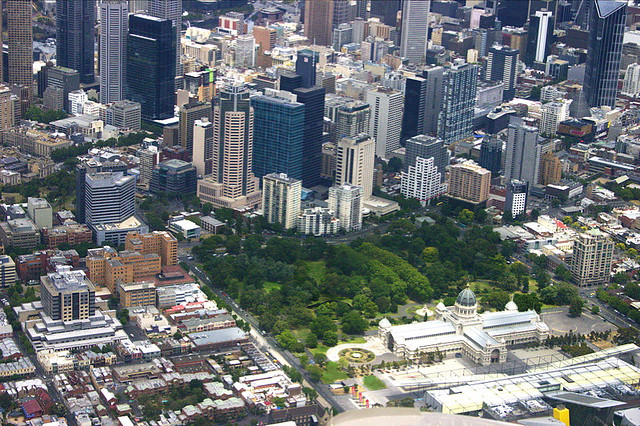
- 1901 – First Parliament of Australia opens in the Exhibition Building on May 9. The west annex of the Building becomes the site of the Victorian Parliament for the next 26 years.
- 1919 – buildings became an emergency hospital for influenza epidemic victims

- 1928 – Exhibition Speedway, a motorcycle speedway track is constructed and opened on 5 November 1928, it hosts the final of the Australian Solo Championship in 1930, 1932 and 1933. It was also considered the birthplace of sidecar speedway.
- 2001 – Taylor Cullity Lethlean with Mary Jeavons wins a landscape award for design and building a new playground of elegant yet robust resolution. The Jury described the design as a distinctive and unified design that respects its historic setting and addresses the demands of creative play for spatial and visual variety.
- July 2004 – After several years of lobbying by the Melbourne City Council, The Royal Exhibition Building and Carlton Gardens, Melbourne, were inscribed on the World Heritage List at the 28th session of the World Heritage Committee held in Suzhou, China.
Closest places in our Australia guide.
More places to explore in Australia.


.jpg?width=1200)


.jpg?width=1200)
.jpg?width=1200)
.jpg?width=1200)


