Greece
Lion Gate
City gate · Argos-Mykines Municipality
Funerary stele
grave stelai from Grave Circle A, Mycenae
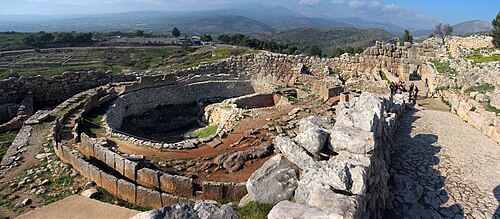
There were a number of grave stelai or stelae found among the six shaft graves at Grave Circle A in the site of Mycenae. These stelai mark the burial sites of the Mycenaean dead, much like modern headstones. At least 21 stelai have been discovered from Grave Circle A, with 12 having identifiable relief sculpture. Most were upright, rectangular slabs of oolithic limestone, ranging in date from 1600 to 1500 BCE. The iconography depicted on these stelai include chariot scenes, hunting scenes, and circular and spiral designs characteristic of the Greek Mycenaean Period. Scholars argue that these scenes demonstrate the prevalence of warfare in Mycenaean culture, in addition to signifying a socially stratified society.
All 21 stelai found at Grave Circle A were cut from oolithic limestone, a material used in many other Mycenaean constructions. Many of these stelai just survive in fragments, though most are rectangular in shape. To incise the stelai, Mycenaean artists carved out the background of a previously sketched image, creating a raised relief. Tools, such as the compass, and templates were likely used to carve the sculptures. Scholars also speculate that the stelai might have been painted. Most of the iconography consists of geometric motifs, including circles and spirals. Figural imagery, including chariot scenes with humans and large animals like horses and lions, also appear on the stelai. The stelai are stylistically similar to the grave stelai found at Grave Circle B, but neither groups of stelai resemble similar pieces created by Minoans.
- Stele I, or the "Simile" stele, consists of a central scene framed by two columns of spiral motifs. The center depicts a man in a chariot directing a horse running over a man, possibly armored, lying down. Below the chariot scene, a lion is depicted chasing a quadruped animal.
- Stele II, or the "Wellenband" stele, consists of three carved columns, the outside of which depict a curving, meander motif, potentially resembling a snake.
- Stele III, or the "Spirals" stele, consists of four vertical columns containing spiral motifs, with circles carved in between spirals.
- Stele IV, or the "Cartoon" stele, consists of three horizontal panels of sculpture, with the top and bottom panels containing spiral motifs. The middle panel depicts a chariot scene, with a man driving the chariot and another man before the chariot with a possible weapon.
- Stele V, or the "Over the Sea" stele, consists of two horizontal panels of sculpture, with the top panel containing a spiral motif. The bottom panel depicts a man in a chariot, directing a horse with reins, with a secondary male figure on the right of the scene, carrying a possible weapon.
- Stele VI, or the "Horsey" stele, consists of a frame of spiral motifs, with a central panel containing four rearing horses, stacked on top of one another.
- Stele VII is mostly fragmentary, but contains spiral motifs and the head of a horse.
- Stele VIII is also mostly fragmentary, but contains spiral motifs, a wheel, the head of a possible charioteer, and the hoof of a possible horse.
- Stelai X, XI, and XII exist in fragments, and could theoretically belong to the same stele. Heads of horses and humans, as well as potential feet can be seen on these stele fragments.
- Stele I, or the "Simile" stele, consists of a central scene framed by two columns of spiral motifs. The center depicts a man in a chariot directing a horse running over a man, possibly armored, lying down. Below the chariot scene, a lion is depicted chasing a quadruped animal.
- Stele II, or the "Wellenband" stele, consists of three carved columns, the outside of which depict a curving, meander motif, potentially resembling a snake.
- Stele III, or the "Spirals" stele, consists of four vertical columns containing spiral motifs, with circles carved in between spirals.
- Stele IV, or the "Cartoon" stele, consists of three horizontal panels of sculpture, with the top and bottom panels containing spiral motifs. The middle panel depicts a chariot scene, with a man driving the chariot and another man before the chariot with a possible weapon.
- Stele V, or the "Over the Sea" stele, consists of two horizontal panels of sculpture, with the top panel containing a spiral motif. The bottom panel depicts a man in a chariot, directing a horse with reins, with a secondary male figure on the right of the scene, carrying a possible weapon.
- Stele VI, or the "Horsey" stele, consists of a frame of spiral motifs, with a central panel containing four rearing horses, stacked on top of one another.
- Stele VII is mostly fragmentary, but contains spiral motifs and the head of a horse.
- Stele VIII is also mostly fragmentary, but contains spiral motifs, a wheel, the head of a possible charioteer, and the hoof of a possible horse.
- Stelai X, XI, and XII exist in fragments, and could theoretically belong to the same stele. Heads of horses and humans, as well as potential feet can be seen on these stele fragments.
Closest places in our Greece guide.
More places to explore in Greece.