Italy
Villa of the Mysteries
Roman villa · Pompei
Archaeological site

Villa Boscoreale is a name given to any of several Roman villas discovered in the district of Boscoreale, Italy. They were all buried and preserved by the eruption of Mount Vesuvius in 79 AD, along with Pompeii and Herculaneum. The only one visible in situ today is the Villa Regina, the others being reburied soon after their discovery. Although these villas can be classified as "rustic" (villae rusticae) rather than of otium due to their agricultural sections and sometimes lack of the most luxurious amenities, they were often embellished with extremely luxurious decorations such as frescoes, testifying to the wealth of the owners. Among the most important finds are the exquisite frescoes from the Villa of Publius Fannius Synistor and the sumptuous Boscoreale Treasure of the Villa della Pisanella, which is now displayed in several major museums. In Roman times this area, like the whole of Campania, was agricultural despite its proximity to cities including Pompeii, and specialised in wine and olive oil. Information on, and objects from, the villas can also be seen in the nearby Antiquarium di Boscoreale.
Many other Roman villas were discovered in the vicinity, often by "treasure" hunters towards the end of the 19th century after which they were reburied, including notably the villas:
- of N. Popidius Florus, from which frescoes were taken
- in contrada Centopiedi-al Tirone, Proprietà Vitiello
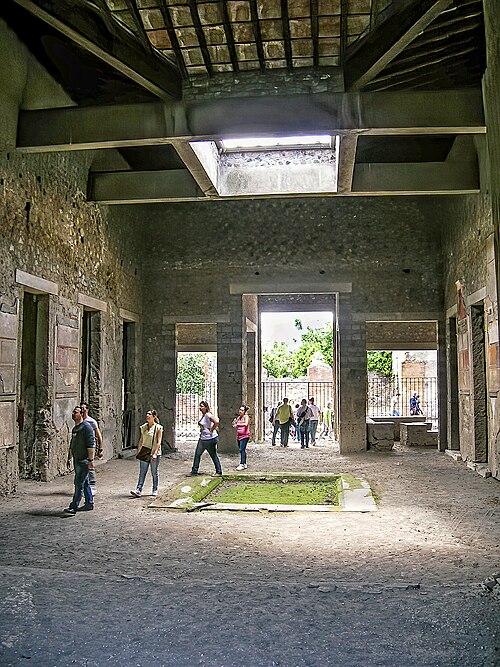
This rustic villa was discovered more recently, in 1977, buried under approximately 26 feet (about 8 meters) of compressed volcanic ash and material from pyroclastic flow, later topped by material from daily activity through the centuries. Unlike the villas plundered and reburied by treasure hunters, Villa Regina was treated as an archaeological discovery and therefore has been preserved in its complete state. The villa is a comfortable working farm rather than a luxurious estate that others nearby were. Nonetheless, an elegant central courtyard is colonnaded on three sides with columns of red and white stucco.
Large quantities of pottery and farm implements were found. Plaster casts of the original entrance doors were made from the hollow spaces left. A plaster cast of a pig found here and killed in the catastrophe was also made.
It also includes preserved parts of a wine press. Near the center of the villa is the wine cellar in which 18 dolia, of total capacity 10,000 liters, were buried for storing the must from the adjoining press.
An unusual find was an oil lamp dating from the 3-5th c. AD showing that the place was tunnelled into in the later Roman era.
Pollen analysis conducted at Villa Regina identified various species of cultivated plant life. Tree varieties included Birch, Hazelnut, Cypress, Ash, Walnut, Pine and Olive. Flowers at the Villa included Anemone, Borage, Dianthus, Amaranth, Aster, Sedge, Geranium, Buttercup, Mallow. Pollen samples additionally confirmed the cultivation of grapes at Villa Regina, likely pressed into wine on site. The holes in the ground left by the roots of the Roman vines were found and vines have again been planted in them. [ citation needed ]
Pollen analysis conducted at Villa Regina identified various species of cultivated plant life. Tree varieties included Birch, Hazelnut, Cypress, Ash, Walnut, Pine and Olive. Flowers at the Villa included Anemone, Borage, Dianthus, Amaranth, Aster, Sedge, Geranium, Buttercup, Mallow. Pollen samples additionally confirmed the cultivation of grapes at Villa Regina, likely pressed into wine on site. The holes in the ground left by the roots of the Roman vines were found and vines have again been planted in them. [ citation needed ]
Although the villa was of relatively modest size compared to others in the area and had no atrium, pool or sculpture collection, its frescoes were exceptional in their beauty and quality.
Evidence in tablets and graffiti shows that the house was probably built around 40-30 BC. The villa was privately discovered, excavated, partially dismantled and reburied in 1900.
The villa had three stories, complete with a bath suite and an underground passage to a stable and agricultural buildings, the latter not excavated. The central ground floor of the living quarters consisted of over thirty rooms or enclosures surrounding a peristyle. The building featured an impressive main entrance approached by five broad steps leading to a colonnaded forecourt rather than the typical atrium.
Ownership of the villa has been contested. While there is no doubt P. Fannius Synistor did reside there, excavated bronze tablets show another name, that of Lucius Herennius Florus. Many things were marked with seals in ancient Rome to indicate possession. It is believed that since the tablet with the letters "L. HER. FLO" on it was found inside the villa, it must serve as a mark of villa ownership. These two are the only confirmed owners in the early 1st century BC and 1st century AD, though there may have been earlier owners.
The Villa is most notable for its works of art, especially its highly skilled buon fresco paintings, said to be the highest quality Roman frescoes ever found and which are now scattered around the world after being auctioned following removal.
Most of the figures in the frescoes have characteristics of Greek Hellenism or Classicism. For instance, those found in the living room appear to be depictions of either philosophers, such as Epicurus, Zeno or Menedemus, or possibly old kings, like King Kinyras of Cyprus. Similarly, the bedrooms of the Second Style also evoke Hellenistic qualities, such as are seen at the Tomb of Lyson or at Kallikles. At a time when the Roman Republic was ending and classicism somewhat fading, this is considered as an interesting comment on style and taste. Seemingly, Greek representations in the home were considered acceptable, even admired and sophisticated. The images survived the quick succession of Vesuvian cataclysms because of the skill of the fresco work and the absence of organic materials such as indigo, murex purple, red madder among its pigments. The reddening of some of its yellow ochre shows temperatures to have exceeded 300 °C.
The Metropolitan Museum of Art, together with King's College, London, is building a virtual model of the Villa, linking the scattered frescoes, based on the notes and plan drawn at the time of excavation by archaeologist Felice Barnabei (1902), photographs taken of the excavation, the research of Phyllis W. Lehmann (1953) and axonometric drawings of the plan, locating the images on the walls, by Maxwell Anderson (1987).
Metropolitan Museum cubiculum reconstruction
The fullest reconstruction from original frescoes at present is of a bedroom ( cubiculum diurnum ), one of the holdings of the Metropolitan Museum since 1903, and since 2007 a feature of the new Roman Gallery. It consists of most of a newly cleaned and reconstructed set of walls entirely painted in highly accomplished fresco. These spacious Roman II Style murals represent their walls as open above socle or dado height, except for the architraves above and a few columns that, together with those other features, frame vividly coloured architectural views of buildings, columns, landscape, garden scenes, religious statues, beyond, emphasizing expansion and grandeur, but including no humans and only a few birds on the short, window wall. This is also the technique in other unreconstructed rooms. For example, In another bedroom, known as Room M, the frescoes depict columns that appear to expand into another room, giving the sense of a much larger, almost unending, space. The facing long walls (19 ft or 5.8 m) of the Metropolitan cubiculum are mirror images of each other, possibly by transfer, with variations. In addition, each is divided into four panels by painted columns.
Distance in these paintings is built up through a series of orthogonal architectural surfaces, and indicated by overlap occlusion, foreshortening, diminution, pronounced aerial perspective, but without consistent vanishing points. Modelling is indicated by side- shading with slight, selective cast shadow. Pompeian red in front planes, contrasting with the blue tone of the fainter, further planes, provides an additional effective cue for depth. The room had one, north-facing, outside window, through which pyroclastic flows from Vesuvius appear to have entered. As part of the sophisticated depictive scheme, the dado or lower parts of the walls are depicted as themselves, but in First Style. Ledges and niches there show near objects: "metal and glass vases on shelves and tables appearing to project out from the wall", playfully belying the common impression that perspective is always for depicting recession from the picture plane. In other parts of the Villa there are brightly coloured non-figurative walls, in First Style, some of which are on display at the Metropolitan Museum of Art and the Louvre Museum.
Closest places in our Italy guide.
More places to explore in Italy.